About Plantago brownii F.Dietr.
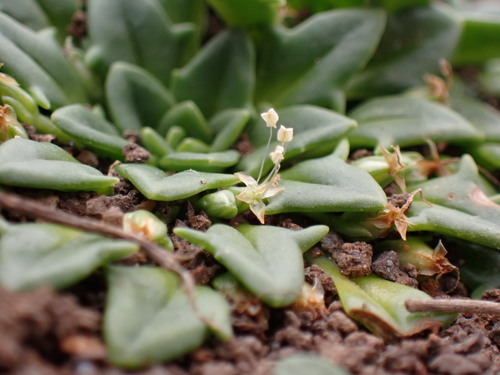
Plantago brownii F.Dietr. grows as a rosette, with a primary root up to 1 cm thick, up to 65 angular-obovate leaves, and short (less than 3 mm long) concealed axillary hairs in the basal rosette. Its leaves have 1–3 veins, measure 0.5–9 cm long including the petiole, and grow up to 1.7 cm wide. The leaves are not punctate; they are usually glabrous on both surfaces, and sometimes bear isolated hairs. Each leaf has an acute apex, and its edges are either smooth or have 2–6 small teeth. The petiole is usually distinguishable from the leaf blade, and grows up to 7 cm long. Each rosette produces 4–42 erect inflorescences that can reach up to 12 cm in length. The inflorescence scapes are ribbed and covered with spreading patent hairs. The inflorescence spikes are globose, holding 1–8 densely crowded flowers. Each flower has an ovate to very broadly ovate bract that is glabrous, or sometimes has a few hairs at the apex. The flower calyx measures 2.6–3.9 mm long and 1.4–3.5 mm wide; it is mostly glabrous, but sometimes has a few hairs on its margins or midrib. The corolla tube is 1.9–3.3 mm long, corolla lobes are 1.0–1.8 mm long, stamen filaments are 2.1–4.7 mm long, anthers are 1.0–1.7 mm long, and the style is 2.3–5.4 mm long and densely hairy. The ovary is 0.9–1.8 mm long, and contains 7–10 ovules. The fruit is a dry dehiscent capsule that opens through circumsessile dehiscence; it is usually ellipsoid to globose, widest at or above its middle, and measures 2.1–4.0 mm long by 0.9–3.2 mm wide. Each capsule holds 3–10 uniform brown seeds 0.9–1.8 mm long, which vary in shape. Plantago brownii flowers and fruits from November to February. Its haploid chromosome number is n=12. This species of plantain is native to Tasmania, Australia, and the subantarctic Auckland Islands of New Zealand. In the Auckland Islands, it occurs on main Auckland Island, Enderby Island, and Ocean Island, and has also been recorded on Rose Island. On Enderby Island, P. brownii can form large, dense "lawns" near the coast. In Tasmania, it is found across the main island, particularly along the northwest, west, and southeast coasts, and also occurs on Flinders Island, Cape Barren Island, Flat Witch Island, Sarah Island, and Tasman Island. Plantago brownii is a halophyte that forms patches or dense turf on coastal rocks and soil in the salt spray zone near the high tide mark, at elevations from 0 to 20 m above sea level, and rarely up to 200 m. In these Tasmanian habitats, it can be a dominant species in local herbfields.