About Plantago arenaria Waldst. & Kit.
Scientific Name and Basic Growth Form
Plantago arenaria Waldst. & Kit. (also referred to as Plantago indica) is an annual herb with a taproot and an erect, hairy stem. Its leaves are arranged oppositely or in whorls of three to five, with elongated internodes between leaf clusters.
Glandular Pubescence
Glandular hairs (glandular pubescence) cover the stems, leaves, sepals, and inflorescences.
Leaf Shape and Base
The leaves are simple, linear or lanceolate in shape, with a base that runs down along the petiole.
Leaf Size and Margins
Leaf margins are entire or slightly toothed; mature leaves measure 2.5–5 cm (1.0–2.0 in) long and 1–3 mm wide.
Modified Leaf Bracts
Some leaves are modified into bracts 0.5 to 2 cm (0.2 to 0.8 in) long, with a pointed cuspidate apex and a round-ovate base.
Inflorescence Structure
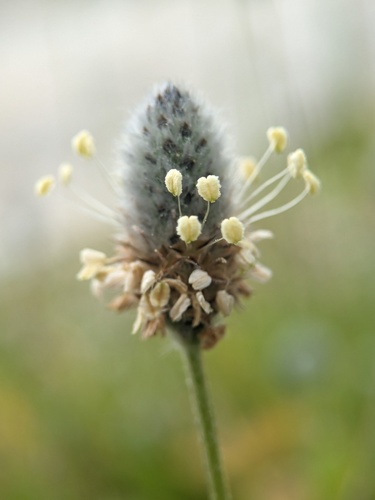
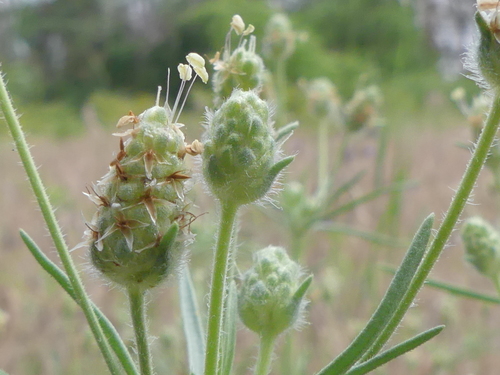
This plant produces a densely flowered inflorescence.
Corolla and Calyx
Individual flowers have a hairless, brownish corolla, and a calyx made of elliptic to obovate sepals with prominent broad veins.
Stamen Characteristics
Stamens extend outward beyond the corolla; their anthers are yellow, ellipsoid, and 1.8–2.2 mm long.
Style and Floral Position
The stigma's style also extends well beyond the corolla. All floral parts are hypogynous, positioned above the ovary.
Fruit Contents
Fruits are capsules that each contain 2 seeds.
Seed Morphology
The seeds measure 2.5–2.8 mm, are black or blackish-brown, shiny, ellipsoid, and have a clear central groove on their inner face.
Native Range
This species is native to North Africa, most of Europe excluding the far north, and southwest Asia ranging from Jordan to Turkey and Iran, as well as western and central Russia, Kazakhstan, Kyrgyzstan, and Tajikistan.
Naturalized Range
It has become widely naturalized in parts of Australia, China, India, Japan, Pakistan, and North America, and occurs more locally in South America.
Habitat Preferences
It grows most commonly in sandy habitats such as arid deserts and sandy beaches, and can also be found on roadsides and alongside railroad tracks.
Common Names and Cultivation
Its seeds, sold under the common names French psyllium or black psyllium, are cultivated for medicinal use alongside other psyllium species such as P. ovata.
Medicinal Uses of Mucilage
Mucilage extracted from the seed coat is used as a laxative for constipation, and to treat irritable bowel syndrome (IBS) and diarrhea. Seed mucilage has also been reported to lower the risk of coronary heart disease.