About Pityopsis falcata (Pursh) Nutt.
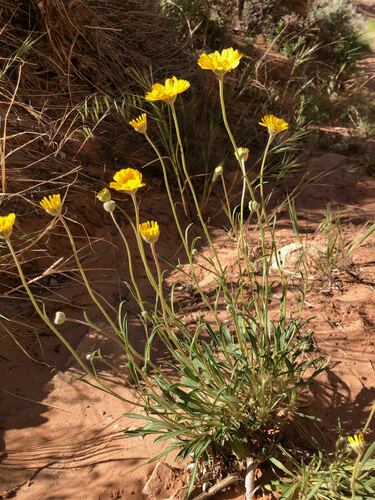
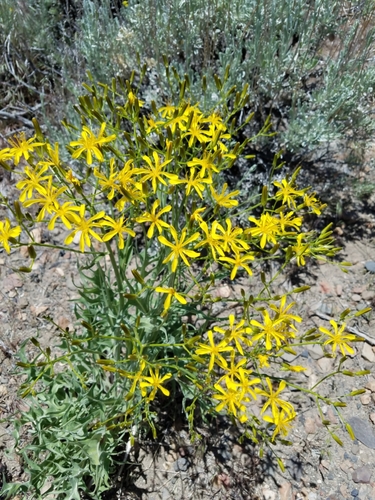
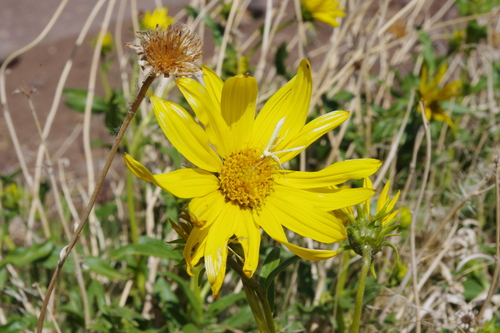
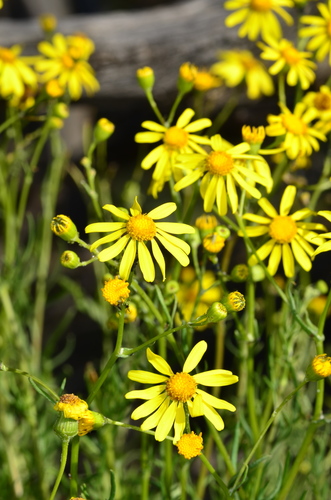
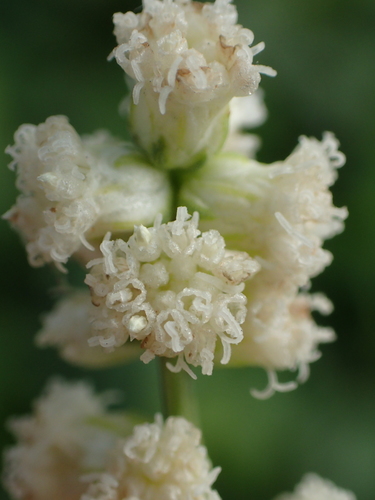
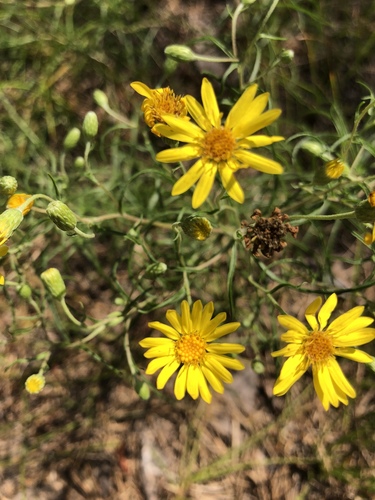
Pityopsis falcata (Pursh) Nutt. is an herbaceous perennial plant that grows to a height of 10 to 40 cm. It is characteristically caespitose, growing from a dense mass of fibrous roots and rhizomes. Its erect stems are sometimes branched, occasionally reddish-brown, striated, and covered in long silky hairs. Basal leaves typically wither by the time the plant flowers, and they are shorter than the cauline (stem) leaves. The sessile cauline leaves are covered in trichomes, falcate in shape (a feature that gives the species its epithet falcata), and often folded along the midvein. Each plant usually produces 4 to 10 flowerheads, and can grow up to 25 flowerheads, arranged in corymbiform arrays. The peduncles are 1 to 4 cm long, bear sparse bracts, and are covered in fine white woolly hair. The involucres are bell-shaped and measure 5 to 8 mm. The phyllaries are arranged in 5 to 6 series, with tufts of hairs at their tips. Each flowerhead holds 9 to 15 yellow ray florets and 30 to 60 disc florets. Pityopsis falcata blooms throughout summer and fall. Its fruits are fusiform cypselae 3 to 4 mm in length. They are wind-dispersed, and have pappi 4 to 6 mm long. The chromosome count for this species is 2n = 18 (or 2n = 9II). The most recent phylogenetic analyses show it is most closely related to P. ruthii, and the two are considered sister species. Pityopsis falcata has a very limited range, restricted to coastal areas between Cape Cod and the New Jersey Pine Barrens. It is often locally abundant, growing in open areas on sandy glacial till deposited along the front of the Wisconsin Glaciation. It is the northernmost species of the genus Pityopsis, and is native to Connecticut, Massachusetts, New Jersey, New York, and Rhode Island. In 1949, a specimen of Pityopsis falcata was collected along Canadian National Railway tracks west of Toronto. This is the only reported occurrence of the species in Canada, and it was apparently a vagrant individual. In 1955, a specimen reported as Pityopsis falcata was collected along a beach in St. Petersburg, Florida. This individual is likely a misidentified specimen of P. tracyi, a species common in Florida. Where Pityopsis falcata and Schinia tuberculum (the golden aster flower moth) co-occur, this moth is a major pollinator of Pityopsis falcata. In other parts of Pityopsis falcata's range, this moth relies on other Pityopsis species such as P. graminifolia as a food source.