About Pituophis melanoleucus (Daudin, 1803)
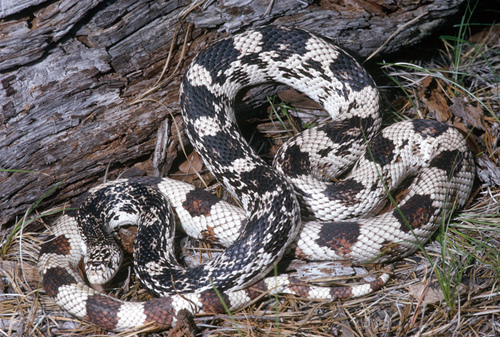
Description: Adult Pituophis melanoleucus are large, powerfully built snakes that reach a total length of 48 to 90 inches (120 to 230 cm), including the tail. Their heads are small and somewhat pointed, with an enlarged rostral scale that extends upward between the internasal scales. Most individuals have four prefrontal scales. At midbody, there are 27 to 37 rows of keeled dorsal scales, and the anal plate is single. The species' color pattern consists of a light base color covered with black, brown, or reddish-brown blotches. Geographic range and habitat: Pituophis melanoleucus is found in the United States, specifically in Alabama, Florida, Georgia, Kentucky, Louisiana, Mississippi, New Jersey, North Carolina, South Carolina, Tennessee, Delaware, and Virginia. The nominate subspecies occurs from southern New Jersey and southern North Carolina west through South Carolina to northern Georgia, eastern Tennessee, southeastern Kentucky, and south into Alabama. The subspecies P. m. lodingi occurs from southwestern Alabama to eastern Louisiana, and its range overlaps with that of P. m. mugitus, which is found from southern South Carolina to Georgia and southern Florida. Pituophis melanoleucus, commonly called the pine snake, inhabits pine flatwoods, sandy pine-oak woodlands, prairies, cultivated fields, open brushland, rocky desert, and chaparral. It occurs from sea level up to an elevation of 9,000 ft (2,700 m). This species requires well-drained, sandy soils with little vegetation for nesting and hibernation sites, and often occupies habitats that experience frequent wildfires. Pine snake populations in New Jersey hibernate communally, while populations in other regions such as Tennessee hibernate alone. Ecology: Pine snakes prey on rats, mice, moles, other small mammals, and eggs. They often enter rodent burrows to search for food, and multiple kills are common in these cases: the snake presses captured mice against the walls of the burrow. Pine snakes stay underground during cold weather and during the hottest part of summer days. When disturbed, they frequently hiss loudly, sometimes flatten their head, vibrate their tail, and eventually strike at an intruder. To produce the hissing sound, the snake forces air out of its lungs, which vibrates the epiglottis. Several mammal species are known to prey on pine snakes in their hibernacula and nesting burrows, including the American red fox (Vulpes fulva), striped skunk (Mephitis mephitis), and Northern short-tailed shrew (Blarina brevicauda). Reproduction: Mating takes place in spring, and clutches of three to 24 eggs are laid between June and August. Eggs are deposited in sandy burrows or under large rocks or logs, and hatch after 64 to 79 days of incubation. Pine snakes are known to build communal nests, with several females laying eggs in the same spot. They tend to build nests in clearings with minimal tree cover. The eggs are adherent and quite large, growing up to 66 mm (2.6 in) long by 45 mm (1.8 in) wide. Newly hatched pine snakes measure 33 to 45 cm (13 to 18 in) long. Eggs laid on wetter substrate tend to produce larger hatchlings than eggs laid on drier substrate.