About Pittosporum ralphii Kirk
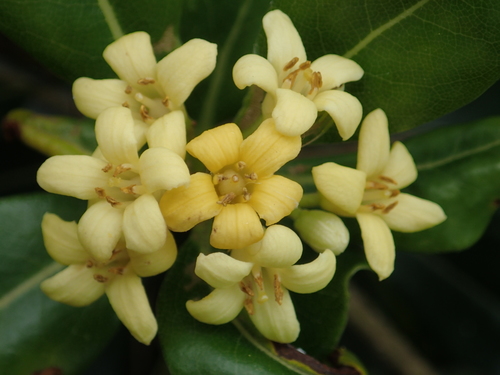
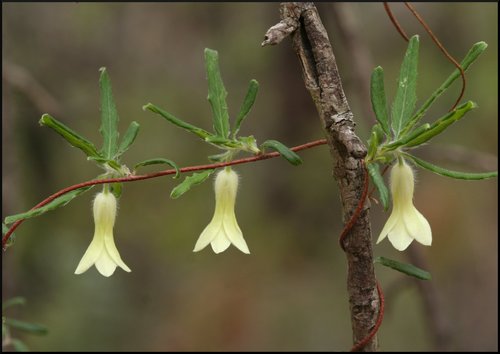
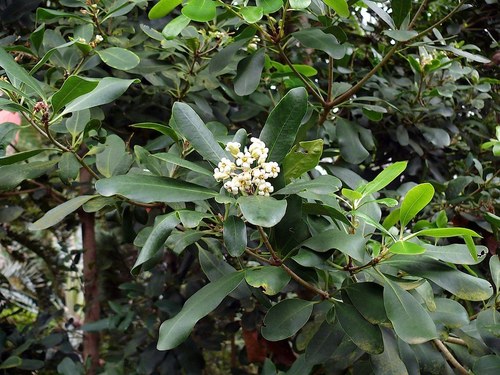
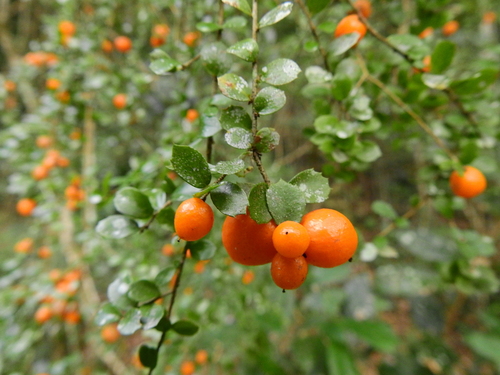
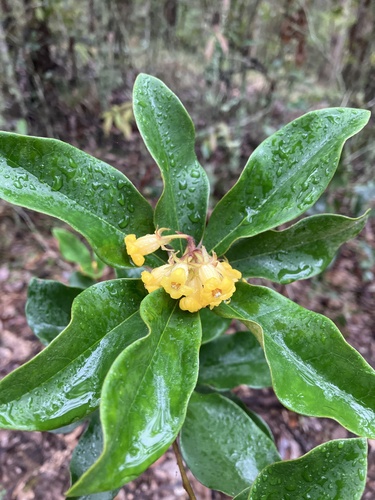
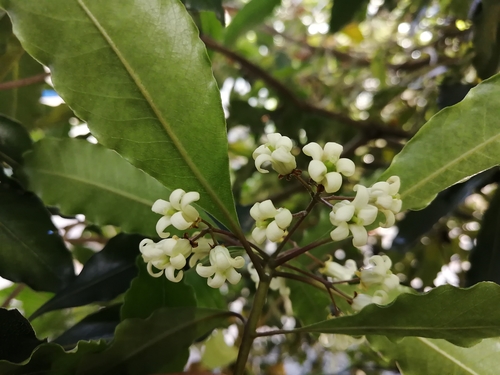
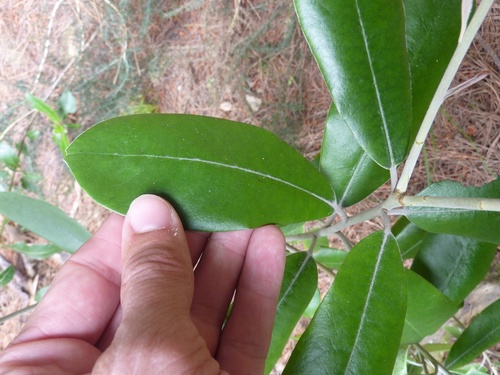
Pittosporum ralphii Kirk has spreading branches and a trunk that can reach up to 15 cm (5.9 in) in diameter, with dark brown bark. Its twigs, flowers, fruit capsules, and the undersides of its leaves are covered in hairs, a trait that leads many to consider it closely related to P. crassifolium. Leaves grow alternately on branchlets, measuring 5–12 cm (2.0–4.7 in) long and 2.5–5.5 cm (0.98–2.17 in) wide. The upper leaf surface is dark green and dull glossy, while the underside is covered in a white to greyish-white mat of fine hairs. Leaf blades have smooth, slightly wavy margins that are typically recurved, and are stiff and leathery with visible main veins. Leaves narrow to a stout leaf stalk that can be up to 2.5 cm (0.98 in) long. This species produces inflorescences called umbels, which are clusters of flowers arranged on a common stem. These umbels hold 3 to 10 flowers, and grow at the tips of branchlets. Each flower is 1 cm wide, with dark red to almost black petals, and gives off a delicate scent, particularly in the evening, presumably to attract night-flying insect pollinators. Flower stalks and their supporting branchlets are covered in a mat of fine hairs. Flowering occurs from November to December (spring in New Zealand). The lower half of each petal forms a bell-like shape enclosed by sepals covered in a fine mat of grey hairs, while the upper half of each petal curves backward to reveal yellow anther tips. The fruit capsules of P. ralphii are 1.5 cm (0.59 in) long, with pale yellow to orange inner surfaces on each capsule valve. The fruit takes around a year to ripen, and is split into three compartments that open to expose the seeds. The wood of this species is very pale brownish to nearly white throughout, with medium luster, fine texture, straight grain, and moderate hardness and weight. Its small pores are visible with a hand lens. P. ralphii is endemic to New Zealand, where it occurs naturally from East Cape to Northern Wairarapa, along the Wairarapa and Patea rivers. It has also become naturalised further south in both the North and South Islands. This species grows between sea level and 900 metres (3,000 ft) in lowland and hill country forest. It most often grows along forest margins and stream sides, or as a component of low forest or shrubland. It is an adaptable species that can be grown successfully in open, full sun locations or in shaded areas. It provides excellent shelter, and is often planted on dry or windy hillsides. It is also fairly tolerant of coastal conditions, prefers well-drained soil, and tolerates most conditions except extreme wetness, though it prefers locations sheltered from extreme wind. As seedlings, P. ralphii prefer moisture, but established plants are much more drought-tolerant. Life cycle and phenology observations note that P. ralphii can flower between September and December, and fruits between November and January. Seeds readily appear spontaneously in gardens, as seeds are dispersed by both exotic and indigenous birds.