About Pittosporum obcordatum Raoul
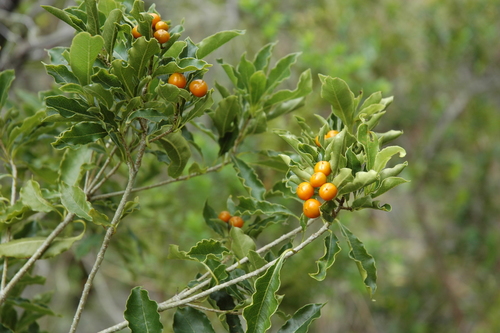
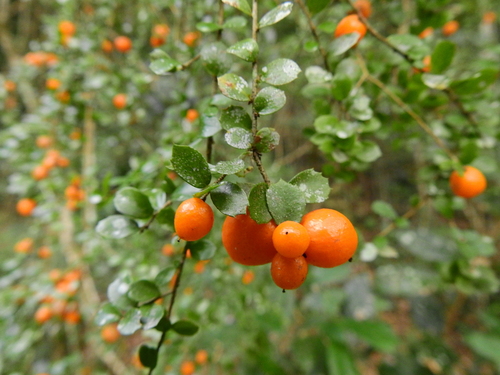
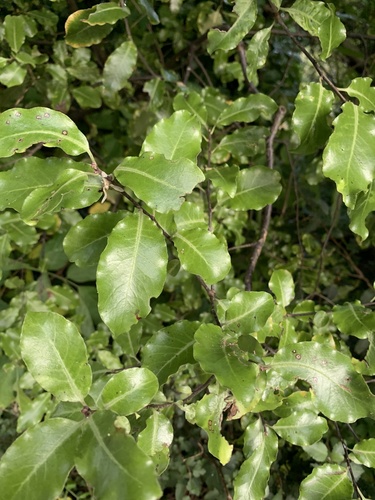
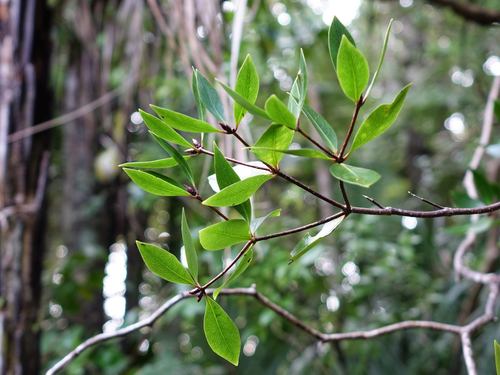
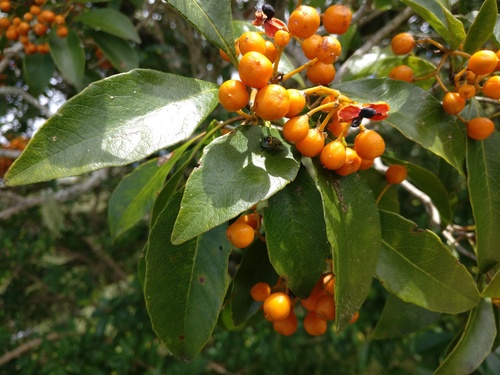
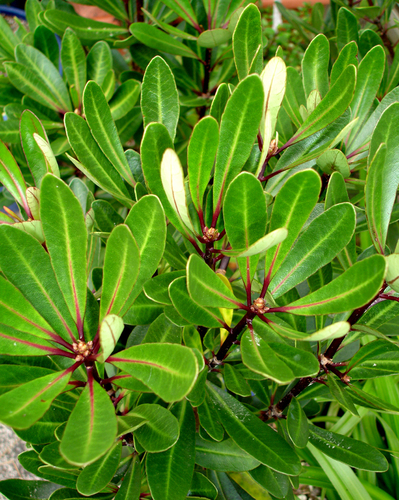
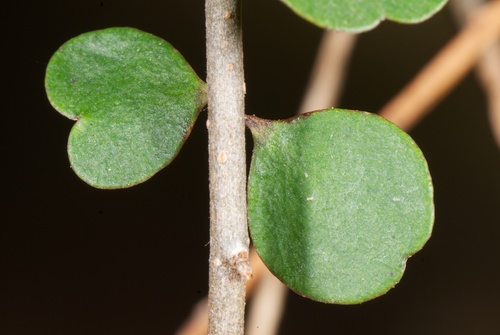
Pittosporum obcordatum Raoul is a dicotyledonous columnar single-trunked shrub or small tree, usually growing less than 10 meters tall. It has slender interlacing divaricating branches, and many grey or reddish-brown branchlets that may be hairy or glabrous. These branchlets bear small woody capsules and scattered leaves. This species is endemic and indigenous to New Zealand. It was first discovered by E. Raoul near Akaroa around 1841. After its discovery, the population of Pittosporum obcordatum declined rapidly. By 1980, only three very small colonies were known in the eastern North Island, located at Wairoa, the Tukituki River near Hastings, and the Tauwhero River near Masterton. The 1981 New Zealand Red Data Book estimated that fewer than 50 total individuals existed. By 1994, the species was scattered across 12 locations in four regions throughout New Zealand, with a total wild population of around 2500 individuals. Approximately 60% of these individuals grow in the South Island, and two North Island localities – Mangarouhi/Waipukurau and Wairua/Whangarei – hold more than 300 individuals total. The species has also been found on Paengaroa Mainland Island. Pittosporum obcordatum prefers habitats in lowland kahikatea/matai forest, eastern lowland alluvial forest, or terrestrial lowland environments. A 1994 ecological study by Clarkson & Clarkson at six North Island locations found the species favors river flats, typically near backswamps, oxbow lake margins, and cut-off meanders. These habitats are below 200 meters in altitude, have mean annual temperatures between 9 and 15 degrees Celsius, mean annual rainfall between 1000 mm and 1500 mm, frequent winter rain, and summer drought. The species can also be found in primary forest, secondary forest, treeland, and scrub, most often stands dominated by Dacrycarpus dacrydioides, Prumnopitys taxifolia, or both, that host abundant, diverse divaricating shrubs and trees. For this reason, it can be considered an indicator species for healthy divaricate-rich vegetation. Pittosporum obcordatum is a slow-growing lowland shrub or small tree, with an estimated maximum lifespan of 120 years per Clarkson & Clarkson 1994. From their 1994 study of six North Island locations, epigeal germination of new season growth occurs from the last week of August through October. After germination, new plants produce 3 to 4 cotyledonary leaves, which are followed by juvenile leaves. The timing of first juvenile leaf appearance depends on when seedlings emerge: seedlings that emerge in mid summer produce their first juvenile leaves 5 to 7 days after emergence, while seedlings that emerge in late autumn may remain without juvenile leaves or have an arrested juvenile leaf until the following spring. Pittosporum obcordatum (chromosome number 2n=24) is dioecious: male plants only contribute genes to the next generation via pollen, and female plants only pass genes via ovules. Around 6.6% of male or female plants occasionally produce a small number of seed capsules, making them inconstant males or inconstant females. Flowering occurs from late September to early December, and lasts approximately three weeks. Populations at different altitudes and latitudes have slightly different flowering times, with plants at higher altitudes and further inland flowering slightly later. Fruiting takes place from December to May, and fruits persist on the plant for a long time. Documented medicinal uses exist for Pittosporum obcordatum. It has been used to make a salve to soothe scalp eczema, and has also been recorded as a treatment for scabies. To prepare the remedy, certain parts of the plant are sun-dried then pounded into a powder, which is mixed with hinu-kōhia oil to form the salve.