About Pittosporum eugenioides A.Cunn.
Pittosporum eugenioides A.Cunn., commonly known as tarata or lemonwood, is an evergreen tree species endemic to New Zealand. It is the largest Pittosporum species found in New Zealand. The specific epithet eugenioides means "resembling Eugenia", a different genus of plants.
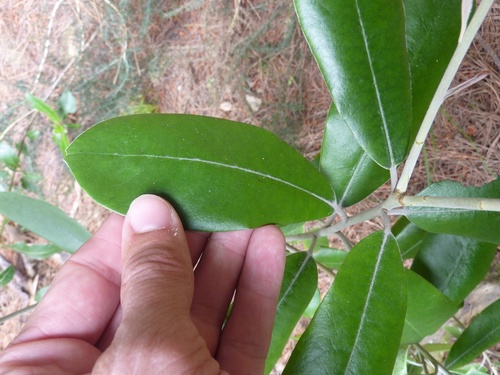
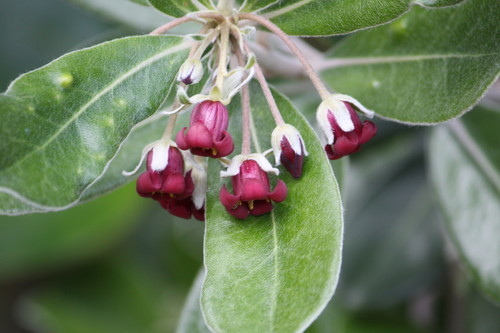
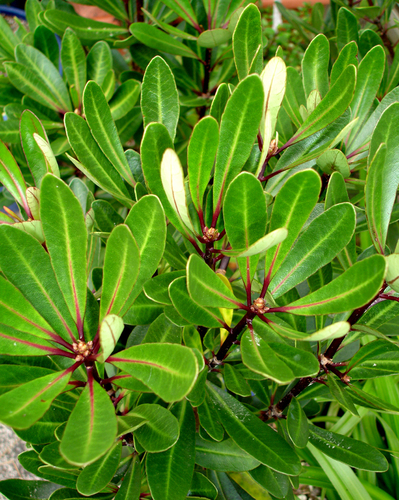
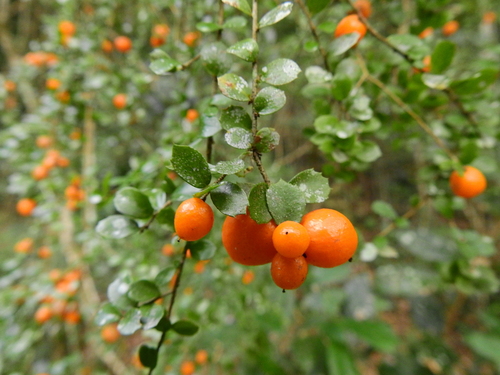
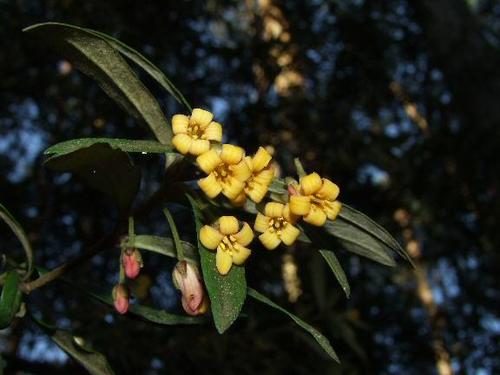
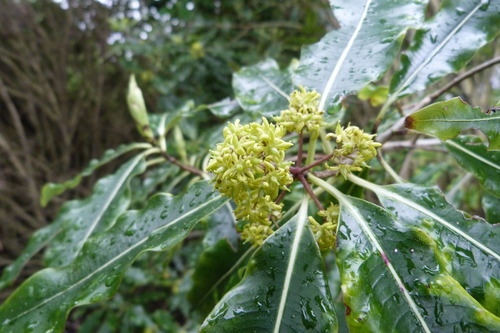
This species grows to 12 m (39 ft) tall by 5 m (16 ft) broad, with a conical shape when young that becomes more rounded as it matures. Its leaves are mottled yellow-green with curly edges and a prominent bright midrib, and give off a strong lemony scent when crushed. It produces highly fragrant clusters of attractive yellow-cream flowers in spring, which are followed by distinctive black seed capsules. The fruit takes 12 to 14 months to ripen, so unripe fruit from the current season and ripe fruit from the previous season can be present on the tree at the same time.
Pittosporum eugenioides is found throughout New Zealand's North and South Islands. It grows along forest margins, stream banks, forest clearings, and in low-lying forests from sea level up to 600 m (1,969 ft) above sea level. It occupies cooler mature lowland and subalpine forest climate zones across New Zealand, and can also grow in both young and old regenerating forest areas. It is effective for quickly establishing a canopy in regenerating sites. The genus Pittosporum contains about 200 species of trees and shrubs distributed across Africa, Australia, parts of southern and eastern Asia, some Pacific islands, and New Zealand; P. eugenioides' endemism to New Zealand is linked to the country's long-term geographic isolation.
In cultivation, this species is now commonly planted in average household gardens across New Zealand, and is stocked by nurseries and garden centres because it is well adapted to local New Zealand conditions. In garden settings, it prefers a sunny to part shade position, tolerates wind, and thrives in well-drained soil. Soil moisture levels affect the viability of tarata seeds: seeds are likely to become unviable if soil moisture is too high. Like other pittosporums, tarata is somewhat drought resistant, and is relatively easy to care for in domestic gardens. It grows well with regular watering during summer, benefits from application of general tree and shrub fertiliser twice a year, in spring and summer during its growing season, and responds well to pruning. The variegated cultivar 'Variegatum' has earned the Royal Horticultural Society's Award of Garden Merit.
Pittosporum eugenioides starts growth as a small compact tree, maturing into a tall branched tree. It flowers between October and December, and its seed capsules open the following year after flowering. Pollination is carried out by both insects and birds, and seeds are dispersed by birds. Seeds germinate quickly, producing seedlings within a month.
Ecology: The pittosporum flower weevil (Aneuma rubricale) is a parasite that feeds on the undersides of lemonwood leaves. Feeding by this parasite only damages leaves and does not kill the tree; the holes the weevils create in leaves are marked by visible dark brownish-purple rings that form around the damage as the leaf reacts. P. eugenioides only hosts adult weevils, as weevil larvae are only known to develop on Pittosporum tenuifolium. Common garden pests that can affect this plant include aphids and blister scale (psyilids); both can be easily controlled and treated with insecticide, with preventative spraying best done in February and again in October.
Traditional Māori cultural uses: Māori traditionally used the gum, crushed leaves, and crushed flowers of tarata for scent, usually mixed with plant oils from species like tītoki and kōhia. Māori also used lemonwood to make hair oils and perfume; for perfume, the oil was mixed with bird fat. Tree gum was used to treat bad breath, when rolled into a ball it was thought to last for a whole generation. When chewed, the gum was also used as a glue.