About Pittosporum crassifolium Banks & Sol. ex A.Cunn.
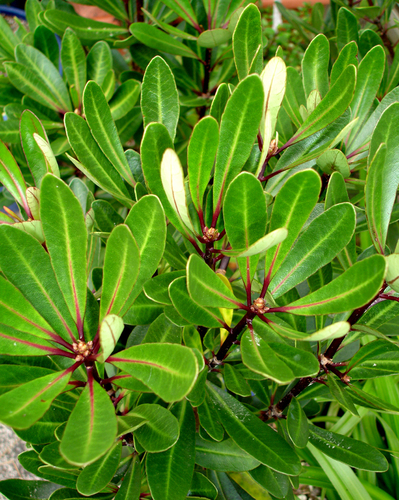
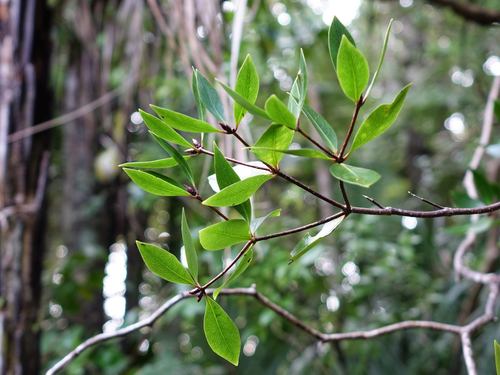
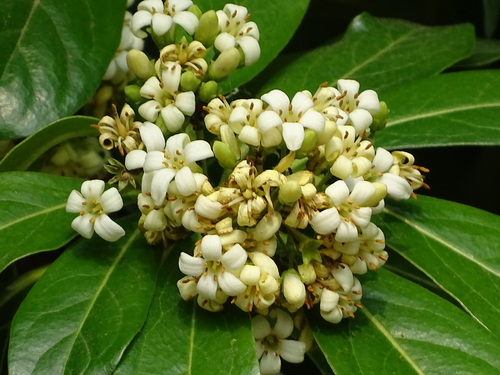
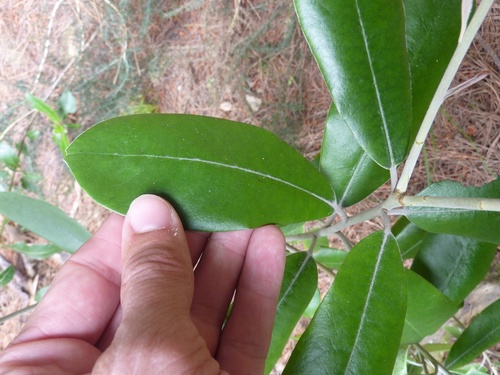
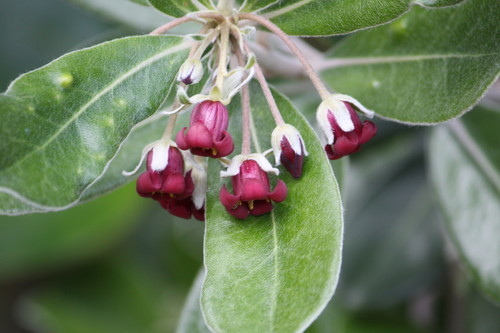
Pittosporum crassifolium Banks & Sol. ex A.Cunn., commonly called karo, has leaves measuring approximately 5–10 cm long by 2–3 cm wide. These leaves are oval, dark green, and leathery, with grey tomentum (fine hairs) covering their undersides, as well as the petioles and inflorescences. This tomentum protects the plant against coastal winds by preventing salt damage and moisture loss. The leaves are simple, alternately arranged, and grow very densely at the outermost tips of stems. Leaf margins are recurved, thick, and leathery; the specific epithet crassifolium translates from Latin to "thick leaf". Leaves often show signs of insect damage, and their apex can vary from obtuse (blunt and rounded) to acute (sharp and tapered). Petioles, the stalk connecting the leaf to the stem, measure approximately 4–14 mm long by 1–3 mm wide. When grown in ideal conditions, karo develops into a small tree up to 5 metres (16 ft) tall, with multiple trunks. Its bark is dark brown to black, with distinct lenticels that enable gas exchange. Juvenile plants differ in appearance from mature adults: their branchlets are covered in tomentum until they mature and darken. From spring to early summer, karo produces fragrant burgundy red flowers. The flower clusters are around 10 cm long, held on long stalks, and grow in terminal umbels (clusters shaped similar to an umbrella). The terminal stalks are hairy, a trait that gives the plant extra protection from salt spray. Karo flowers are unisexual: each terminal cluster produces between 5 and 10 male flowers, and up to 5 female flowers. A notable trait of karo flowers is their strong fragrance that can fill evening air. The flower sepals, the green structures below the flower bud, measure approximately 7–11 mm by 1.5–3 mm, with small cilia (tiny hairs) and brown tomentose covering along their margins. After flowering, karo produces green capsules that later develop into woody seed pods. The seeds inside are black, sticky, and shiny, held within a three-angled (trigonous) capsule measuring approximately 25 mm by 25 mm. The capsule is filled with black glutinous matter. This species is endemic to the upper North Island of New Zealand, but has since spread both within New Zealand and internationally, and is considered a weed in non-endemic areas. The key feature distinguishing Pittosporum crassifolium from other native New Zealand pittosporums, such as Pittosporum tenuifolium and Pittosporum eugenioides, is the distinct grey tomentum on the undersides of its leaves. Its leaves also have less undulation than the leaves of these other species. Karo's original native distribution was generally the top half of New Zealand's North Island, ranging from North Cape to Poverty Bay, and it was also naturally present in the Kermadec and Chatham Islands. It has since naturalised throughout New Zealand, and is now reasonably common in the South Island, Chatham Islands, and Stewart Island; it is considered an urban weed in the South Island, where it was not originally endemic. It has dispersed widely across New Zealand through both indigenous and exotic birds, via natural bird dispersal. Internationally, it has naturalised in Norfolk Island, Hawaii, and the Isles of Scilly. It has also been recorded in South Africa, Portugal, England, and America, with additional observations on iNaturalist from other countries. All areas where this species has become established are coastal, and its natural adaptations let it tolerate these local conditions. Karo grows in a wide variety of habitats, including forest margins, cliff faces, streamsides, and rocky areas. The tomentum on leaf undersides lets it thrive in coastal conditions by reducing salt damage and preventing moisture loss. Because it occurs mainly in coastal areas near the sea, it is called the most tolerant of New Zealand's tree pittosporums for coastal conditions. Karo produces its fragrant dark red flowers from August to October. Toward the end of the flowering period, it develops green capsules that grow into seed pods holding black seeds. When the fruit ripens in September, the capsule splits into three or four valves that have orange colouring on their inner surface. These fruits are eaten by many species including rats and possums. Ripe seeds remain on the shrub for approximately six months after ripening in winter, giving plenty of time for dispersal by birds and other animals. In spring, karo produces new pale green leaves covered in white tomentum, which creates a contrast against older dark foliage and blooming red flowers.