About Pittocaulon praecox (Cav.) H.Rob. & Brettell
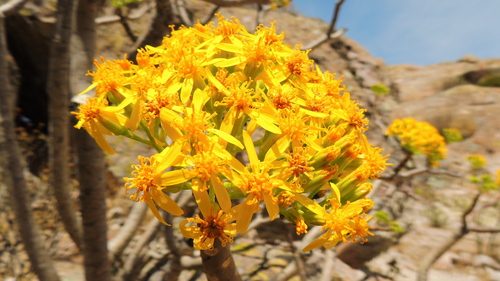
Pittocaulon praecox (Cav.) H.Rob. & Brettell is a deciduous shrub or small tree that reaches up to 4 meters in height. It has succulent, erect, light gray stems that branch in a candelabrum-like fork shape. Its hairless leaves are cordate (heart-shaped) at the base, clustered at the upper ends of branches, and have leaf stalks (petioles) up to 17.5 cm long. The smooth leaf margins bear 5 to 8 tapering, pointed lobes. The inflorescences are grouped into five or six ligules that resemble yellow petals. The fruit is a dry, cylindrical or club-shaped achene less than 1 cm long, topped with a pappus of white bristles. This species is native to semi-arid and temperate zones of central and southern Mexico. Its short roots let it grow on thin, uneven soils. It specifically thrives on deposits of extrusive igneous material, such as the Nealtican malpaís and Pedregal de San Ángel in Coyoacán, Mexico City. Pittocaulon praecox has proliferated so extensively in Pedregal de San Ángel that the xerophytic ecosystem there is typically classified as "matorral de palo loco". An infusion made from its leaves is used as a traditional remedy for rheumatism, wounds, and dermatitis.