About Pithecellobium dulce (Roxb.) Benth.
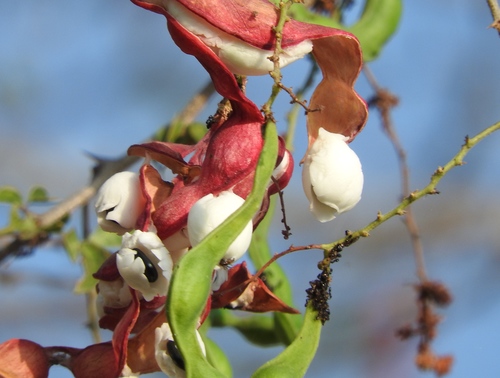
Pithecellobium dulce is a tree that reaches 10 to 15 m (33 to 49 ft) in height. Its spiny trunk can grow up to 9 meters in girth, equal to 9.4 feet thick DBH, and its leaves are bipinnate. Each pinna has a single pair of ovate-oblong leaflets that measure approximately 2 to 4 cm (0.79 to 1.57 in) long. The flowers are greenish-white, fragrant, sessile, and can reach about 12 cm (4.7 in) in length, though they appear shorter due to coiling. After flowering, the tree produces a pod that turns pink when ripe. When ripe, the pod opens to expose pink or white edible seed arils, the seed-containing pulp. The pulp holds flat, circular, shiny black seeds. The pollen of this species forms polyads made of many individual pollen grains connected together. Birds that feed on the sweet pulp disperse the tree’s seeds. This tree is drought resistant, and can grow in dry lands from sea level up to an elevation of 1,500 m (4,900 ft), which makes it well suited for cultivation as a street tree.
Pithecellobium dulce acts as a host plant for the caterpillars of the Common nawab (Polyura athamas), three-spot grass yellow (Eurema blanda), Bright babul blue (Azanus ubaldus), and several species of moth.
As a food source, the sweet and sour pulp inside the seed pods is eaten raw in Mexico, the Philippines, Pakistan, Qatar and India. It is also served as an accompaniment to various meat dishes, and used as a base for a sweet drink made with sugar and water called agua de guamúchil. The 1980 Revised handbook to the flora of Ceylon, edited by M.D. Dassanayake, states that the seeds are eaten locally; this information is not present in the original 1894 Flora of Ceylon. Many studies starting in the 1980s have investigated the composition and potential uses of the seeds. These studies have shown that seeds can be processed to extract a greenish oil. When refined and analyzed, this oil contains potentially edible fatty acids; the exact composition varies between studies, but all confirm oleic acid and palmitic acid are common components. Oil makes up 10-17% of the total weight of the seeds. Seeds also contain between 30% and 67.11% protein, and researchers suggest this protein could be used for animal feed in the future.
In traditional medicine, the bark is used as an astringent to treat dysentery in India. Records from 1933 originally note that it has been used as an antipyretic in India, and to treat eye inflammation. However, an anecdotal report from Sri Lanka claims the bark contains a substance that causes eye infections and swelling of the eyelids. The Huastec people of northern Veracruz and San Luis Potosí, Mexico, used different parts of the tree to treat gum ailments, toothache and cancer. The leaves are reportedly used in an alcoholic poultice to treat bile problems, and are also used to prevent miscarriage, though some sources also note leaves are used to induce abortion. The fruit pulp is described as astringent and hemostatic, and is used to treat hemoptysis. Ground seed is sometimes traditionally used to clean ulcers. Extracts from unspecified parts of the plant are also used to treat hemorrhages, chronic diarrhea, and tuberculosis.