About Pistia stratiotes L.
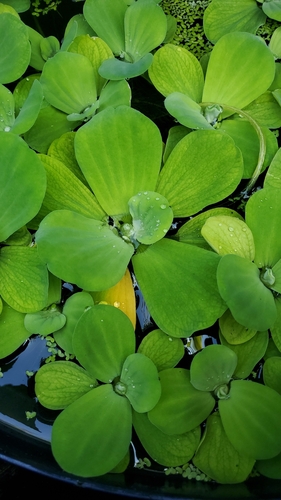
Pistia stratiotes L. is a perennial monocotyledon that forms a rosette of thick, soft leaves. It floats on the water surface, with its roots hanging submerged beneath the floating leaves. Leaves range from 2 to 15 cm long, are light green, have parallel venation and wavy margins. The leaf surface is covered in short white hairs that form basket-like structures that trap air bubbles, increasing the plant's buoyancy. Spongy parenchyma with large intercellular spaces in the leaves also helps the plant float. Its flowers are dioecious, lack petals, and are hidden among the leaves in the center of the plant. It has a spadix inflorescence that holds one pistillate flower with one ovary, and 2 to 8 staminate flowers with two stamens. Male and female flowers are separated by folds in the spathe, with male flowers positioned above female flowers. After successful fertilization, it produces oval green berries that contain ovoid seeds. The plant reproduces asexually via propagation through stolons, though sexual reproduction has also been observed in ponds of Southern Brazil. Pistia stratiotes grows in slow-moving rivers, lakes, and ponds. It achieves optimal growth at temperatures between 22 and 30 °C, and can tolerate maximum temperatures up to 35 °C. It does not grow in colder temperatures found beyond the tropics of Cancer and Capricorn. It also requires slightly acidic water, with a pH range of 6.5 to 7.2, for optimal growth. The center of origin of Pistia stratiotes has long been debated. Evidence for nativity to northern Africa comes from Egyptian hieroglyphics, and descriptions matching Pistia recorded from the Nile River by ancient Greek botanists Dioscorides and Theophrastus. Co-evolution of Pistia stratiotes with multiple insects native to Brazil and Argentina, including the water lettuce weevil, suggests it has been native to South America for a long time. Fossil specimens from Florida dating to the late Pleistocene (~12,000 BP) and early Holocene (~3,500 BP) indicate a native presence in the southeastern United States. Recent genetic evidence indicates that Pistia is not a monotypic genus, as has long been assumed. Instead, Pistia appears to consist of at least three genetically distinct, but morphologically and ecologically similar, species across the globe. Pistia stratiotes has a variety of medical uses across parts of Asia and Africa. In Nigeria, dried leaves are ground into powder and applied to wounds and sores for disinfection. A similar use exists in Indian traditional medicine, where powdered leaf is applied to syphilitic eruptions and skin infections. In Nigeria and Gambia, leaves are infused in water to make an eyewash for treating allergic conjunctivitis; this eyewash is known to have a cooling and analgesic effect, leading to the plant being commonly called 'eye-pity' in Africa. Leaves of Pistia stratiotes can also be burned to ash, and in Indian and Nigerian traditional medicine, this ash is used to treat ringworm infections of the scalp. Leaf extracts of P. stratiotes have demonstrated anti-inflammatory properties: they reduce mast cell infiltration and degranulation during allergic reactions. Ethanolic extracts have also been linked to reduced symptoms of inflammatory conditions including arthritis and fevers. The plant's traditional use for treating ringworm has prompted testing of its methanolic extracts against dermatophyte fungi. Studies found significant fungicidal activity against Trichophyton rubrum, Trichophyton mentagrophytes, and Epidermophyton floccosum.