About Pistacia atlantica Desf.
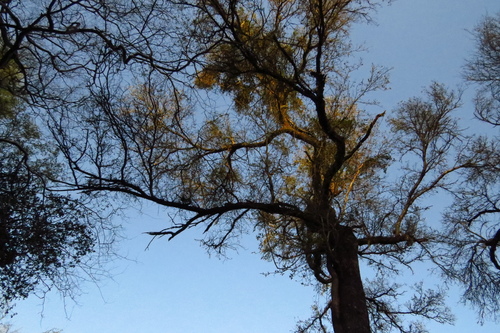
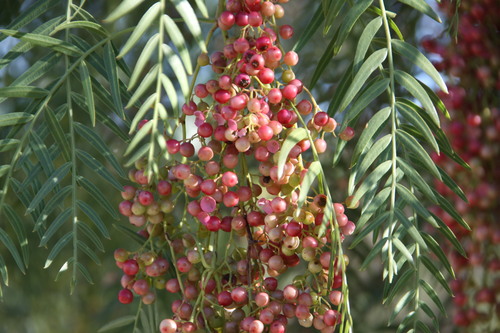
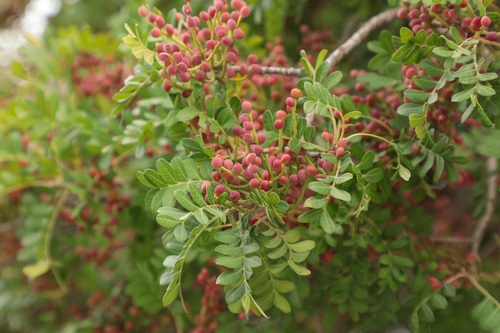
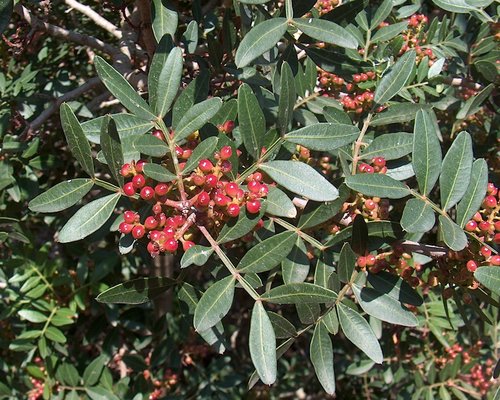
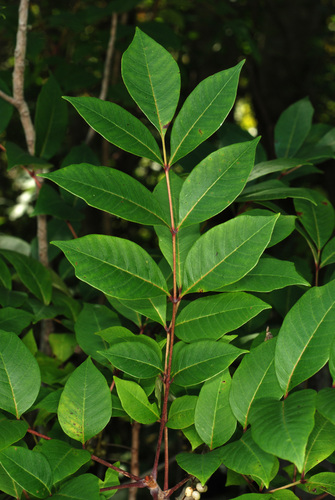
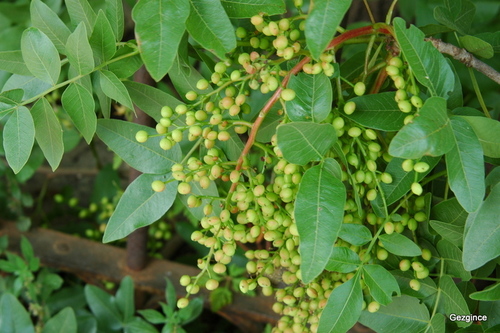
Pistacia atlantica Desf. is a slow-growing deciduous tree that can reach up to 1,000 years of age. It grows up to 7 m (23 ft) tall, with spreading, erect branches that form a dense crown. Its trunk is stout, covered in ashen gray fissured bark; old trees may have trunks up to 2 m (6 ft 7 in) in diameter, and it can take 200 years for a tree to reach 1 m (3 ft 3 in) trunk width. Older branches also have fractured, ash-colored bark, which gives the tree a grizzled overall look. Its leaves are imparipinnate, with 7 to 9 lance-shaped, oval, almost sessile, dark green leaflets that are shiny on the upper surface, born on slightly winged petioles. When infested by gall-producing aphid species including Pemphigus utricularis, Slavum wertheimae, and Forda riccobonii, galls often form on the tree’s leaves and branches. These aphid galls can contain up to 20% tannin by weight. The tree is typically dioecious, meaning male and female unisexual flowers grow on separate individuals. Both male and female flowers are small, greenish, inconspicuous, arranged in loose racemes, and fall away quickly. While monoecious and hermaphrodite individuals do occur, they are very rare. In some populations, male outnumber female trees. Female trees produce oblong, fleshy, oily fruits that are 6 to 8 mm (0.24 to 0.31 in) long. Fruits start out pink, ripen to blue or reddish blue, and measure roughly the thickness of a pea. Trees begin bearing fruit at 8 to 10 years old, and produce abundant fruit starting 2 to 3 years after first fruiting. Fruits ripen from July to October each year. In colder regions, leaves emerge in May and fall in November. It grows in oak woodlands, oak sclerophyllus, and thermophilous forests, at altitudes up to 600 m. It is native to Eurasia, ranging from North Africa to the Iranian Plateau; it is also one of the few native deciduous species of the Canary archipelago. Historically, it was common across its native range, but overharvesting for wood (when other good sources of timber were rare) has reduced its current distribution. Today it remains common in mountain forests of Iran, and is a characteristic landscape tree in parts of Algeria outside the Sahara. This wild pistachio is the most economically important tree in many parts of the Kurdish regions, including the Zagros Mountains, where it is managed as a valuable forest tree. Historically, its resin and fruit oil were used for a range of medicinal purposes. In Iran, its resin is called saqez, and remains an important commercial commodity. It is also used to combat soil erosion: it strengthens soil, and is planted for reforestation of arid, steep slopes to prevent landslides. It is hardier and more frost-resistant than Pistacia terebinthus, so it is used as a rootstock for cultivated Pistacia vera (pistachio) in Ukraine and the United States. Its resin is used to manufacture alcohol and lacquer, and its essential oils are used in the perfume industry. Leaf and gall tannins are used as raw material for tanning leather. Dried sap is burned as incense for celebrations and religious ceremonies, producing a pleasant-smelling smoke. The fruits are a local food source, though cultivated P. vera is far more valuable for food production. The seeds are edible oil-bearing seeds similar to common pistachio nuts, and contain up to 60% fat. Raw fruits are generally not popular as food, as they are said to taste like turpentine; they contain around 45% oil. In Turkey, candy made with this species is called tsukpi pistachio, and immature fruits are sometimes harvested and eaten with sour milk. In the Kevan region of Turkey, the resin is used as chewing gum, and the tree is called the kevove rubber tree locally. In the Paphos region of Cyprus, the resin is called Cyprus turpentine, Cyprus balsam, or locally Paphos Gum (Paphitiki Pissa in Cypriot Greek), and is also used to make chewing gum. Its resin has been reported to have significant antimicrobial and antifungal activity; 26 compounds have been identified in its hexane extract, with the major components being α-pinene (57.06%), β-pinene (9.83%), trans-pinocarveol (2.95%), trans-Verbenol (3.97%), and α-Phellandren-8-ol (3.81%). In Fars province, Iran, it is used to make a local food called OuBanneh. Pistacia atlantica is planted as an ornamental, drought-tolerant shade tree for gardens and parks. It was imported to California to use as rootstock for cultivated pistachio trees. These introductions have allowed the species to escape cultivation, and it is now an occasional invasive species in California.