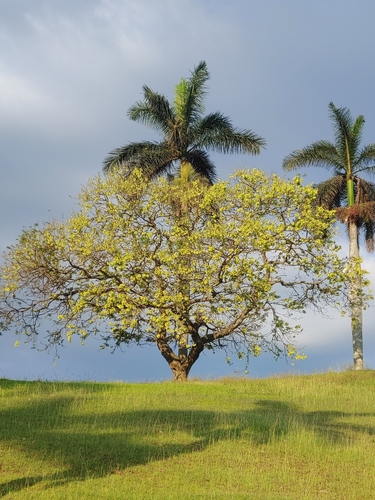
About Piscidia piscipula (L.) Sarg.
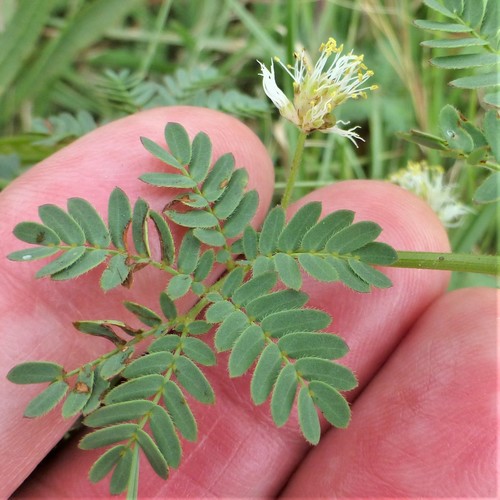
Piscidia piscipula, commonly called the Florida fishpoison tree, is a medium-sized tree that reaches 12 to 15 m in height, with trunk diameters between 46 and 118 cm. It grows an irregular, open crown made up of stout, erect branches. Its deciduous leaves are alternate, pinnately compound, and 9 to 23 cm long. Each leaf holds 5 to 11 oppositely arranged leaflets that are 4 to 8 cm long. The upper surface of leaflets is dark green, while the lower surface is distinctly paler grayish-green and covered in fine hairs. The tree produces white flowers tinged with red or pink, arranged in pea-like clusters that appear in May. These flowers are attractive to bees. Trees may begin blooming when they are around 4 years old and 4 m tall. After flowering, the tree forms light brown, bean-like pods 8 to 10 cm long, each marked with four papery wings. Pods ripen in July and August, and hold red-brown, bean-shaped seeds. The stem bark is thin, olive gray with irregular dark patches and many smaller scales. It has an unpleasant odor, a distinctly acrid and bitter taste, and causes a burning sensation when held in the mouth. When seeds are removed from ripe pods and sown about 6 mm deep in moist soil, they germinate in 8 to 10 days. Seedlings should be fertilized and watered regularly until they are well established. Cuttings planted in moist soil sprout roots very quickly. Rooting occurs so readily that posts made from fresh timber of this species will occasionally take root unintentionally. The Florida fishpoison tree grows in coastal zones. It prefers well-drained, sandy soils with a humus top layer. It has some tolerance to short-term storm surges of brackish or seawater. Even though it grows in coastal conditions, it is usually sheltered from direct salt spray by neighboring vegetation. Established trees have very high drought tolerance. Cold sensitivity restricts this tree to areas no colder than plant hardiness zone 11. This tree acts as a larval host plant for several butterfly species: the native cassius blue butterfly (Leptotes cassius), the hammock skipper (Polygonus leo), and the introduced fulvous hairstreak (Electrostrymon angelia). In regions with appropriate climate and soil, the Florida fishpoison tree grows as a hardy, medium-sized shade tree with attractive seasonal flowers. It is well suited for yards and planting along fence rows. The species is shade intolerant, and requires full sunlight for maximum growth. P. piscipula can be toxic and should only be used under the direction of a doctor, with an individually determined dosage. It has been used in herbal medicine to treat nervous conditions, pain, and insomnia. Recent scientific studies conducted on animals suggest that bark extracts from this species may have potential anti-inflammatory, sedative, and antispasmodic effects.