About Pipraeidea melanonota (Vieillot, 1819)
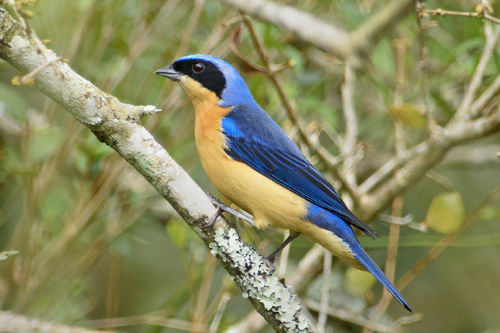
The fawn-breasted tanager, with the scientific name Pipraeidea melanonota (Vieillot, 1819), has an average body length of 14 cm (5.5 in) and a weight range of 18–25 g (0.63–0.88 oz). This tanager species has an unusually short, wide beak that resembles the beaks of swallows, along with short legs, a short tail, and long wings. Its most distinctive coloration features are a sky-blue crown and a broad black mask that extends over the eyes into the ear-coverts. For males, the crown and nape are medium blue, while the forehead, lores, ocular area, and ear-coverts are deep black. Males have dull blue mantle and back, bright turquoise-blue lower back and rump, and dusky blue tail. The throat and underparts of male fawn-breasted tanagers are cinnamon-colored. Their iris is dark red to reddish-brown, and the bill is dusky, with a normally grey lower mandible. Females have similar coloration to males, but their markings are usually duller—this is especially noticeable in the crown region—and their back has a brownish tint. Juveniles have almost no distinct patterning, and are dull brownish-grey overall. Fawn-breasted tanagers are usually seen alone or in pairs, most often in semi-open landscapes, and may perch at any height. Their calls are "see" or "swee" tones. These calls can occur as slow sets of 4 or 5 notes, or as a faster pulsating trill pattern made up of around a dozen notes. The range of the fawn-breasted tanager spans across South America, covering most of Brazil, Venezuela, Colombia, Peru, Ecuador, Bolivia, east Paraguay, Uruguay, and northeastern Argentina, extending to the southern bank of the Río de la Plata. This species inhabits forest borders, bushy pastures, cultivated small semi-open areas with large trees, and clearings with scattered trees. Its tolerable elevation range varies by geographic location. In the Andes and Ecuador, it occurs at altitudes between 1500 and 2500 m, reaching a maximum elevation of 3000 m. In Colombia, it can be found as low as 900 m, and in Venezuela as low as 400 m.