About Pipilo maculatus Swainson, 1827
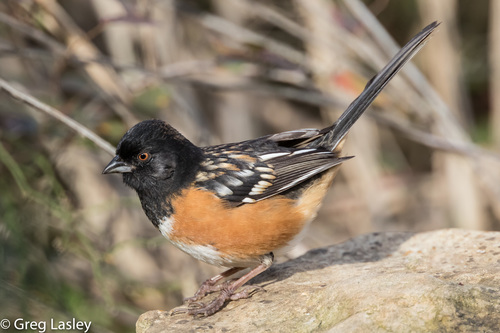
Pipilo maculatus, commonly known as the spotted towhee, is a large New World sparrow roughly the same size as a gray catbird. It has a long, dark, fan-shaped tail with white corners at the tip, a round body typical of New World sparrows, bright red eyes, and dull pink legs. This species measures 17 cm (6.7 in) to 21 cm (8.3 in) in total length, weighs between 33 g (1.2 oz) and 49 g (1.7 oz), and has a wingspan of 28 cm (11 in).
Adult males have a generally darker head, upper body, and tail, paired with a white belly, rufous sides, white spots on the back, and white wing bars. Females have a similar overall pattern, but are colored dark brown and grey rather than black. Spotted towhees have white spots on their primary and secondary feathers. They are similar in size and overall structure to eastern towhees, but eastern towhees lack these white spots on all feathers, and instead have a white base to their primary feathers that is absent in spotted towhees.
Spotted towhees inhabit dry upland forests, open forests, brushy fields, and chaparrals. They also occur in fringe wetland forests and riparian forests located near the edge of upland forests. They do not live in arid climates, so they are not found in the Sonoran Desert. They occur across northwestern North America: they breed across northwestern North America, and are present year-round in California, Nevada, Arizona, Utah, Oregon, Washington, Idaho, and southern British Columbia. They are found in all of Arizona except the arid Sonoran Desert, and all of California except the southeast corner that borders Arizona. Their range has been recorded expanding eastward as far as western Iowa and southwestern Minnesota.
Because much of the spotted towhee's overlapping range in Arizona, New Mexico, and California experiences regular forest fires, the species tends to be found in unburned chaparral and avoids recently burned chaparral and forests, due to lack of ground cover and reduced ability to forage. Spotted towhees will return to areas that have been recovering from a burn for less than 15 years, when recovering understory provides good ground cover and accessible ground foraging. However, populations decrease immediately after a fire until vegetation regrows. In the southwestern United States, the species' breeding habitat relies heavily on coastal sage scrub, which provides cover from predators.
Spotted towhees migrate to northern and northwestern United States and southwestern Canada to breed in scrubland, parks, and suburban gardens. Northwestern populations migrate east to the central plains of the United States, mostly the northwestern-central Great Plains. In some other regions, individual birds may move to lower elevations during the winter. Across western North America, their general breeding habitat is chaparral, thickets, or shrubby areas. Where their ranges overlap in the Midwest, primarily Nebraska and North and South Dakota, spotted towhees hybridize with eastern towhees. Where their ranges overlap in southwestern Mexico, spotted towhees hybridize with collared towhees.