About Pinus serotina Michx.
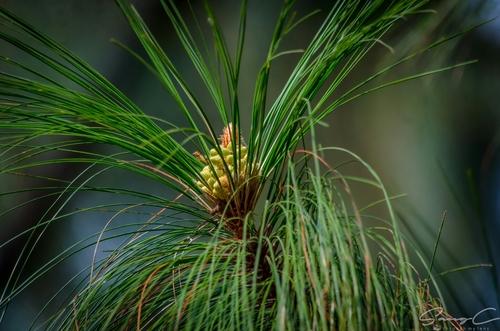
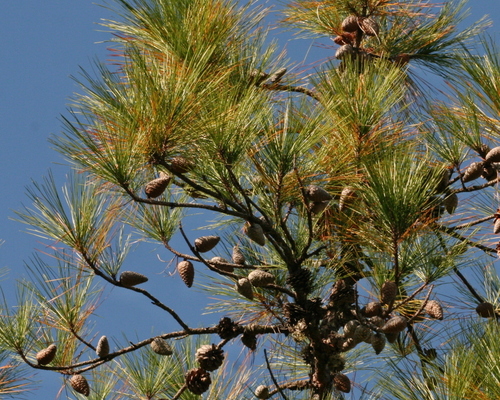
Pinus serotina Michx., commonly called pond pine, typically has a crooked growth habit and an irregular crown. It usually grows up to 21 metres (69 ft) tall, and rarely reaches 29 metres (95 ft). Its needles grow in bundles of three or four, and measure 15–20 cm (6–8 in) long. Like Pinus rigida (pitch pine), Pinus serotina grows needles and small branches directly from its trunk, unlike pitch pine which only grows in drier areas. Pinus serotina is very similar to the common Pinus taeda (loblolly pine), but differs in its direct needle growth from the trunk, smaller mature size, and tendency not to grow straight. The bark of pond pine forms rough, brownish-red plates. Pond pine is less cold hardy than loblolly pine and pitch pine, and takes 18 years to reach full maturity.
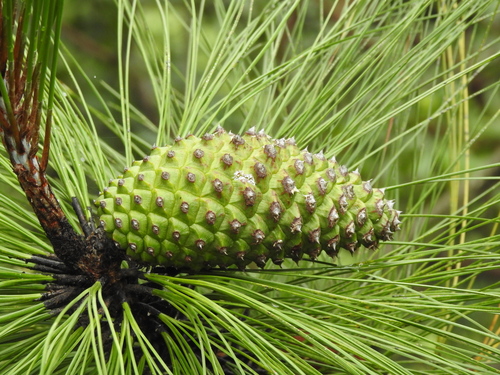
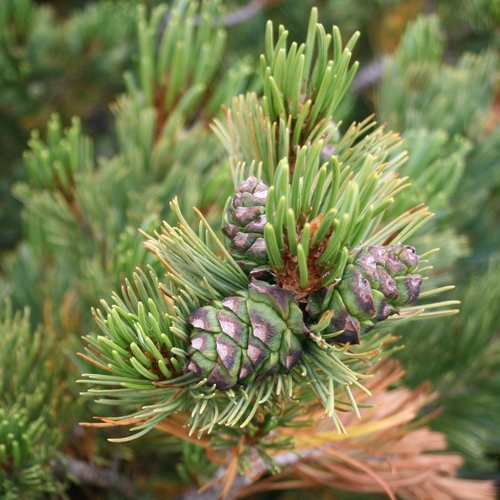
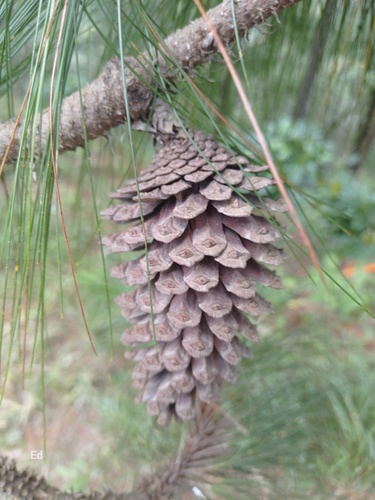
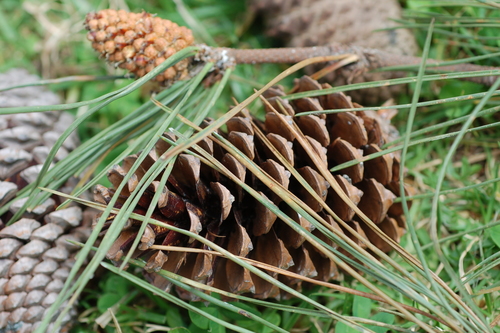
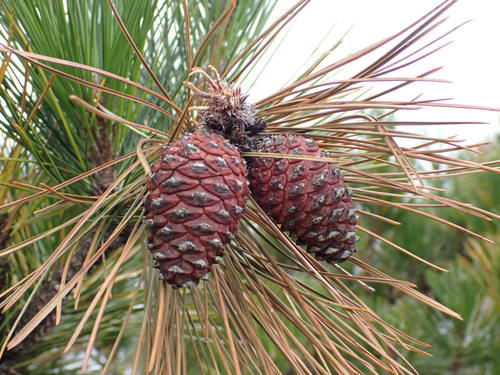
Pinus serotina produces nearly round seed cones that are 5–8 cm (2–3+1⁄4 in) long, with small prickles on the scales. Its cones are usually serotinous, meaning they require fire to open. Pollen cones are cylinder-shaped, yellow-brown, and up to 1.8 inches long. After pollination, seed cones take two years to mature. While some cones release their seeds, most Pinus serotina cones persist on the tree and retain their seeds. Seed cones and their scales are red-brown. Foliar sheaths have long bases and measure 0.4 to 0.8. Seeds are ovule-shaped, 0.2 to 0.24 inches (0.51–0.61 cm) long, with an angled tip and pale brown color. For regeneration purposes, seed trees 23 to 25 centimetres (9.1–9.8 in) in diameter at breast height and 30 years old are expected to produce 5,000 seeds.
Pinus serotina is primarily found on wet, poorly drained sites, most commonly in or near swamps, ponds, bays, marshes, and pocosins. It also grows very well in mineral soils. This species is often associated with longleaf pine (Pinus palustris), as both require frequent fire. Pond pine requires fire for seed germination. It also grows in flatwoods, flatwoods bogs, savannas, and barrens. At the northern end of its range, pond pine intergrades and hybridizes with pitch pine (P. rigida); it can be distinguished from pitch pine by its longer needles and on average slightly larger cones. Some botanists treat pond pine as a subspecies of pitch pine. Pinus serotina grows in mild, humid climates, with average temperatures ranging from 45 to 80 °F (7 to 27 °C), recorded extreme temperatures from −10 and 110 °F (−23 and 43 °C), and average annual precipitation between 44 and 55 inches (110 and 140 cm).
Pinus serotina stands provide habitat for many wildlife species, particularly birds and mammals in wetland and flatland environments. Pond pine is intolerant of shade. Reproduction requires fire that causes intense scorching or defoliation: dormant buds are protected by the tree's thick bark, and if the upper portion of the tree is killed by fire, epicortical buds can resume new growth. For sufficient seed production after fire, 15 to 20 seed trees are needed per hectare (6 to 8 per acre). Without heat from fire, seed release is limited by pond pine's serotinous cones. Pond pine seedling growth is often limited by soil moisture, lack of nutrients, and competition. Under poor growing conditions, pond pine seedlings may grow as little as 30 cm (12 inches) or less per year.
Despite its poor form and relatively slow growth, Pinus serotina can produce economically valuable stands for pulpwood and saw timber in sites where other trees will not grow. Tan or green dyes can be obtained from its needles. Vanillin flavoring is produced from byproducts of its pulpwood resins. It has been suggested as a potential remedy for kidney issues, administered as a rub or in a steam bath, and may also be useful for treating mucous membrane diseases and respiratory complaints. Pond pines are also used to prevent erosion and improve water quality.