About Pinus quadrifolia Parl. ex Sudw.
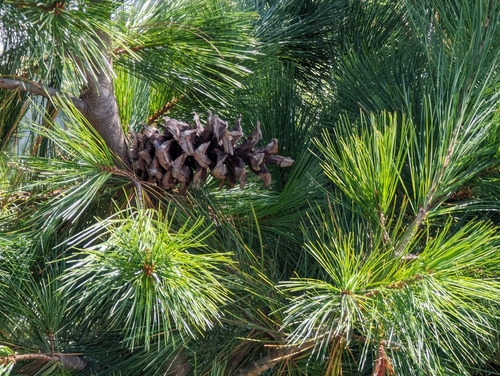
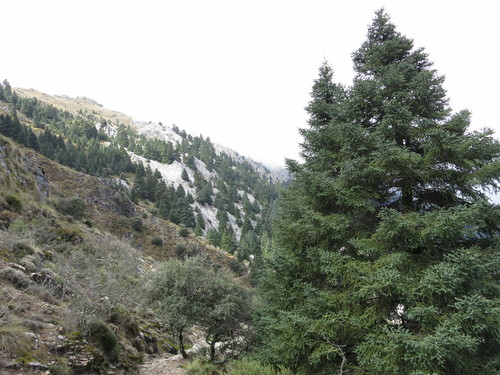
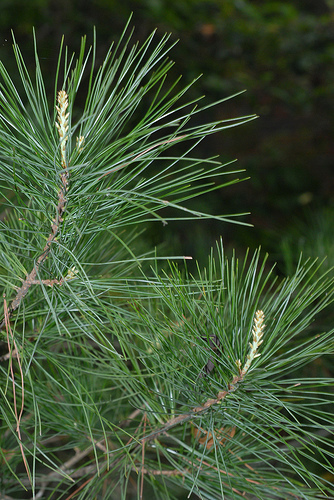
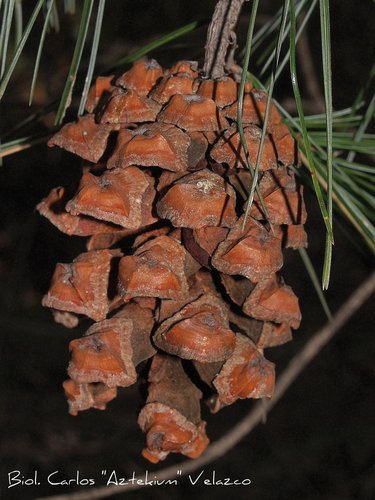
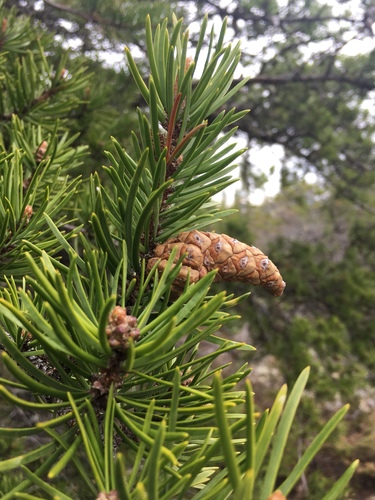
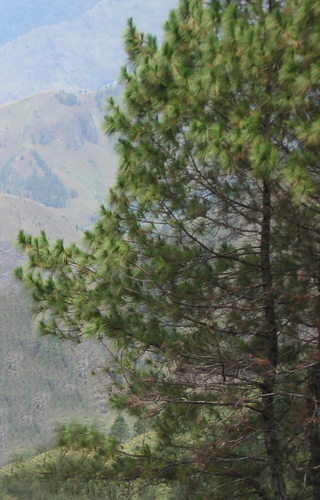
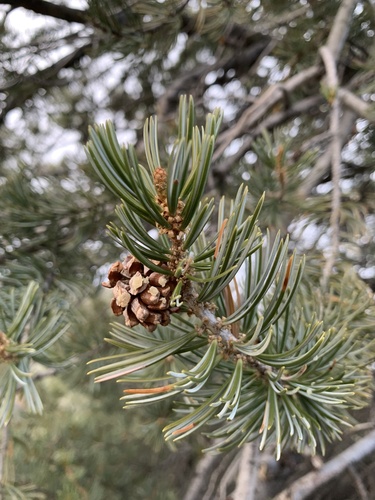
Pinus quadrifolia Parl. ex Sudw., commonly called Parry pinyon, is a small to medium-sized tree that grows 8 to 15 m (26 to 49 ft) tall, with a trunk diameter of up to 40 cm (16 in), and rarely reaches larger sizes. Its bark is thick, rough, and scaly. Its needle-like leaves grow in bundles of 4 to 5; they are moderately stout, 2.5–5.5 cm (1–2+1⁄8 in) long, glossy dark green. There are no stomata on the outer face of the needles, while the inner surfaces bear a dense bright white band of stomata. Parry pinyon starts producing cones when it is 10 to 20 years old, and reaches maximum seed production at 50 years of age or older. The cones are round, 4–5.5 cm (1+5⁄8–2+1⁄8 in) long and wide when closed. They start out green, and ripen to a yellow to orange-buff color after 18 to 20 months. Cones have only a small number of thick scales, with typically 5 to 10 fertile scales. When mature, cones open to 5 to 7 cm (2 to 2+3⁄4 in) wide, and retain seeds on the scales after opening. The seeds are 10–14 mm (13⁄32–9⁄16 in) long, with a thin shell, a white endosperm, and a small vestigial wing that is 1–2 mm (1⁄32–3⁄32 in) long. Pinyon jays disperse these seeds by plucking them from open cones; jays use the seeds as food, store many seeds for later use, and some unused stored seeds go on to grow into new trees. Besides birds, rodents and other mammals also disperse the species' seeds. Parry pinyon grows in areas with low organic material density, which lowers the risk of fire spread. However, the species itself is susceptible to fire due to its low-hanging branches and thin bark. Larger Parry pinyons can survive low to moderate heat fires, but younger Parry pinyons are often killed entirely by fire. Parry pinyon cannot resprout after a fire. The species' edible seeds, called pine nuts, are collected throughout its native range, but it is far less important for pine nut harvest than Colorado pinyon (Pinus edulis). Parry pinyon is also occasionally planted as an ornamental tree, and sometimes used as a Christmas tree. Because the species has a limited distribution, its seeds are not gathered commercially, and are most often consumed by birds, rodents (especially woodrats), and other mammals. The Cahuilla tribe of southern California used this species' resin to make a face cream for girls to prevent sunburn. The tribe also used the nuts for multiple purposes: they gave nuts to babies as a breast milk alternative, ground nuts and mixed the powder with water to make a beverage, roasted and ate whole nuts, and turned them into mush. Nuts were also an important trade item for the Cahuilla with neighboring tribes. Pine needles and roots were used as material for basketry, and bark was used to build house roofs. Resin was used as glue to mend pottery and reattach arrowheads to arrow shafts. The wood was burned for firewood and incense, as it is highly combustible and produces a pleasant scent. The Diegueno people also ate the species' nuts and seeds.