About Pinus ponderosa Douglas ex C.Lawson
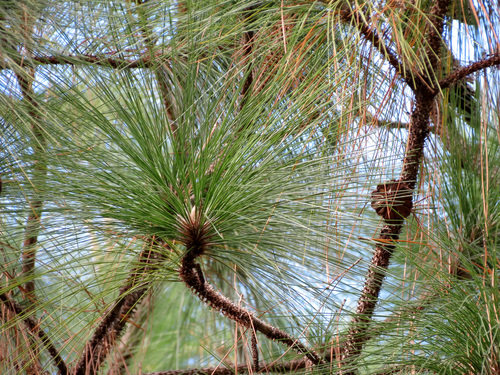
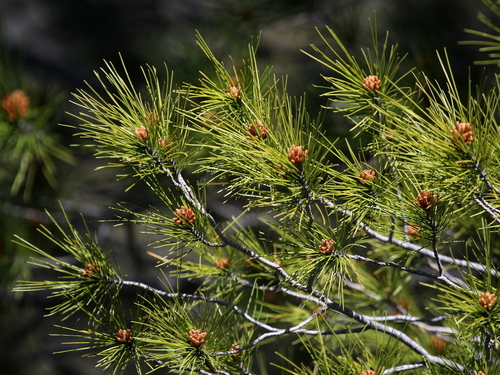
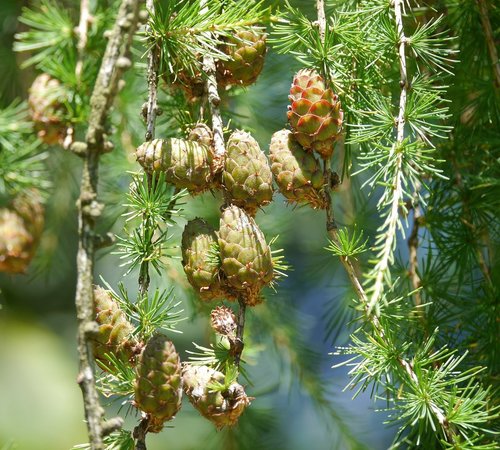
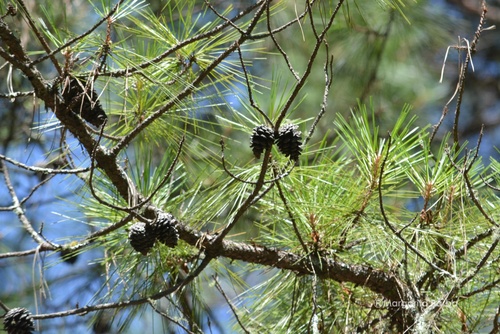
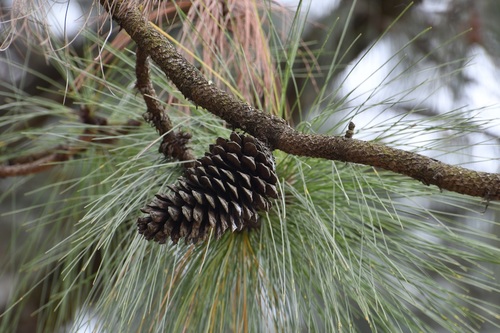
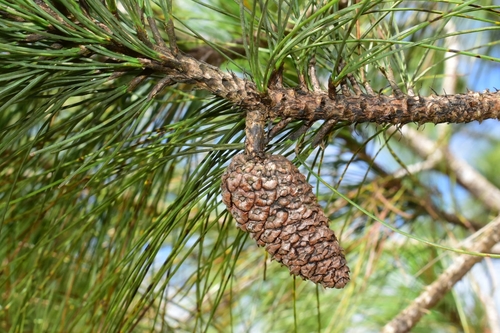
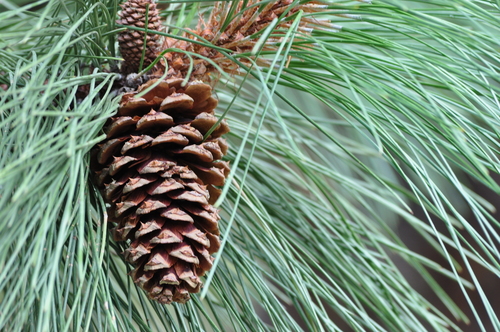
Pinus ponderosa Douglas ex C.Lawson, commonly called ponderosa pine, is a large evergreen coniferous pine tree. Its bark is a key feature that distinguishes it from other pine species: mature and overmature trees have yellow to orange-red bark that forms broad to very broad plates separated by black crevices, while younger trees have blackish-brown bark, which led early loggers to call these young individuals "blackjacks". Some botanists recognize five varieties or subspecies of Pinus ponderosa, all identifiable by their characteristically bright-green needles; this bright green contrasts with the blue-green needles that define Jeffrey pine. Each of the five taxa has distinct traits: the Pacific subspecies has the longest needles, at 15–25 centimeters (6–9+1⁄2 inches), which are also the most flexible, and grows in plume-like fascicles of three, with green immature cones. The North Plateau (or Columbia) ponderosa pine has long needles measuring 12–20.5 cm (4+3⁄4–8 in), which are relatively flexible, arranged in three-needle fascicles, and has purple immature cones. The Rocky Mountains subspecies has shorter needles, 9.2–14.4 cm (3+1⁄2–5+3⁄4 in) long, that are stouter, growing in bushy, tuft-like fascicles of two or three, and usually has green immature cones, which are purple at high altitudes. The southwestern subspecies has stout needles 11.2–19.8 cm (4+1⁄2–7+3⁄4 in) long, arranged in fascicles of three, with fascicles averaging 68.5–89 mm (2+3⁄4–3+1⁄2 in) in length. The central High Plains subspecies is marked by having the fewest branches, an average of 1.4 branches per whorl, with stout, upright branches that grow at narrow angles from the trunk. It has long green needles 14.8–17.9 cm (5+3⁄4–7 in) long that extend farthest along the branch, giving a shape resembling a fox tail. Across the whole species, this subspecies has the widest, stoutest, and fewest needles, with fascicles averaging 56–71 mm (2+1⁄4–2+3⁄4 in) long. The species produces egg-shaped cones 8–13 cm (3–5 in) long, which are often found in large numbers underneath mature trees. Each cone scale has a sharp point. There is conflicting scientific reporting on the scent of Pinus ponderosa bark: some sources state the bark smells of turpentine, which may reflect its high content of terpenes including alpha-pinene, beta-pinene, and delta-3-carene. Other sources claim it has no distinctive scent, while still others report that bark sampled from a furrow smells like vanilla. All sources agree that Jeffrey pine has a stronger scent than ponderosa pine. When stumps are carved into, pitch-filled stumps give off a scent of fresh pitch. Pinus ponderosa is the dominant tree species of the ponderosa shrub forest Kuchler plant association. Like most western North American pines, it is generally associated with mountainous terrain, but it also grows along the banks of the Niobrara River in Nebraska. Scattered stands occur in Oregon's Willamette Valley, and in the Okanagan Valley and Puget Sound areas of Washington. Stands grow throughout low-elevation valleys in British Columbia, reaching as far north as the Thompson, Fraser, and Columbia watersheds. At its northern range limit, it only grows below 1,300 meters (4,300 ft) elevation, and is most common below 800 meters (2,600 ft). The species covers 4,000 square kilometers (1×10^6 acres), 80% of the total area, of South Dakota's Black Hills. It is found on the foothills and mid-height peaks of the northern, central, and southern Rocky Mountains, as well as in the Cascade Range, the Sierra Nevada, and the maritime-influenced Coast Range. In Arizona, it is the dominant species on the Mogollon Rim, and scattered across the Mogollon Plateau and on mid-height peaks between 1,829 and 2,835 meters (6,000 to 9,300 ft) elevation in Arizona and New Mexico. Arizona pine (Pinus arizonica), which grows in the mountains of extreme southwestern New Mexico, southeastern Arizona, and northern Mexico, is sometimes classified as a variety of ponderosa pine, but is currently recognized as a separate species. Ponderosa pine also grows in the Chisos, Davis, and Guadalupe Mountains of Texas, at elevations between 1,219 and 2,438 meters (4,000 and 8,000 ft). For ponderosa pine, the natural fire cycle is 5 to 10 years, with natural ignitions producing low-intensity fires. Low-severity fires occurring roughly once a decade have allowed individual specimens to live for 500 years or more. The species has thick bark, and its buds are protected by needles, which lets even some younger trees survive less intense fires. In addition to being adapted to dry, fire-prone areas, Pinus ponderosa often grows on the edges of deserts because it is comparatively drought resistant, partly due to its ability to close its leaf pores. It can also absorb some water from sandy soils. Despite being relatively widespread across the American West, it is shade intolerant. Pinus ponderosa needles are the only known food source for caterpillars of the gelechiid moth Chionodes retiniella. Blue stain fungus (Grosmannia clavigera) is introduced into the sapwood of P. ponderosa through the feeding galleries of all species in the bark beetle genus Dendroctonus, which includes the mountain pine beetle, and this fungus has caused extensive damage to P. ponderosa stands. Western pine beetles and other beetle species consume ponderosa pine bark. Squirrels, chipmunks, quail, grouse, and Clark's nutcracker eat ponderosa pine seeds, while mule deer browse on young seedlings. Many different animals, including the pileated woodpecker, nest in ponderosa pine trees. Indigenous peoples of North America used ponderosa pine for multiple purposes: they consumed its seeds and sweet inner bark, chewed its dried pitch, and used the pitch as a salve. They used limbs and branches for firewood and building material, and carved trunks into canoes. They wove needles and roots into baskets, and boiled needles to make a solution for treating coughs and fevers. Ponderosa pine has long been an important commercial timber species in western North America, valued for its versatile wood. Logging of ponderosa pine forests for lumber and other wood products has occurred in both the United States and Canada (primarily British Columbia) since the 19th century. Old-growth ponderosa pine was widely harvested by settlers for lumber, including for railroad construction. The wood is pale yellow to light brown, straight-grained, and moderately soft, making it suitable for a wide range of construction and manufacturing applications. Younger trees produce poor-quality lumber because the wood tends to warp. Due to its abundance and warm appearance, ponderosa pine has been used in many notable buildings in the western United States, often contributing to a rustic parkitecture aesthetic. One iconic example is the Grand Canyon Lodge, where architect Gilbert Stanley Underwood used massive ponderosa pine beams for the building's sloped roof and expansive interiors. Another example is Fuller Lodge in Los Alamos, New Mexico, which uses more than 700 locally harvested ponderosa pine logs in its log-style design. When cultivated as a bonsai, ponderosa pines are prized for their rough, flaky bark, contorted trunks, flexible limbs, and dramatic deadwood. Wild-collected specimens are often heavily sculpted by their native environment, resulting in distinctive twisted trunks, limbs, and deadwood. In mountain habitats, wild ponderosas sometimes grow in small rock pockets that stunt their growth, creating naturally compact forms ideal for bonsai. The main challenge of cultivating this species as bonsai is its naturally long needles, which requires years of training and care to reduce to a size appropriate for the form. This species is also grown as an ornamental plant in parks and large gardens.