About Pinus pinea L.
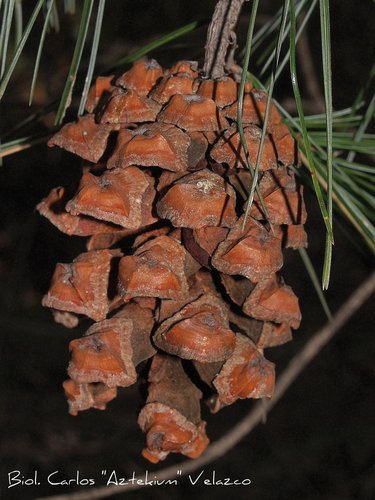
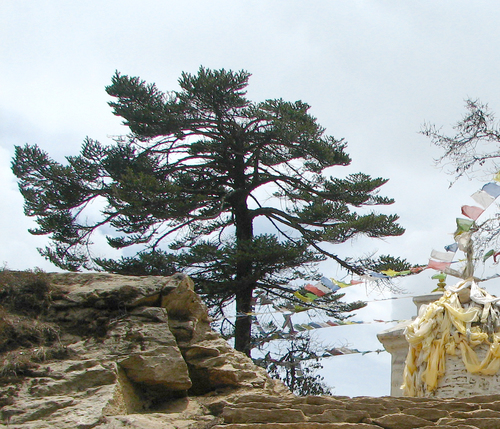
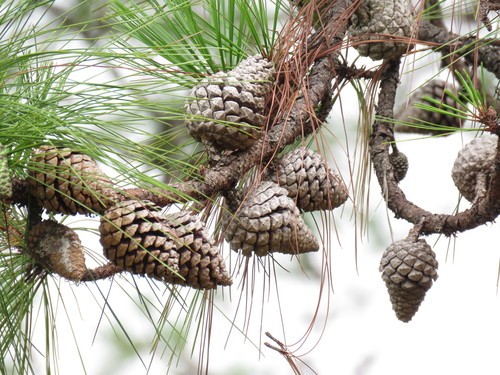
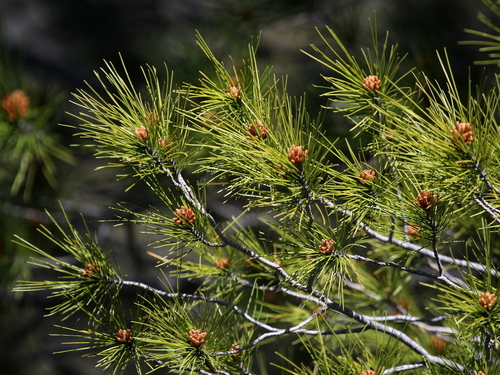
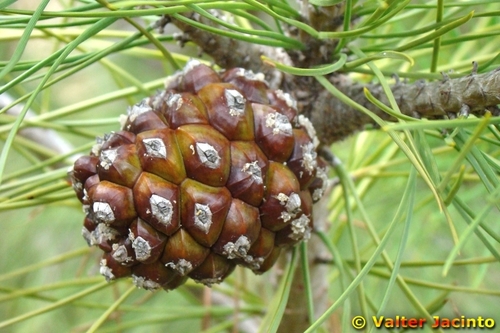
Pinus pinea L., commonly known as the stone pine, is a coniferous evergreen tree. It can grow over 25 metres (80 feet) tall, though a height of 12–20 m (40–65 ft) is more typical. The tree changes shape as it ages: young stone pines grow as a bushy globe, mid-aged trees develop an umbrella-shaped canopy atop a thick trunk, and mature trees gain a broad, flat crown that can exceed 8 m (26 ft) in width. Its bark is thick, red-brown, and deeply fissured into wide vertical plates. The foliage of mature stone pines consists of flexible, mid-green, needle-like leaves that grow in bundles of two, measuring 10–20 cm (4–8 in) long, and can reach exceptional lengths of up to 30 cm (12 in). Trees up to 5–10 years old produce distinct juvenile leaves: these are single (not paired), 2–4 cm (3⁄4–1+1⁄2 in) long, and glaucous blue-green. Starting from the fourth or fifth year of growth, adult leaves grow alongside juvenile leaves, and fully replace juvenile leaves by around the tenth year. Older trees will also grow juvenile leaves in new growth after injury, such as a broken shoot. The cones of the stone pine are broad and ovoid, 8–15 cm (3–6 in) long, and take 36 months to mature — longer than any other pine species. Its seeds, commonly called pine nuts (known as piñones, pinhões, pinoli, or pignons), are large, 2 cm (3⁄4 in) long, and pale brown with a powdery black coating that rubs off easily. The seeds have a rudimentary 4–8 mm (5⁄32–5⁄16 in) wing that falls off very easily. The wing is not effective for wind dispersal, so the seeds are spread by animals, originally mainly by the Iberian magpie, but largely by humans throughout recent history. Pinus pinea is a characteristic but taxonomically controversial species found across the Mediterranean basin, and its definitive native range is heavily debated. Strong evidence points to its origin in the Western Mediterranean, particularly the Iberian Peninsula (Portugal and Spain), where the most extensive natural stands grow and the species reaches its highest altitudes. Evidence from Paleolithic and Pleistocene sites with Pinus pinea remains on the South Iberian Peninsula strongly supports that the species was once part of the natural forest ecosystem of that region. In addition, pollen dated to 18–22 thousand years ago (the end of the Pleistocene) found in Southern France supports the hypothesis that Pinus pinea is native to that area. By contrast, other sources argue the native range extends into the Central and Eastern Mediterranean, specifically covering regions of Italy (Tuscany, Sardinia, Sicily), the Peloponnese (Greece), the coasts of Asia Minor (Turkey), and Lebanon. Pinus pinea has been intensively cultivated for its valuable edible nuts and timber since at least the 4th century B.C., and possibly earlier. This long history of human activity means that while the species is currently found across coastal areas from Portugal to Lebanon and the Black Sea, it is often impossible to tell truly native stands apart from stands naturalized from ancient artificial plantings. During a prehistoric period with a more humid climate, the range of Pinus pinea included North Africa, covering parts of the Sahara Desert and Maghreb in what is now Morocco, Algeria, Tunisia, and Libya. Pinus pinea is a diagnostic species of the vegetation class Pinetea halepensis. It has been extensively cultivated for at least 6,000 years for its edible pine nuts, which have been traded since early historic times. The tree has been cultivated across the Mediterranean region for so long that it has become naturalized, and is often considered native beyond its original natural range.