About Pinus palustris Mill.
Pinus palustris Mill., commonly called longleaf pine, is also grouped as a southern yellow pine or longleaf yellow pine. It was historically called pitch pine, a name that was dropped to avoid confusion with Pinus rigida.
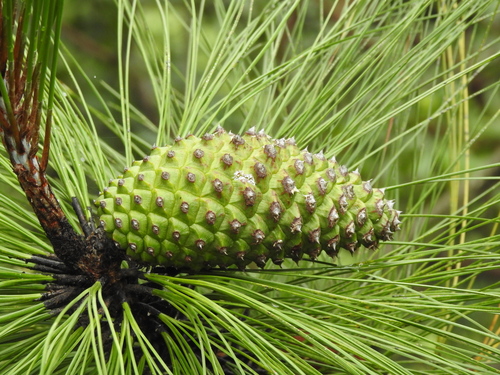
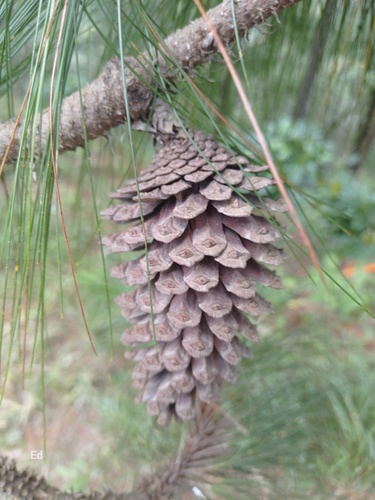
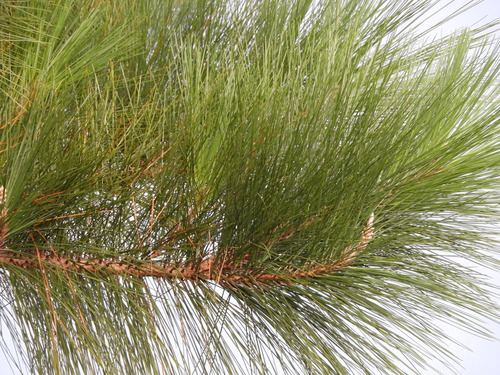
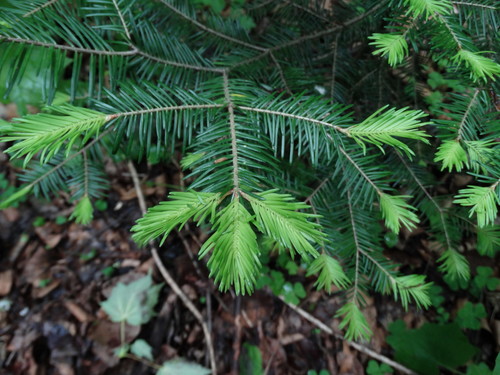
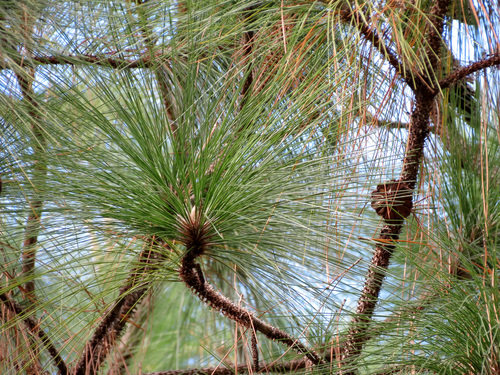
The bark of Pinus palustris is thick, reddish-brown, and scaly. Its leaves are dark green, needle-like, and grow mainly in bundles of three, sometimes two or four, especially on seedlings. The needles are often twisted and measure 20–45 centimetres (7+3⁄4–17+3⁄4 inches) in length; a local race growing in a cove near Rockingham, North Carolina has needles reaching up to 24 inches (61 centimetres) in length. It is one of two long-needled pine species native to the Southeastern United States, the other being slash pine. Both female seed cones (ovulate strobili) and male pollen cones (staminate strobili) begin development during the growing season before buds emerge. Pollen cones start forming inside their buds in July, while young seed conelets form during a short window in August. Pollination happens in early spring the following year, when pollen cones are 3–8 cm (1+1⁄4–3+1⁄4 in) long. Seed cones mature roughly 20 months after pollination. Mature seed cones are yellow-brown, 15–25 cm (6–9+3⁄4 in) long, 5–7 cm (2–2+3⁄4 in) broad, and open to 12 cm (4+3⁄4 in). Each cone scale has a small, sharp, downward-pointing spine at its center. Seeds are 7–9 millimetres (1⁄4–3⁄8 in) long, with a 25–40 mm (1–1+5⁄8 in) wing.
Longleaf pine reaches full size in 100 to 150 years and can live up to 500 years old. When young, it grows a long taproot that is usually 2–3 metres (6+1⁄2–10 feet) long. Mature trees develop a wide, spreading lateral root system with several deep "sinker" roots. It grows on well-drained, usually sandy soil, and characteristically forms pure stands. Young seedlings grow in a distinct "grass stage", where they do not look tree-like and instead resemble a dark-green fountain of needles. This stage lasts 5–12 years, with very slow vertical growth that often leaves the plant only ankle high for years. After this stage, the tree puts on rapid growth, especially when growing in an open gap with no overhead tree canopy. During the grass stage, the terminal bud is protected from lethal heating by tightly packed needles, making the seedling very resistant to low-intensity fires.
Longleaf pine is highly pyrophytic (resistant to wildfire) and dependent on periodic fire. Periodic natural and human-set fires favor this species by removing competing vegetation and exposing bare soil for successful seed germination. An open canopy with no dense layer of medium-tall trees (midstory canopy) creates open longleaf pine forests or savannas.
Before European settlement, longleaf pine forest covered up to 90,000,000 acres (360,000 km2), spanning from Virginia south to Florida and west to East Texas. Its native range was shaped by frequent widespread natural and human-lit fires across the Southeast. In the late 19th century, virgin longleaf pine stands were among the most sought-after timber sources in the country. Clear-cutting and fire suppression reduced the ecosystem to less than 5% of its pre-settlement range. Loggers left large mounds of flammable debris after logging that often fueled catastrophic fires that destroyed remaining trees and seedlings. Exposed soil after clear-cutting was highly prone to erosion, which washed nutrients out of the already porous sandy soil, further disrupting natural seeding. Most virgin longleaf pine forests were logged out by the 1920s. At its lowest extent in the 1990s, only about 1.3 million hectares (3.2 million acres) of longleaf pine forest remained, equal to roughly 5% of its original range. Conservation efforts raised the total area of longleaf forest cover to 2.3 million ha (5.6 million ac) by 2023. Small outlying eccentric populations survive in Uwharrie National Forest in the central Piedmont region of North Carolina, protected by relative inaccessibility and intentional 20th century protection by a private landowner; the protected property is now owned and managed by the LandTrust for Central North Carolina.
Longleaf pine forests support exceptionally high biodiversity. They host high levels of plant diversity, including diverse sedges, grasses, carnivorous plants, and orchids. The forests provide habitat for the gopher tortoise, a keystone species whose burrows provide shelter for hundreds of other animal species. The endangered red-cockaded woodpecker depends on mature longleaf pine forests, and its populations have declined alongside the loss of this ecosystem. Nine salamander species, 26 frog species, and 56 reptile species are characteristic of longleaf pine savannas, 13 of which are habitat specialists. Longleaf pine seeds are large and nutritious, and form a major food source for birds including the brown-headed nuthatch, wild turkeys, and northern bobwhite, as well as rodents. White-tailed deer, the only native large herbivore currently present in longleaf pine woodlands, also feed on the species, and the forests provide thermal cover, roosting sites, and predator escape cover for many animals. Feral pigs find young grass-stage longleaf pine appealing, and the historical practice of releasing free-roaming swine into woodlands for feeding may have contributed to the species' decline. Some of the best-preserved longleaf pine stands are located in the Red Hills Region of Florida and Georgia, where forests have been burned regularly for decades to create habitat for bobwhite quail on private hunting plantations.
Active efforts are underway to restore longleaf pine ecosystems across the species' natural range. Organizations such as the Longleaf Alliance promote research, education, and management for longleaf pine. The USDA offers cost-sharing and technical assistance to private landowners for longleaf restoration through the NRCS Longleaf Pine Initiative, and similar programs are available from most state forestry agencies in the species' native range. In August 2009, the Alabama Forestry Commission received $1.757 million in stimulus funding to restore longleaf pines in state forests. Four large core protected areas hold potential to protect coastal plain biological diversity and restore wilderness areas east of the Mississippi River: Eglin Air Force Base (over 187,000 ha), Apalachicola National Forest (over 228,000 ha), Okefenokee-Osceola (over 289,000 ha), and De Soto National Forest (over 200,000 ha). Nearby available land could expand the total protected territory for each of these areas to well over 500,000 ha, allowing for both forest restoration and recovery of native plant and animal populations fragmented by habitat loss. The United States Forest Service carries out prescribed burning programs in the 258,864-acre Francis Marion National Forest outside Charleston, South Carolina, with a goal of expanding longleaf pine forest to 44,700 acres (181 km2) by 2017 and 53,500 acres (217 km2) long-term. Prescribed burning also improves open, park-like habitat preferred by the endangered red-cockaded woodpecker, supports wildlife dependent on limited grass-shrub habitat, and reduces the risk of damaging unplanned wildfires. Longleaf pine restoration has been ongoing on nearly 95,000 acres of state and federal land in the sandhills region of South Carolina between the piedmont and coastal plain since the 1960s. This region is characterized by deep, infertile sands deposited by a prehistoric sea and generally arid conditions; most native longleaf was logged by the 1930s, leaving the land heavily eroded. Between 1935 and 1939, the federal government purchased most of the area from local landowners as a relief measure under the Resettlement Administration, resettling landowners on more fertile land elsewhere. Today, half of the area is part of South Carolina Sand Hills State Forest, and half is managed by the United States Fish and Wildlife Service as the adjacent Carolina Sandhills National Wildlife Refuge. Early restoration focused on reestablishing forest cover, and fire suppression was practiced until the 1960s, when prescribed fire was introduced to both properties to restore the longleaf/wiregrass ecosystem. Nokuse Plantation is a 53,000-acre private nature preserve around 100 miles east of Pensacola, Florida, established by philanthropist M.C. Davis, who spent $90 million purchasing land primarily from timber companies to create the preserve. A core goal of the preserve is longleaf pine restoration, and 8 million longleaf pine seedlings have been planted on the property. A 2009 study from the National Wildlife Federation found that longleaf pine forests are particularly well adapted to environmental changes caused by climate disruption. In 2023, the Virginia Department of Conservation and Recreation announced a plan to reintroduce longleaf pines to Dendron Swamp Natural Area Preserve, using seedlings grown from cones collected at South Quay Sandhills Natural Area Preserve.
Historically, longleaf pine forests across the southeastern Atlantic and Gulf Coasts of North America were the source of naval stores—resin, turpentine, and timber—needed for merchant and navy ships. After extensive logging, most former longleaf forest was replaced with faster-growing loblolly pine and slash pine plantations, converted to agriculture, or developed. Longleaf pine is available for purchase from many nurseries within its range; the southernmost known point of sale is in Lake Worth Beach, Florida. Its yellow, resinous wood is used for lumber and pulp. Wide boards salvaged from old-growth virgin timber (originally cut up to 1 meter/3.3 feet wide) are reused as flooring in upscale homes through an active salvage business. The extremely long needles are popular for coiled basket making. In 2021, annual sales of pine straw (longleaf needles) for use as mulch were estimated at $200 million. Old stumps and taproots become fully saturated with resin and do not rot; even century-old buried stumps are often dug up and sold as fatwood (also called "fat lighter" or "lighter wood"), which is popular as kindling for fireplaces, wood stoves, and barbecue pits. The heartwood of old-growth longleaf pine boles is also often resin-saturated. Boards cut from this resin-saturated wood are very heavy and rot-resistant, but they are highly flammable and produce extremely hot fires when burned. Longleaf pine seeds are edible raw or roasted.