About Pinus maximartinezii Rzed.
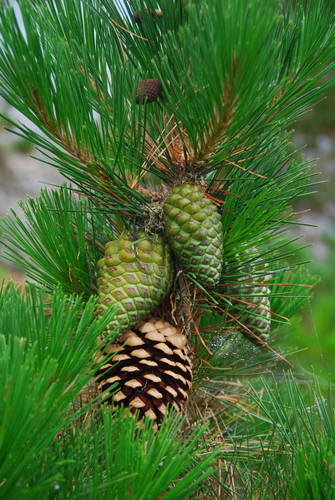
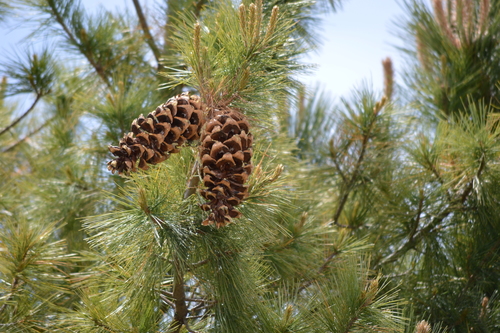
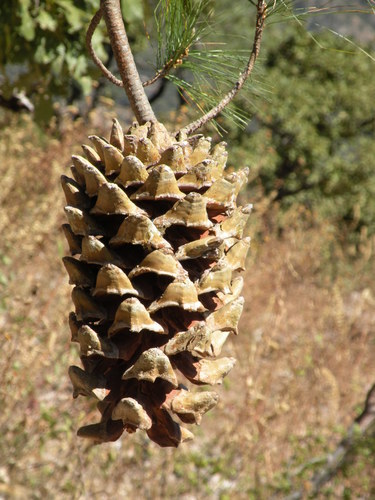
Pinus maximartinezii Rzed. is a small tree that grows 5–15 m (16–49 ft) tall, with a trunk diameter reaching up to 50 cm (20 in). Its bark is brown, thick, and fissured at the base of the trunk. Its leaves, called needles, grow in bundles (fascicles) of five; they are slender, 7–13 cm (2+3⁄4–5 in) long, and colored deep green to blue-green. Stomata are restricted to a bright white band on the inner surfaces of the needles. The cones are ovoid and very large, measuring 15–27 cm (6–10+3⁄4 in) long and 8–14 cm (3+1⁄4–5+1⁄2 in) broad when closed, and can weigh up to 2 kg (4.4 lb). When young, the cones are green, and they ripen to yellow-brown after 26–28 months. The cones have very thick, woody scales, with typically 30 to 60 fertile scales per cone. This scale structure is unusual for pines in the soft pine group (Pinus subgenus Strobus), where most species have flexible scales. When mature, the cones open to 10–15 cm (4–6 in) broad. The seeds are 2–3 cm (3⁄4–1+1⁄4 in) long, with a thick shell and a vestigial 1–2 mm (0.04–0.08 in) wing. Seedlings of this species have 18–24 cotyledons, the highest number recorded for any plant. This species differs from all other pinyon pines by its very massive cones and large seeds. Like other pinyons, its seeds are edible. Harvesting of most of the seeds the species produces to use for food threatens the species' survival, as it limits natural pine regeneration. The species has a highly localized range, restricted to only two small areas in the southern Sierra Madre Occidental: Sierra de Morones in southern Zacatecas, and La Muralla in Durango. It grows at moderate altitudes from 1800 to 2400 m, at 21° North latitude, in warm, temperate, dry climate conditions. The Mexican government has classified this species as endangered. It has only recently entered cultivation, where it is grown as a very attractive ornamental tree.