About Pinus lambertiana Douglas
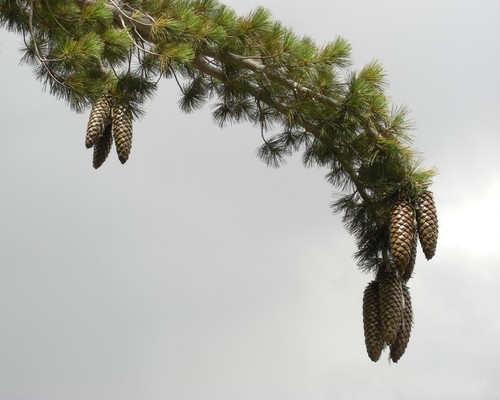
Pinus lambertiana, commonly known as sugar pine, is the tallest and most massive pine tree, and produces some of the longest cones among all conifers. This species is native to coastal and inland mountain regions along the Pacific coast of North America, ranging north to Oregon and south to Baja California, Mexico. Sugar pine grows in Oregon and California in the western United States, extending south into Baja California. It occurs specifically in the Cascade Range, Sierra Nevada, Coast Ranges, and Sierra San Pedro Mártir. It is generally more abundant in the southern part of its range, and grows at elevations between 500 and 1,500 m (1,600 and 4,900 ft) above sea level. According to David Douglas, who was led to the exceptionally thick tree specimen he sought by a Native American, some Native American tribes used this species for food. Tribes ate the tree's sweetish seeds, which were consumed raw or roasted, and also processed into flour or pulverized into a spread. Native Americans also ate the tree's inner bark. The sweet sap or pitch was eaten in small quantities, due to its laxative properties, and could also be chewed as gum. Its sweet flavor is largely derived from the pinitol it contains. During the mid-19th century California Gold Rush, sugar pine trees were heavily harvested for lumber. In modern times, sugar pine is harvested in much lower volumes, and is reserved for high-end products, similar to western white pine. Its odorless wood is preferred for packing fruit and storing drugs and other goods. Its straight grain also makes it a useful material for constructing organ pipes. Sugar pine wood was also long used to make piano keys; in 1907 or 1908, the Connecticut piano-action manufacturer Pratt, Read & Co. purchased 950,000 feet of clear sugar pine for piano key production in and around Placerville, California.