About Pinus koraiensis Siebold & Zucc.
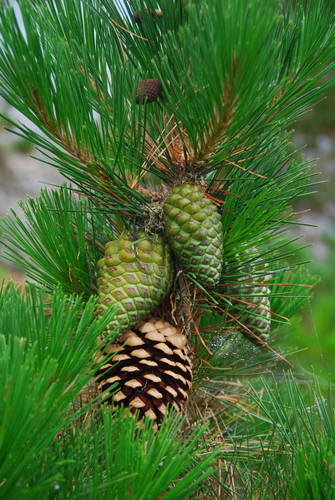
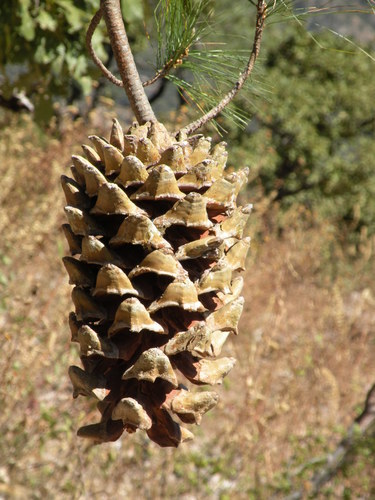
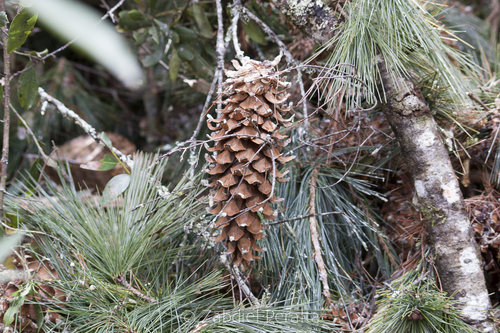
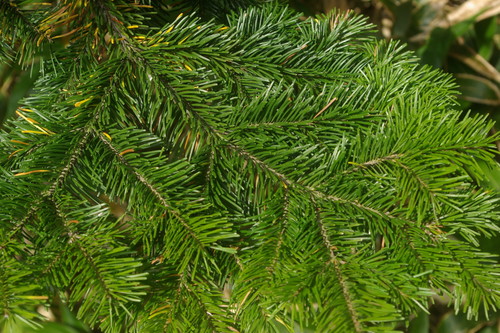
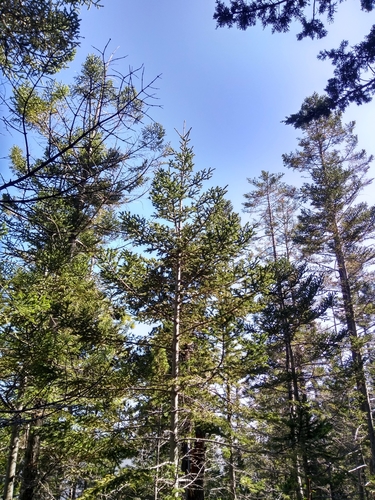
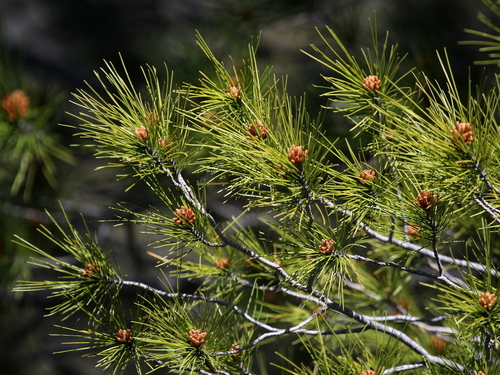
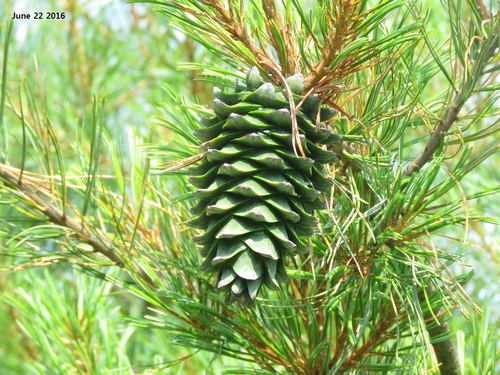
Pinus koraiensis Siebold & Zucc. is a member of the white pine group, belonging to the genus Pinus and section Quinquefoliae. In its native growing conditions and habitat, it reaches 20–35 m (66–115 ft) in height, and rarely grows as tall as 50 m (160 ft). Cultivated individuals are typically smaller, usually growing to around 20 m (66 ft) tall. Young trees have a broad conical shape, which becomes columnar with a conical apex as the tree ages. Young specimens have ascending branches, while older trees develop more horizontal branches. Its grey or brownish bark flakes off to expose reddish inner bark. The sapwood is yellowish white, and the heartwood is light yellowish-brown or light reddish-brown. Branchlets and winter buds are also reddish-brown. Blue-green needles grow in bundles of five along the branches; each needle is 6–13 cm (2.4–5.1 in) long, with dark glossy green outer faces and glaucous white stomatal bands on inner faces. P. koraiensis is monoecious, producing separate male and female cones. Male (pollen) cones are reddish-yellow, and mostly grow clustered in the lower section of new branches to form spikes; pollination occurs in spring. Seed cones measure 9–14 cm (3.5–5.5 in) long (rarely 20 cm/7.9 in long) and 6–8 cm (2.4–3.1 in) in diameter (rarely 10 cm/3.9 in diameter). They grow solitarily or in groups near the top of new branches, are green or purple when immature, and ripen to grey-brown in early autumn. Seeds take approximately 18 months from pollination to reach maturity. Mature seeds do not fall from the cones, and are instead dispersed by birds, primarily the northern nutcracker (Nucifraga caryocatactes), which collects the seeds in autumn for dispersal. The nut shells are reddish brown. P. koraiensis can live up to 700 years. After 100–200 years of growth, it enters its fruitful youth stage, and after 300–400 years, it enters its fruitful adult stage. Wild P. koraiensis grows slowly, taking fifty or even eighty years to produce cones. Cultivated P. koraiensis usually requires more than twenty years to bear cones, but grafted seedlings can produce cones within a few years. P. koraiensis is a precious tree species that holds both economic and ecological value. Ecologically, it provides water and soil conservation; its root system has large water storage capacity, so ecologists refer to it as a "small reservoir". It also functions to maintain biodiversity. Economically, every part of the plant can be used. In China, it has a long history of use in food, beverage, health preservation, and medical treatment. Ancient people called its fruit "longevity fruit". The traditional Chinese medicine "sea-pine nut" refers to the seeds of P. koraiensis, which are used as a nourishing and strengthening agent. Today, the modern P. koraiensis industry has made notable achievements in food, health products, medicine, cosmetics, and fine chemicals. The tree's nuts are edible and sold commercially, and it is the most common species sold as pine nuts in markets across Europe and the United States. Nut oil from the species contains 11.5% pinolenic acid (cis–5–cis–9–cis–12 octadecatrienoic acid), an unusual fatty acid. This acid is reported to have a variety of physiological effects including weight loss, lipid lowering, immune enhancement, anti-inflammation, anti-oxidation, enhanced insulin sensitivity, and anti-tumor metastasis. Pine nut oil extracted from P. koraiensis nuts has high nutritional value, and is also used to make lubricants and soap. The tree is a source of turpentine resin and tannin. Pine needles can be used to extract pine needle oil. Pine pollen is the dried pollen produced by the pollen cones; it is both a traditional Chinese medicine and a traditional Chinese cooking ingredient, and is even used in the names of foods and drinks such as "pine flower cake" and "pine flower wine". The Institute of Nutrition and Food Hygiene of the Chinese Academy of Preventive Medicine has confirmed that pine pollen contains over 200 nutritional components and bioactive substances, with five core health care functions: anti-fatigue, anti-aging, blood lipid regulation, immunity enhancement, and beautification. The Doping Testing Center of the Institute of Sports Medicine of China has stated that no ingredients banned by the Olympic Games were found in pine pollen. P. koraiensis is also used as an ornamental tree. It tolerates multiple soil types, thrives in urban environments, and is adapted to climates with very cold winters. Several cultivars exist, including the blue-tinged 'Glauca' and 'Silveray', and the wide-bodied 'Winton'. It is also a good species for afforestation in northeastern China. Its wood is versatile and very useful for construction. It is lightweight, has straight grain, and is easy to work with. It is used for a wide variety of products, including telephone poles, railroad ties, bridges, boats, plywood, flooring, furniture, sports equipment, and musical instruments. It can easily be broken down into chips, particle board, or pulp for paper production. In the past, its fatwood was the best kindling in forest areas of northeast China; today it is a rare collectible object. Carvings or prayer beads made from this fatwood are collected and used like precious ancient objects.