About Pinus hartwegii Lindl.
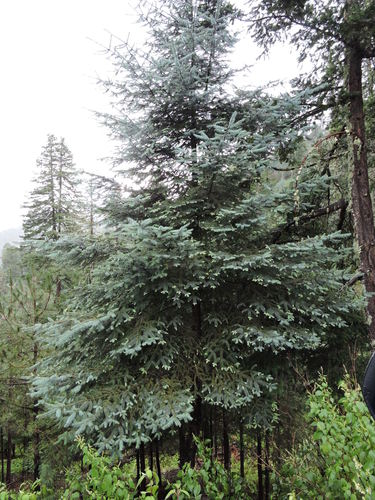
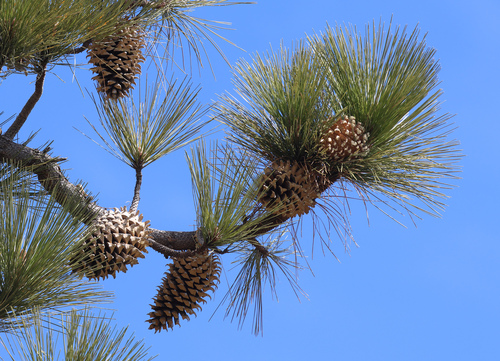
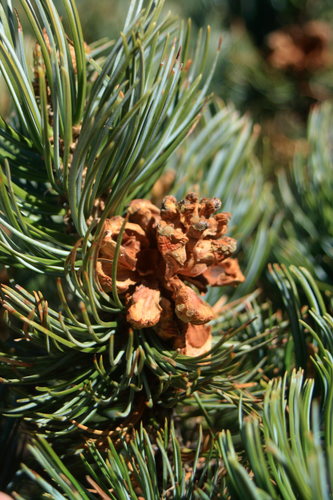
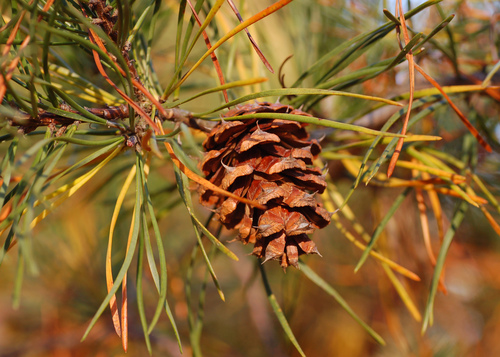
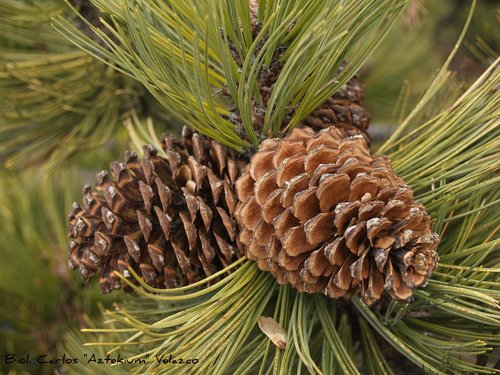
Pinus hartwegii Lindl. is an evergreen tree that reaches 20–30 metres (66–98 ft) in height, with a broad, rounded crown. Its bark is thick, dark grey-brown, and either scaly or fissured. The leaves are needle-like, dark green, with five (occasionally four) needles per fascicle. The needles are 10–20 cm long and 1.2–1.5 mm thick, and the persistent fascicle sheath is 1.5–2 cm long. Its cones are ovoid, 6–13 cm long, and black or very dark purple; when mature in spring, the cones open to 5–7 cm broad. The seeds are winged, 5–6 mm long with a 1.5–2.5 cm wing. Pollination occurs in late spring, and cones mature 20–22 months after pollination. This species is closely related to Pinus montezumae (Montezuma pine), and differs from it in having shorter leaves, as well as black (not brown) smaller cones. It replaces Montezuma pine at high elevations, and often hybridizes with it where the two species meet at middle elevations. Pinus hartwegii is a very high elevation species, growing at elevations between 2,500–4,300 metres (8,200–14,100 ft). It forms the alpine tree line on most of Mexico's higher mountains. It grows in both the Sierra Madre Occidental and Sierra Madre Oriental mountain ranges. Its range extends from Chihuahua State and Nuevo León (between 29° North latitude and 26° North latitude) south to the highest peaks in the mountain ranges on the El Salvador–Honduras border, at 15° North latitude. In the Sierra Madre Occidental, this pine grows in a climate with very dry winters, a very heavy rainy season in summer, and constant frosts from October to March. Unlike many other tree species that grow at high elevation, Pinus hartwegii does not develop a dwarfed and contorted shape. Even at the alpine tree line, this tree is not damaged by cold and wind-blown ice at this elevation. Because of this trait, Pinus hartwegii has been studied as an evolutionarily unique member in research on tree line ecophysiology.