About Pinus flexilis E.James
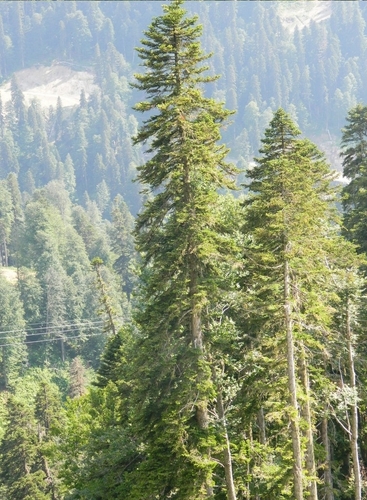
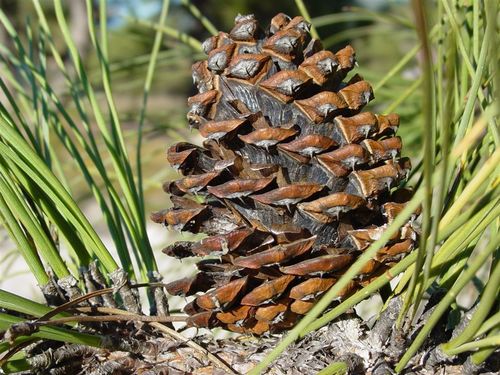
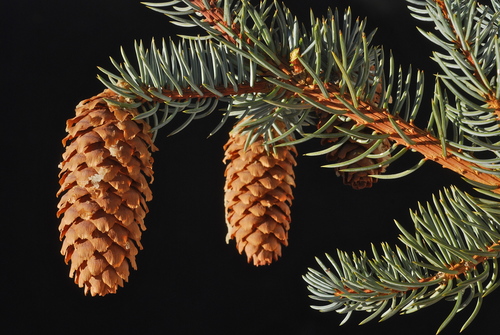
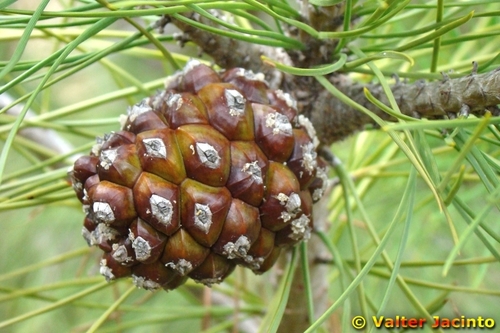
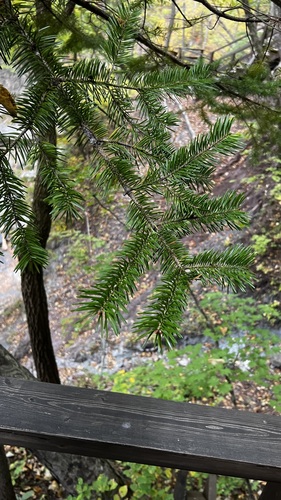
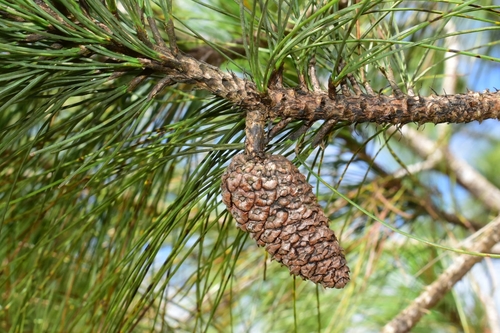
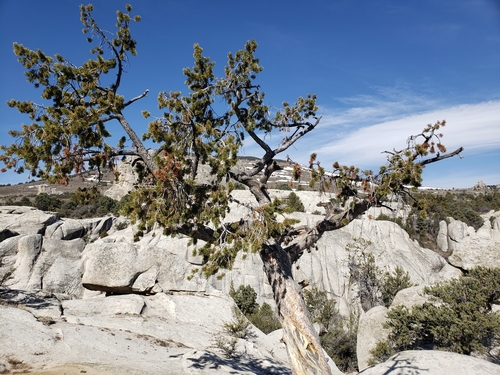
Pinus flexilis E.James, commonly called limber pine, gets both its common name "limber" and scientific specific epithet flexilis from its pliant branches. Its needles grow to around 8 centimeters (3 1⁄4 inches) long and are dark blue-green. The bark is dark grey with prominent heavy creases, and its pale wood is lightweight and soft. Limber pine is typically a high-elevation pine that often marks the tree line, growing either alone or alongside other pines including whitebark pine (Pinus albicaulis), either of the bristlecone pines, or lodgepole pine (Pinus contorta). In favorable growing conditions, it grows into a tree up to 20 meters (65 feet) tall, and rarely reaches 25 meters (80 feet) tall. On exposed tree line sites, mature trees are much smaller, only reaching heights of 5–10 meters (15–35 feet). In steeply sloping, rocky, windswept terrain in the Rocky Mountains of southern Alberta, limber pine is even more stunted. It grows here in old stands where mature trees consistently stand less than 3 meters (10 feet) tall. One of the world's oldest living limber pines grows on the banks of the upper North Saskatchewan River at Whirlpool Point in Alberta. Recent measurements recorded a maximum girth of 185 inches. In 1986, two researchers retrieved a 10 cm core sample and counted 400 rings; extrapolating this data gives an estimated age close to 3,000 years. The largest portion of limber pine's range is in the Rocky Mountains, stretching from southwest Alberta and southeastern British Columbia south through Colorado and New Mexico into the northern states of Mexico. It also grows throughout the Great Basin states of Nevada and Utah, in the eastern Sierra Nevada and White Mountains of Northern California, and in the San Bernardino and San Gabriel Mountains of the Transverse Ranges in Southern California. Continuing south, the species is found in the San Jacinto Mountains, Santa Rosa Mountains, and Hot Springs Mountain of the Peninsular Ranges. Small disjunct populations exist in eastern Oregon, western North Dakota, western Nebraska, and the Black Hills of South Dakota. It grows across a wide range of altitudes based on latitude, from 850 to 3,810 m (2,790 to 12,500 ft). In the northern half of its range, it grows in the montane zone near the lower tree line; between the 45th and 40th parallels in the middle of its range, it grows on windswept sites in the montane and subalpine zones; and in the southern part of its range, it grows mainly at high elevations in the subalpine zone near the upper tree line. It occurs more often on the outer fringes of forests than within closed forest stands. Pinus flexilis is an important food source for several species, including red squirrels and Clark's nutcrackers. Clark's nutcrackers are also important seed distributors for the species, and evidence indicates limber pines co-evolved with this bird, which is the species' primary seed disperser. In one relic low elevation population, seeds are also dispersed by small rodents. American black bears and grizzly bears may raid red squirrel caches to eat limber pine nuts. Squirrels, Northern flickers, and mountain bluebirds often nest in limber pine trees. There is some evidence that P. flexilis forms a symbiotic relationship with nitrogen-fixing bacteria that live in its needles. The species is generally shade tolerant and fire resistant, but it does not thrive in dense habitats, and instead grows in areas that are relatively hostile to other plant species. The popular cultivar P. flexilis 'Vanderwolf's Pyramid' is widely available as an ornamental garden tree. Despite usually being listed under P. flexilis in nursery catalogs, 'Vanderwolf's Pyramid' actually derives from P. reflexa. Southwestern white pine is popular as a windbreak or ornamental tree due to its drought tolerance. It is also grown as a Christmas tree, favored for its soft needles and stiffer branches compared to Eastern white pine. The large seeds of Pinus flexilis are edible, and Native Americans in Montana reportedly consumed them.