About Pinus cembroides Zucc.
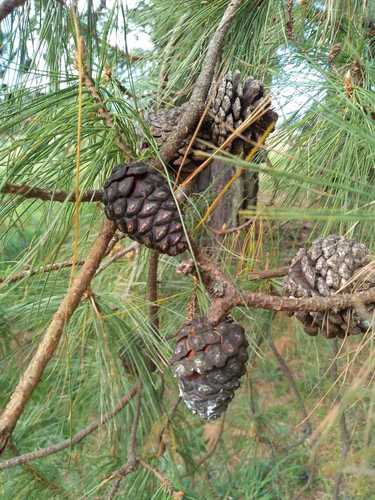
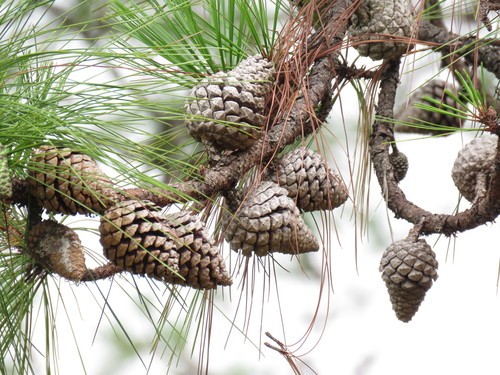
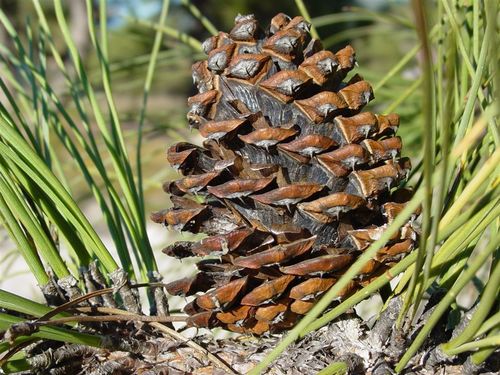
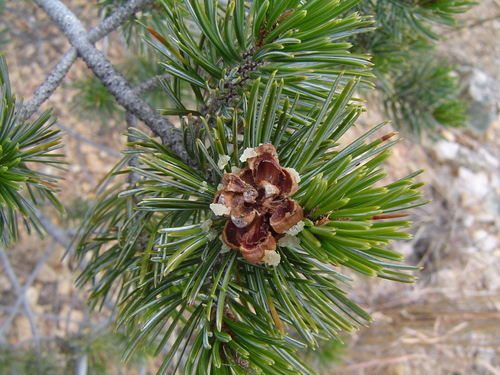
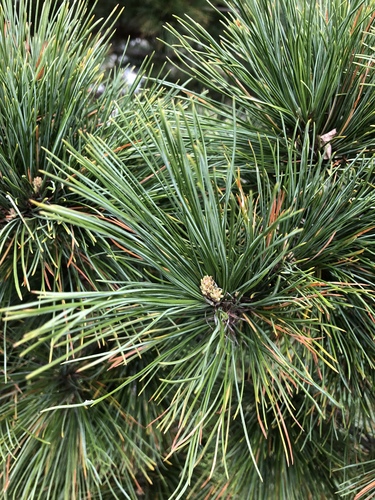
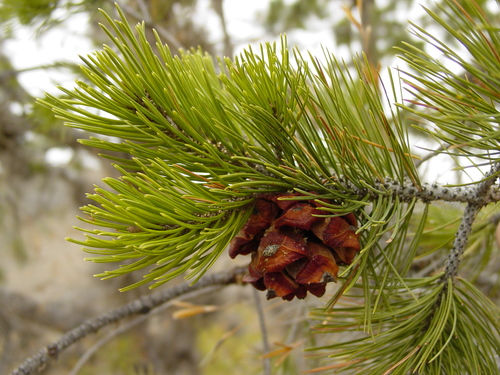
Pinus cembroides Zucc. is a small to medium-sized tree that grows 8 to 20 metres (26 to 66 ft) tall, with a trunk diameter reaching up to 50 centimetres (20 in). Its bark is dark brown, thick, and deeply fissured at the base of the trunk. Its leaves, called needles, grow in a mix of pairs and threes; they are slender, 3 cm (1+1⁄4 in) to 6 cm (2+1⁄4 in) long, dull yellowish green, and have stomata on both their inner and outer surfaces. The species produces globose cones that are 3 cm (1+1⁄4 in) to 4 cm (1+1⁄2 in) long and broad when closed. Cones start out green, ripen to yellow-brown after 18 to 20 months, and have only a small number of thick scales, with typically 5 to 12 fertile scales. When mature, the cones open up to 4 cm (1+1⁄2 in) to 5 cm (2 in) broad, and retain seeds on their scales after opening. The seeds are 10 mm (3⁄8 in) to 12 mm (1⁄2 in) long, with a thick shell, pink endosperm, and a vestigial 2 mm (1⁄16 in) wing. Its native range extends from the far western part of Texas, United States, where it is limited to the Chisos and Davis Mountains, south through most of Mexico. It occurs widely along the Sierra Madre Oriental and Sierra Madre Occidental mountain ranges, and grows more rarely in the eastern Eje Volcánico Transversal range. A disjunct population exists in the Sierra de la Laguna of southern Baja California Sur; some authorities classify this population as a separate species, P. lagunae. The subspecies Pinus cembroides subsp. orizabensis (formerly treated as Pinus orizabensis) is found farther south in the state of Veracruz. This pine grows at moderate altitudes, mostly from 1,600 to 2,400 m (5,200 to 7,900 ft), and inhabits areas with low annual rainfall, ranging from 380 to 640 mm (15 to 25 in) per year. In its ecology, Mexican jays disperse Pinus cembroides seeds by plucking them from open cones. The jays use these seeds as a major food source, store many seeds for later consumption, and some unused stored seeds go on to germinate and grow into new trees. Abert's squirrels also feed on Pinus cembroides seeds, preferring them over the seeds of ponderosa pine. For human use, the seeds of this species are widely collected in Mexico, and are the main edible pine nut in the region. They are palatable when eaten raw, but their flavor is widely considered to improve when roasted.