About Pinus ayacahuite Ehrenb. ex Schltdl.
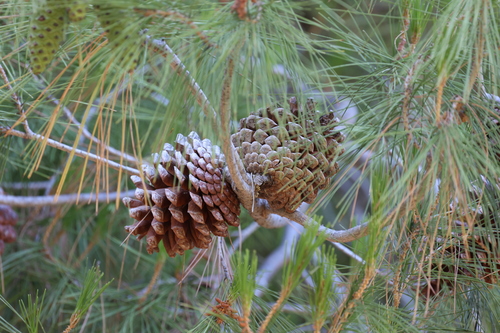
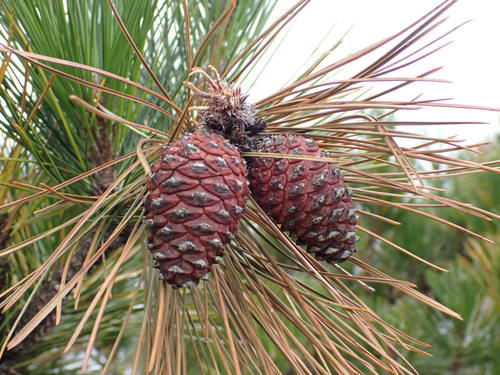
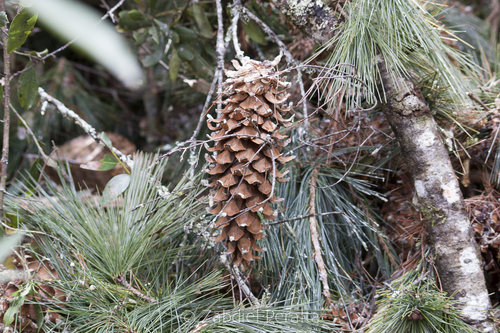
Pinus ayacahuite, commonly known as ayacahuite pine and Mexican white pine, is a pine species in the Pinaceae family. It is native to mountainous regions of southern Mexico and western Central America, where it occurs in the Sierra Madre del Sur mountains and the eastern end of the Eje Volcánico Transversal. Its native range falls between 14° and 21°N latitude, covering the Mexican states of Guerrero, Oaxaca, Puebla, Veracruz and Chiapas, as well as the countries of Guatemala, El Salvador and Honduras. It grows in relatively moist areas that receive summer rainfall, while populations in the eastern and southern parts of its native range grow under very wet conditions. It requires full sun and well-drained soils, with an average annual temperature between 10 °C and 19 °C, and tolerates climates ranging from subtropical to cool. Pinus ayacahuite is a large tree, normally reaching 30–45 m in height, and exceptionally growing up to 50 m tall. It belongs to the white pine group, Pinus subgenus Strobus. Like all members of this group, its leaves (called needles) grow in fascicles (bundles) of five, with a deciduous sheath. The needles are finely serrated, and measure 9–16 cm long. Its cones are long and slender: 15–40 cm long and 4–6 cm broad when closed, opening to 6–10 cm broad, with thin, flexible scales. The seeds are small, 6–8 mm long, and have a long slender wing that is 18–25 mm long. This species is moderately susceptible to white pine blister rust (Cronartium ribicola), but cultivated specimens have proven somewhat less susceptible than most other American white pines, such as western white pine and sugar pine. Pinus ayacahuite has been planted for ornamental purposes and commercial use in the paper industry across different latitudes and altitudes around the world. In equatorial and tropical regions, commercial production takes place at high elevations in Kenya, Tanzania and Angola. In temperate subtropical regions, commercial plantations are located in the highlands of South Africa, the highest elevations of Southern Brazil, and northern India. In temperate regions at middle and low altitudes, it is grown in the Argentine provinces of Salta, Tucumán and Córdoba, at elevations between 500 and 1500 m above sea level. At low elevations near sea level, commercial production occurs in Queensland and New South Wales in Australia, and in New Zealand. As an ornamental tree, it has been successfully planted in the British Isles. In 2013, the largest recorded specimen in Germany measured 20.5 m tall, and grows in the arboretum Sequoiafarm Kaldenkirchen. Although its entire native range lies south of the Tropic of Cancer, giving it tropical origins, it is surprisingly cold-tolerant. It has survived temperatures down to nearly -30 °C when grown in cultivation in Scotland and Pennsylvania, United States. It is grown as an ornamental tree in parks for its attractive foliage and very long cones, which are among the longest cones that can be grown in many temperate areas. Its valuable wood is used for general indoor construction work.