About Pinus attenuata Lemmon
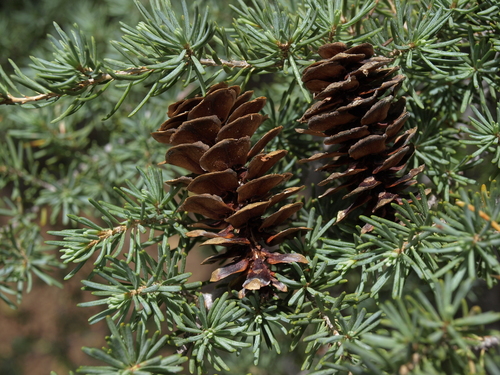
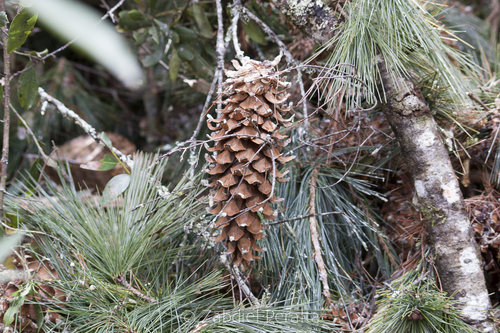
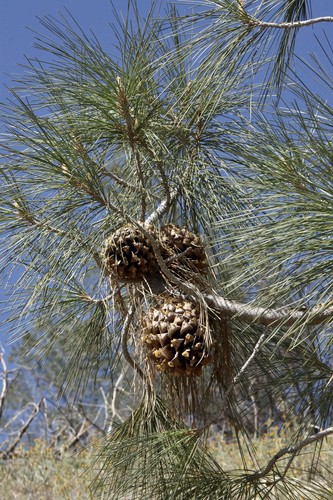
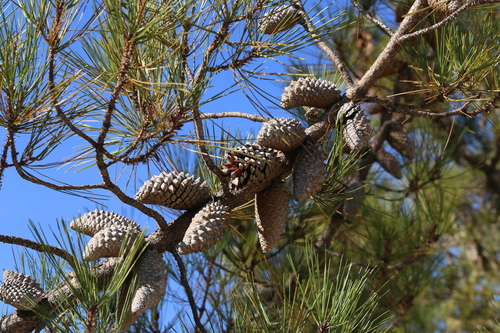
Individual Pinus attenuata (knobcone pine) specimens can live up to 100 years. It typically has a conical crown and a straight trunk, reaching heights of 8 to 24 meters (26 to 79 feet). On especially poor quality sites, it may instead grow as a shrub. When young, its bark is thin, smooth, flaky, and gray-brown; with age, the bark becomes dark gray-red-brown and develops shallow furrows that divide it into flat scaly ridges. Its twigs are red-brown and often covered in resin. The wood of this species is knotty and has little value as lumber. Its leaves are needle-shaped, arranged in fascicles of three, yellow-green in color, twisted, and grow 9 to 15 centimeters (3+1⁄2 to 6 inches) long. The cones are sealed shut with resin, have an irregular shape, and measure 8 to 16 centimeters (3+1⁄4 to 6+1⁄4 inches) long. They grow in clusters of three to six whorled on branches, and their scales end in a short stout prickle. Cones may occasionally be found attached to the trunk and larger branches. Knobcone pine grows in dry, rocky soils in southern Oregon and northern California, at elevations between 300 and 750 meters (980 and 2,460 feet) above sea level. It forms nearly pure stands, and prefers to grow in areas where it has no competition from other species. In coastal habitats, knobcone pine may hybridize with bishop pine (Pinus muricata) and Monterey pine (Pinus radiata). In the western foothills of the Sierra Nevada, it is often a co-dominant species alongside blue oak (Quercus douglasii). This species is susceptible to wildfire, but heat from fire melts the resin sealing its cones, releasing seeds to allow new regrowth. Knobcone pine is shade intolerant.