About Pinus aristata Engelm.
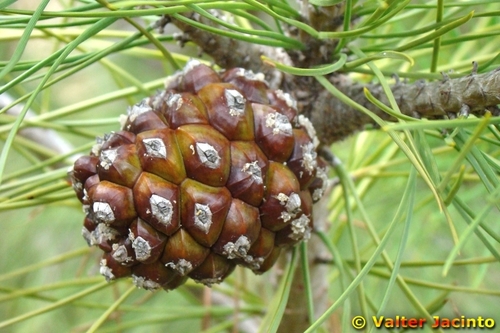
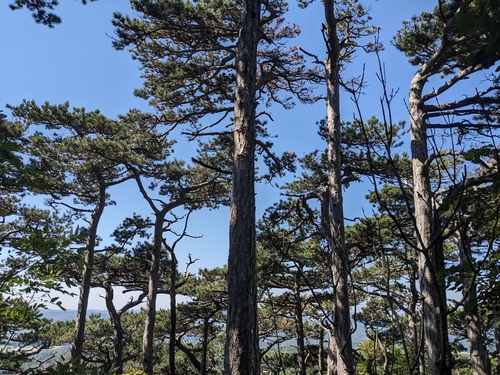
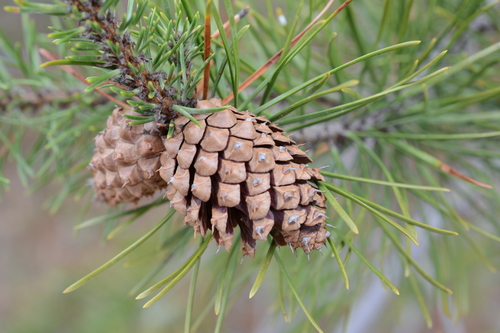
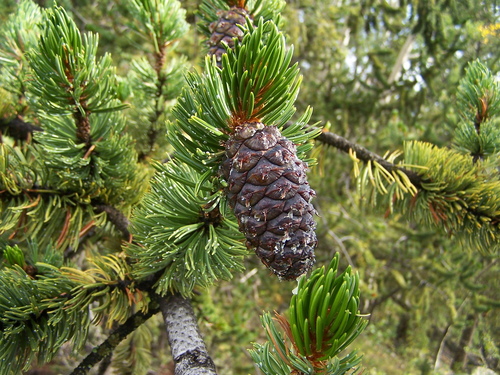
Pinus aristata Engelm., also called Colorado bristlecone or Rocky Mountain bristlecone pine, is a medium-size tree that commonly reaches 15 meters (49 ft) in height, and occasionally grows as tall as 20 m (66 ft) in its natural habitat. In favorable growing conditions, individuals grow straight and upright, but they become increasingly stunted, short, and twisted when growing closer to the timberline. When fully mature, the tree’s crown is flattened, irregular, or round in shape. The trunk can be very large, commonly 75 cm (2 ft) in diameter and reaching up to 1 m (3.3 ft) across, and tapers very noticeably toward the top. Young trees have fairly smooth, white-gray bark, while bark on old trees becomes dark, cracked, and scaly in texture, with color ranging from red-brown to gray. Non-stunted young trees have evenly spaced whorls of branches. Older trees have crooked, twisting branches that may be partially dead. Twigs start out red-brown, and turn gray as they age. Twigs and very young branches are covered in needles that persist for 10 to 17 years, giving them a shaggy, bottle brush appearance. The needle-like leaves grow in bundles of five, measuring 2–4 centimeters long, and are usually longer than 3 cm. The fascicle, the needle-holding base, breaks down more quickly in Pinus aristata than in Pinus longaeva, giving the tree’s branches a more even overall appearance. The resin canals in the needles are closer to the surface and less sturdy, which causes the noticeable white resin flecks that appear on the needles. Botanist Dana K. Bailey described resin-covered needles as looking "dandruffy"; the small dried resin droplets are easily mistaken for scale insects. Between the white specks, the needles are dark green. The buds are egg-shaped with a long tapering (acuminate) point, and measure around 1 cm in size. New shoots are light orange, and may be either hairy or hairless.
Colorado bristlecone grows in three western U.S. states: Colorado, New Mexico, and Arizona. Its northern range limit lies at approximately 40 degrees north latitude. It is widely distributed across the Southern Rocky Mountains, but is restricted to small scattered areas within this overall range. Its elevation range is widest in Colorado, where it grows from 2,100 to 4,000 meters (6,900 to 13,100 ft). The Arizona population is only found between 2900 m and 3700 m in elevation. In New Mexico, trees begin growing at a similarly high starting elevation of 3000 m, and share the same maximum elevation as the Arizona population.
Rocky Mountain bristlecone grows in krummholz habitat at the edge of alpine tundra, where it develops the characteristic dwarfed and gnarled growth of this "crooked woods" environment. Its habitat extends downward into subalpine forests, and even lower into the driest parts of middle elevations. At elevations where silver spruces (Picea engelmannii) and subalpine firs (Abies lasiocarpa) are reduced to stunted, ground-hugging shrubs, bristlecones and limber pines (Pinus flexilis) grow into full-sized trees. A greater tolerance for dry conditions allows them to grow more successfully in these challenging mountain habitats. In Arizona, this bristlecone pine species is only found on the San Francisco Peaks, four volcanic cinder cones in north-central Arizona. The alpine trees and flora of this area resemble those of the Southern Rocky Mountains more than they resemble the flora of Nevada or California, and the area hosts Colorado bristlecone pines rather than Great Basin bristlecones. On the San Francisco Peaks, the pines grow on south-facing slopes alongside limber pines. This isolated mountain habitat island sits 400 kilometers (250 mi) from the nearest alpine habitat in southern Colorado.
In the Southern Rocky Mountains, like limber pine, it may grow in extensive single-species stands on some sites, or grow mixed with other tree species. In the southern parts of the Sangre de Cristo Range, it replaces limber pines at higher elevations on very dry sites. It becomes more common in more northerly portions of its range, especially in habitats above 3,000 meters (10,000 ft). A large 120-hectare (300-acre) bristlecone pine stand grows in Valle Vidal within the Carson National Forest. In both New Mexico and Colorado, the species mostly grows on steep, dry south-facing slopes. In Colorado, more than 50 areas in the state’s southern and central mountain ranges hold notable bristlecone pine populations. On the Spanish Peaks in southern Colorado, bristlecone pines grow alongside ponderosa pines and Rocky Mountain white oaks at relatively low elevations, an unusual habitat for the species. They also grow in nearly pure stands higher up in the Spanish Peaks’ subalpine zone. A 49-hectare (120-acre) forest growing on the southeastern flank of Mount Bross in the Pike National Forest is designated the Windy Ridge Bristlecone Pine Scenic Area. Further north, it grows on the mountains of the Front Range south of James Peak. In the southern part of its range around Pikes Peak, it occurs on south-facing slopes, while limber pines grow on north-facing areas. In areas around Mount Blue Sky, bristlecone pines more often mix with limber pines, though bristlecones tend to be more common on fine-textured soils, while rocky ridges host more limber pines. The rocks and derived soils along the Front Range are Precambrian granite. The small 4.9-hectare (12-acre) grove in the Mount Goliath Natural Area is notable both for the age of one of its trees and for its easy public access from the Mount Blue Sky Scenic Byway. The typical high-altitude grove habitat is quite cool, even in summer. Measurements taken in the Front Range in the 1970s recorded mean annual temperatures between 8.3 to 3.3 °C (46.9 to 37.9 °F). Winds are also quite severe, with common speeds of 24–40 kilometers (15–25 mi) per hour.
Seeds of the Rocky Mountain bristlecone are eaten by Clark's nutcracker (Nucifraga columbiana), which may also store the seeds in years with particularly large seed crops. Unlike the seeds of Colorado pinyon (Pinus edulis), Pinus aristata seeds have the same speckled camouflage patterns matching soil that are seen in other species, and are not adapted to be primarily dispersed by animals. Rocky Mountain bristlecone is quite vulnerable to fire. Thirty years after forest fires, stands show very little regeneration, and have lower abundance than other tree species that are better able to colonize newly open areas. In the past, the species was used for fuel, electric utility poles, signposts, and as support timbers in mines.
Rocky Mountain bristlecone is the most common bristlecone pine in cultivation. It is an attractive slow-growing small tree suitable for small gardens in cold climates. It was brought into cultivation by Parry at the Arnold Arboretum soon after he collected material for its scientific description in 1861. It has been cultivated in the United Kingdom since at least 1863, but is rarely planted there. In garden settings, it ranges from 2–6 meters (8–20 ft) high and 3–4.5 m (10–15 ft) wide. Due to its slow growth, it is rare to see a landscaping specimen taller than 10 m. It requires well-drained soil, and grows particularly well in rocky, low-organic-matter soils. It also tolerates alkaline soils. It tolerates windy conditions, though it will show visible wind damage. It has extreme cold resistance, and is hardy in USDA zones 3–7. Supplemental water can encourage faster growth, but overwatering that causes deformed growth or death is a frequent problem in landscaping. The Colorado bristlecone is quite flammable, and is also susceptible to air pollution. Young trees are symmetrical and bushy, while older trees develop a more open structure and irregular shape.