About Pinguicula ionantha R.K.Godfrey
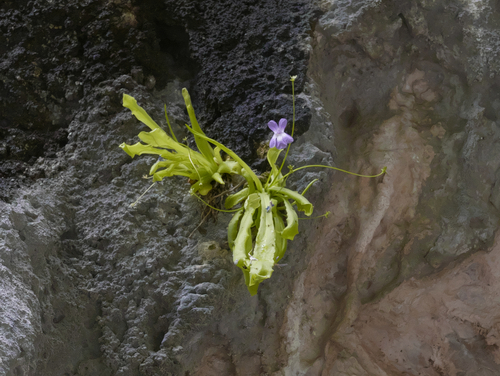
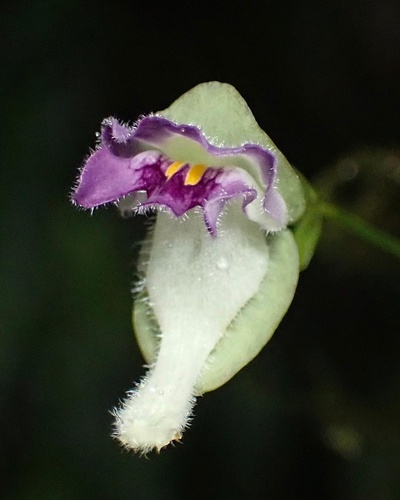
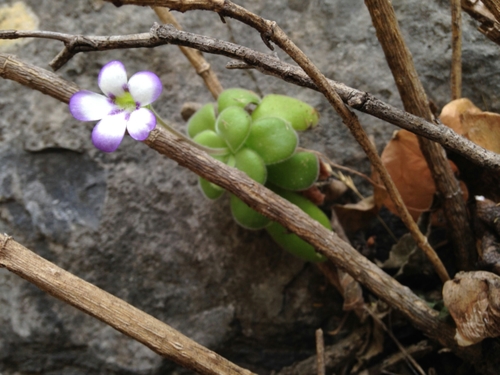
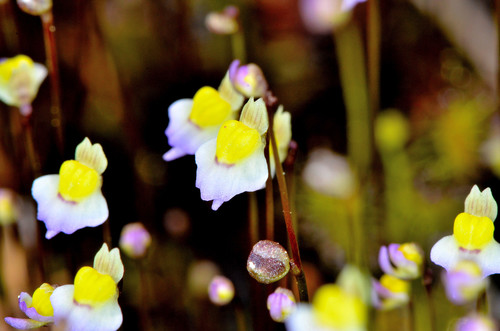
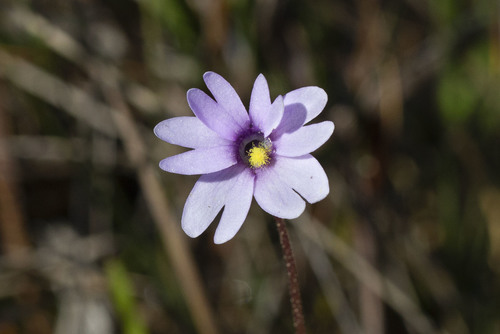
Pinguicula ionantha R.K.Godfrey is a perennial carnivorous herb that forms a rosette of bright green, fleshy leaves with rolled edges. Each leaf can grow up to 8 centimeters long, and the upper surface of each leaf is coated in sticky glandular hairs. Like all species in the genus Pinguicula, this plant uses these hairs to trap insects, which it then digests for nutrients. Flowers are borne on an erect scape that can reach up to 15 centimeters tall, and scapes develop between February and April. The flower is pale violet with a darker violet throat that may feature darker purple veining. The corolla can be up to 2 centimeters wide, with a greenish spur around half a centimeter long at its back end. At the center of the flower is a conical palate covered in yellow or red hairs, and the corolla lobes bear white hairs. This plant is only known from six counties located between Tallahassee and Panama City, Florida. There are 83 recorded historical occurrences of the species, and recent surveys located living plants at 43% of these historical sites. While drought may have reduced recent counted plant numbers, the species is believed to be in overall decline. This butterwort grows in bogs within pine savanna habitat. Lower-elevation bog habitat in the region is dominated by pond cypress, and adjacent higher-elevation pine flatwoods habitat is dominated by longleaf pine. The plant can be found in deep bogs, shallower seeps, wet depressions, and puddles, and it can survive underwater for several days at a time following rainfall. When wildfire occurs in the area, this rare plant and other native species grow more abundant. Fire suppression remains a major threat to the species' habitat. Other threats include habitat destruction and modification. Silviculture is common in this section of the Florida Panhandle, where natural habitat is cleared of brush and planted with trees for timber. Some of these tree plantations supply the paper pulp industry. Land is also cleared for urban development. Some populations grow near roads, and road maintenance activities impact these plants, sometimes leading to local extirpation. One population was affected by Hurricane Frances in 2004, when storm surge introduced saltwater into its habitat. In the past, this species was overcollected by plant enthusiasts. Today, the plant is propagated in cultivation, and the International Carnivorous Plant Society holds a permit to sell its seeds.