About Pimelea sericea R.Br.
Species and Growth Form
Pimelea sericea R.Br. is a shrub that typically reaches a height of 20 to 80 cm, with dense hairs covering its young stems.
Leaf Arrangement and Shape
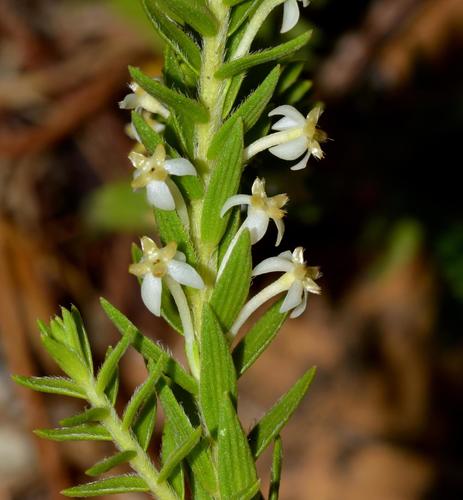
Its leaves are arranged in opposite pairs, are elliptic in shape, measure 3 to 9 mm long and 2 to 6 mm wide, and grow on a short petiole.
Leaf Surface Characteristics
The upper leaf surface is dark green, hairless, and sometimes glaucous, while the lower leaf surface is densely covered with white or silky silvery hairs.
Flower Sex and Cluster Traits
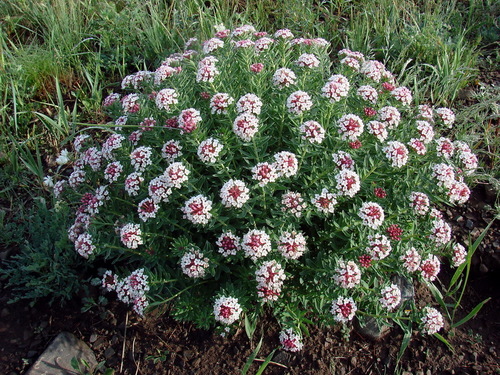
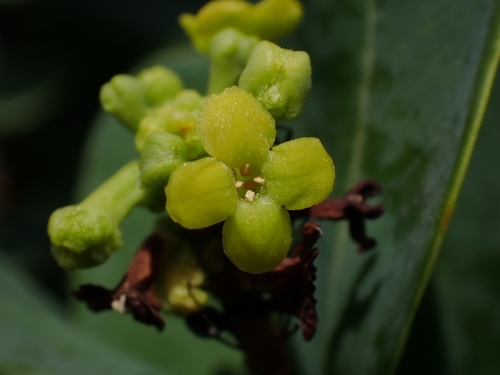
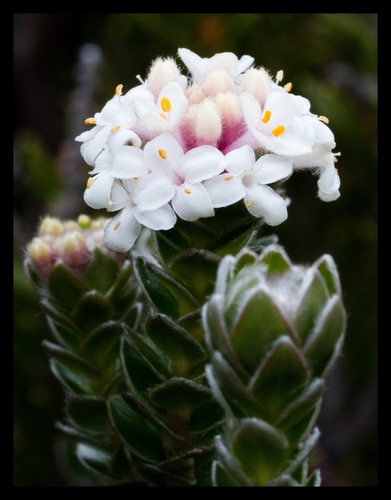
Most of the flowers of this species are bisexual, growing in compact clusters of many flowers at the ends of branches; the flowers can be white, pink, or pinkish-white, and are densely hairy on the outside.
Floral Morphology
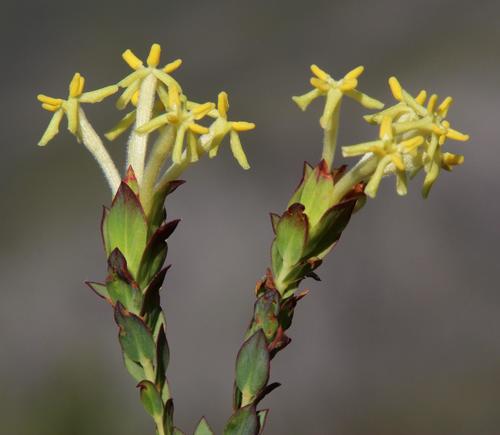
The floral tube of this species is 5.5 to 7.5 mm long, the sepals are 2 to 3 mm long, the stamens are shorter than the sepals, and the style protrudes out from the floral tube.
Flowering Period
Flowering of Pimelea sericea mainly occurs between November and February.
Similar Species Distinction
Pimelea leiophylla is morphologically similar to P. sericea, but differs in having sparse hairs on the upper leaf surface, more flowers per cluster, a distribution restricted to altitudes below around 450 m, and occurrence on the Freycinet Peninsula and Schouten Island.
Habitat and Distribution
This pimelea grows in alpine and subalpine moorland at altitudes between 750 and 1,400 m, on mountains in Tasmania, including Cradle Mountain, Mount Barrow and Mount Wellington.