About Pimelea physodes Hook.
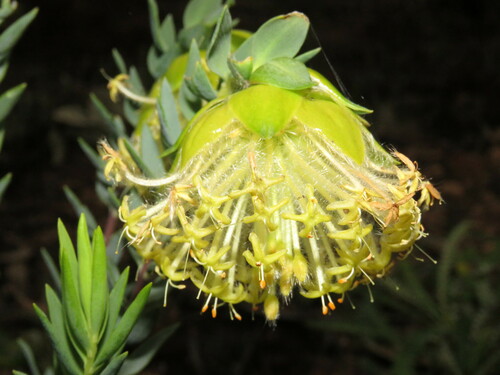
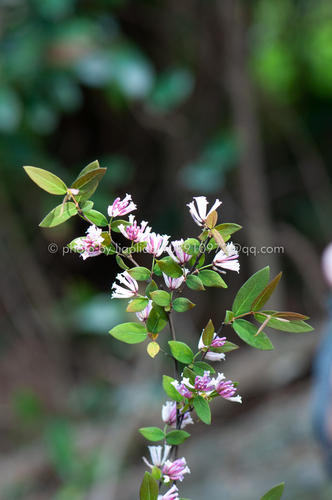
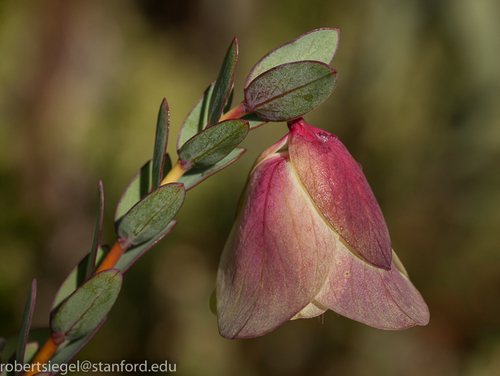
Pimelea physodes Hook., commonly called Qualup bell, is a shrub that usually grows 0.2 to 1 meter (7.9 inches to 3 feet 3.4 inches) tall, and produces a single stem at ground level. Its leaves are arranged in opposite pairs, and are more or less sessile. The leaves range from egg-shaped to narrow elliptical, are 12 to 32 millimeters (0.47 to 1.26 inches) long and 5 to 11 millimeters (0.20 to 0.43 inches) wide, and are the same shade of green on both surfaces. The flowers of this species are arranged in a bell-like inflorescence, a shape similar to that seen in some distantly related Darwinia species, especially Darwinia macrostegia, also known as Mondurup bell. The inflorescence’s peduncle is 3 to 14 millimeters (0.12 to 0.55 inches) long. Individual flowers are green or creamy green, with a floral cup 6 to 9 millimeters (0.24 to 0.35 inches) long, and very narrow triangular sepals that are roughly the same length as the floral cup. Most flowers are bisexual, while a small number are female. The stamens are 11 to 16 millimeters (0.43 to 0.63 inches) long. Like other pimeleas, this species has no petals; its style is reddish and extends out past the flower. Each flower cluster is surrounded by three or four pairs of green and cream-colored involucral bracts, which usually also have varying amounts of red or purple. These bracts are elliptical, 22 to 60 millimeters (0.87 to 2.36 inches) long and 11 to 45 millimeters (0.43 to 1.77 inches) wide, and are glabrous. Flowering takes place from July to October. Qualup bell grows on sandplains and hillsides in near-coastal areas between Pallarup Nature Reserve, Fitzgerald River National Park, Jerramungup, and Mount Desmond near Ravensthorpe. Gregory John Keighery has recorded the tawny-crowned honeyeater (Gliciphila melanops) as a probable pollinator of this species.