About Pimelea microcephala R.Br.
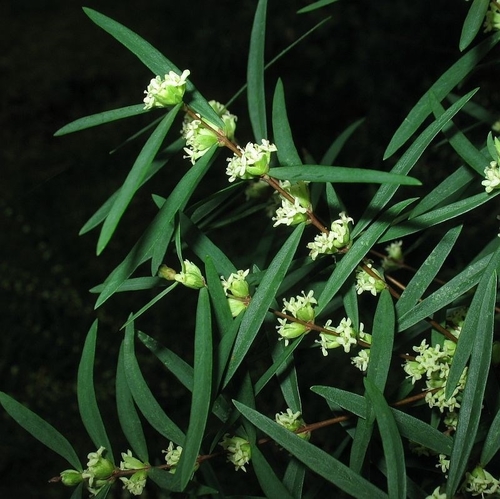
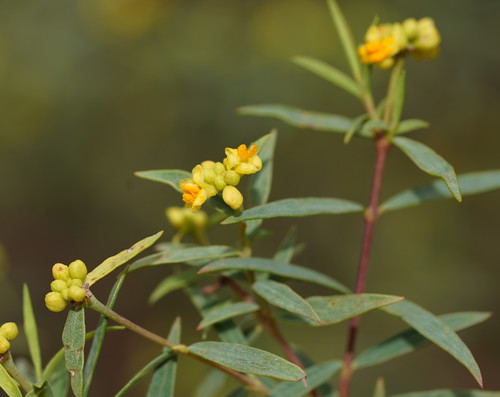
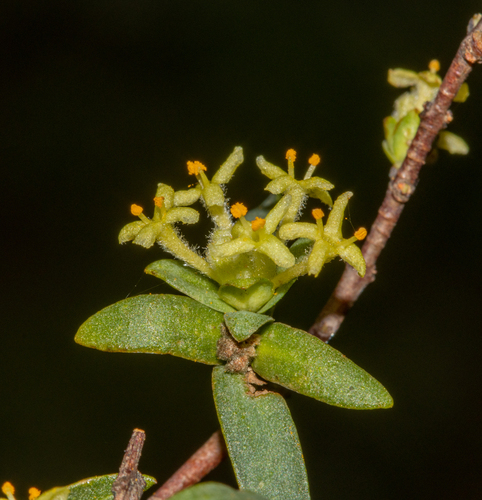
Pimelea microcephala R.Br. is an erect, dioecious shrub that typically grows 0.7 to 4 meters (2 feet 4 inches to 13 feet 1 inch) tall, with glabrous stems. Its leaves are arranged in opposite pairs, and range in shape from linear to more or less narrowly elliptic. Most leaves are 7 to 40 millimeters (0.28 to 1.57 inches) long, 1 to 4 millimeters (0.039 to 0.157 inches) wide, and borne on a short petiole. The flowers of this species are white to yellow or greenish, and arranged in compact heads at the ends of branches on a peduncle 2 to 13 millimeters (0.079 to 0.512 inches) long. The flowers are glabrous on the inside, usually densely curly-hairy on the outside, and grow on a hairy pedicel. Male flowers grow in heads holding 8 to 100 individual flowers, with a floral tube 3 to 7 millimeters (0.12 to 0.28 inches) long. Female flowers grow in heads holding 7 to 12 individual flowers, and each is 2 to 4 millimeters (0.079 to 0.157 inches) long. The sepals are 0.2 to 2 millimeters (0.0079 to 0.0787 inches) long, and the stamens of male flowers are shorter than the sepals. Flowering occurs mainly from April to September, and the fruit is a succulent red nut. Commonly called mallee rice-flower, this species grows in shrubland, woodland and mallee habitats. It is widespread across all mainland Australian states and the Northern Territory. It has been recorded in north-western Victoria, inland New South Wales, southern Northern Territory, and the Avon Wheatbelt, Carnarvon, Coolgardie, Gascoyne, Geraldton Sandplains, Great Victoria Desert, Mallee, Murchison, Nullarbor, Pilbara and Yalgoo bioregions of Western Australia. The subspecies Pimelea microcephala subsp. glabra is restricted to the north-west of South Australia.