About Pilosella officinarum Vaill.
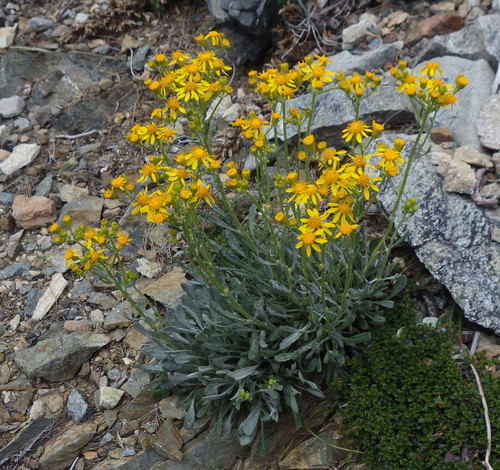
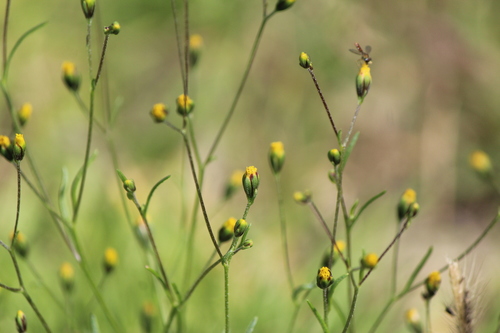
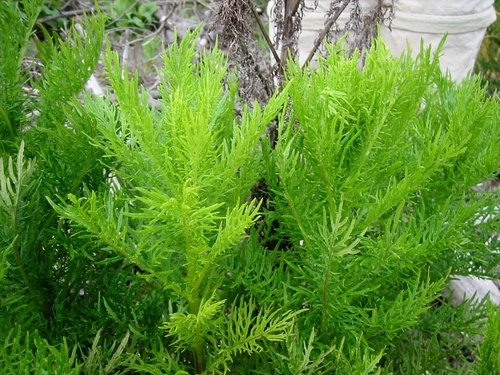
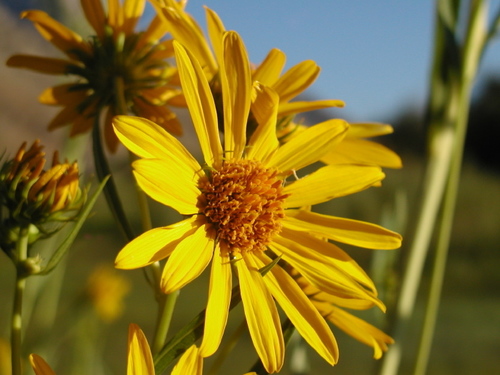
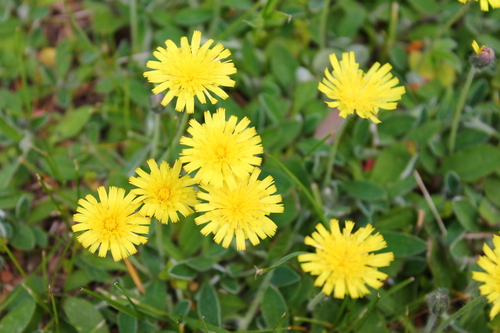
Pilosella officinarum Vaill. is a hairy perennial plant that grows a basal rosette of leaves. Except for its flower parts, the entire plant is covered in glandular hairs, which are usually whitish; hairs on the stem are sometimes reddish. The leaves of the basal rosette have smooth untoothed edges, and range from acute to blunt at the tip. These leaves measure 1–12 centimetres (0.39–4.72 in) long and 0.5–2 centimetres (0.20–0.79 in) wide, and their underside is densely covered in fine hair. The flowering stem, called a scape, grows 5–50 centimetres (2.0–19.7 in) tall and emerges from the centre of the basal rosette. Each scape bears a single flowerhead that is pale lemon-yellow in colour, and the outermost strap-shaped florets have a reddish underside. It flowers from May to August, and its flowers are visited by many groups of insects, especially flies. This plant prefers dry, sunny locations, and grows well in sandy or other low-fertility soil types. It produces stolons that grow new rosettes at their tips; each new rosette can develop into a new clone of the original plant, forming dense mats in open areas. It can also reproduce by spreading seeds. Pilosella officinarum is a known allelopathic plant; its roots secrete several substances that inhibit root growth, even the root growth of itself. Where possible, it can be controlled through crop rotation with clover and grasses. Recent research suggests this species exhibits atavism through the re-emergence of sexual reproduction. This plant has been recorded as an invasive species in Sphagnum peatlands disturbed by peat extraction in southern Patagonia. Common name mouse-ear hawkweed, this species has become a widespread introduced invasive species in North America, where it occurs in southern Canada, and the northeastern and northwestern United States. It is classified as a level C noxious weed in the United States, with higher restricted levels in the states of Washington and Oregon, and is listed as a weed in Quebec. It does not hold any special weed designations in other regions of Canada. It is known to be highly invasive in New Zealand's tussock fields, which have no native hawkweed species, and biological control measures are currently in use to control this species and other similar hawkweeds there. In the Australian states of Victoria and New South Wales, all Hawkweed species are declared State Prohibited Weeds and are controlled under the Biosecurity Act 2015. Multiple eradication programs, often run with volunteer support, currently operate to locate, prevent the spread of, and eradicate any Pilosella (also grouped as Hieracium) species. Joseph Pitton de Tournefort recorded a historical belief that blades coated in this plant's juice could cut through stone just as easily as they cut through wood.