About Pilosella caespitosa (Dumort.) P.D.Sell & C.West
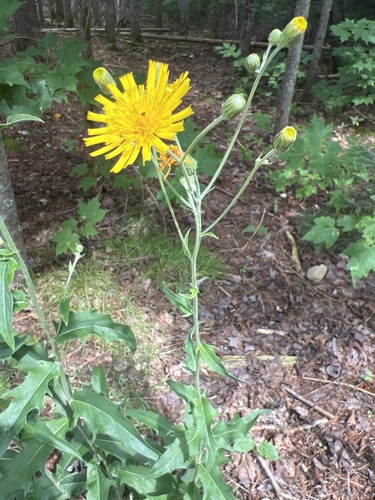
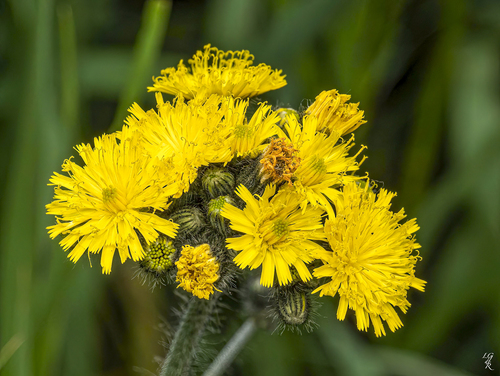
Pilosella caespitosa (Dumort.) P.D.Sell & C.West is a creeping perennial plant with shallow fibrous roots and long rhizomes. Its leaves are hairy on both sides, a distinguishing feature from the similar Pilosella floribunda, which only has hairs on its leaf undersides. The leaves are spathulate, reach up to 15 centimeters (6 inches) in length, and are almost entirely basal, with only 1 or 2 very small stem-borne cauline leaves. The leaves lie flat against the ground, overlap, and can smother non-vigorous turf. Stems are bristly and typically leafless, though occasionally a small leaf may appear near the stem midpoint. Dense blackish hairs cover the stems, leaves, and bracts, and all these plant parts exude milky juice when broken. Flower heads measuring 1 centimeter (1/2 inch) across grow in tight clusters of 5 to 40 flowers at the top of stems that reach 1/3 to 1 meter (1 to 3 feet) tall. All corollas are ligulate and bright yellow. Each individual flower head is an inflorescence, and each petal forms its own seed, making each one a separate floret. The seeds are shiny, black, and plumed. After maturing, seeds are dispersed by wind, clothing, hair, feathers, and vehicles that disturb fields or soils. P. caespitosa persists and regrows each year from rhizomes, and often spreads via extensive stolons that form a dense, colony-forming mat of hawkweed that effectively eliminates other native vegetation. This species prefers well-drained, moist silt loam soil with a coarse texture and moderately low organic matter content. Its presence can be an indicator of low soil fertility or slightly acidic soils. Historically, Pilosella caespitosa has been used to heal eyesight. Pliny the Elder recorded a belief that hawks ate this plant to improve their own eyesight. This species is tolerant of drought and trampling, and grows in habitats where soil is neglected, including roadsides, neglected residential and commercial landscapes, minimally maintained public parks and open spaces, vacant lots, rubble dump sites, and abandoned grassy meadows. It is an introduced species in North America, where it occurs across multiple Canadian provinces (British Columbia, Manitoba, New Brunswick, Newfoundland, Labrador, Nova Scotia, Ontario, Prince Edward Island, and Quebec) and multiple U.S. states and the District of Columbia (Connecticut, Washington D.C., Georgia, Idaho, Illinois, Indiana, Massachusetts, Maine, Michigan, Minnesota, Montana, North Carolina, New Hampshire, New Jersey, New York, Ohio, Oregon, Pennsylvania, Rhode Island, Tennessee, Virginia, Vermont, Washington, Wisconsin, West Virginia, and Wyoming). It is classified as a noxious weed in Idaho, Montana, Oregon and Washington. Its native range covers much of Europe, including Austria, Belarus, Bulgaria, Czechoslovakia, Estonia, France, Finland, Germany, Greece, Hungary, Latvia, Lithuania, Norway, Poland, Romania, Sweden, Switzerland, Ukraine, and Former Yugoslavia.