About Pilosella aurantiaca (L.) F.W.Schultz & Sch.Bip.
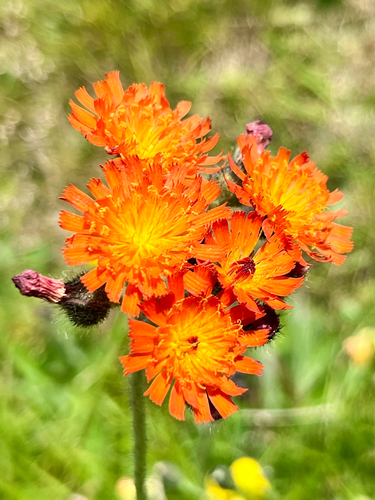
Pilosella aurantiaca (L.) F.W.Schultz & Sch.Bip. is a low-growing plant with shallow fibrous roots and a basal rosette of elliptical to lanceolate leaves. Leaves measure 5–20 centimetres (2.0–7.9 in) long and 1–3 centimetres (0.39–1.18 in) broad, and all parts of the plant exude milky juice. The flowering stem is usually leafless, or bears just one or two small leaves; both stems and leaves are covered with short stiff blackish hairs called trichomes. Stems can grow up to 60 centimetres (24 in) tall, and hold 2–25 capitula (flowerheads), each 1–2½ cm in diameter, clustered at the end of short pedicels. The flowers are typically orange, almost red; while this hue is virtually invisible to bees, the flowers also reflect ultraviolet light, which makes them more noticeable to pollinators. A wide range of insects visit the flowers, including many species of bees, butterflies, and pollinating flies. Flower color can vary across a broad range, from deep rust-orange to pure yellow, and often shows distinct color gradients. In the United Kingdom, this species flowers in June and July. After flowering, it produces seed heads of the dandelion clock type. Each individual fruit, a cypsela similar to an achene and resembling a seed, is fitted with a pappus (or "parachute") made of white or pale brown hairs, which is an adaptation for wind dispersal. This plant propagates both by wind-dispersed seeds, and vegetatively via stolons and shallow rhizomes in autumn or spring. Pilosella aurantiaca is native to central, eastern, northern, southeastern, and southwestern parts of Europe. It is widely naturalized in many other regions, including other parts of Europe such as Great Britain and Ireland, as well as Central Asia, Canada, many states in the United States, Japan, and New South Wales. In horticulture, P. aurantiaca is widely grown as an ornamental garden plant valued for its very decorative flowers. It is often used in wildflower gardens because its bright orange flowers are highly attractive to a wide range of pollinators. Common named fox and cubs, this species has a long history of use in European folk medicine. It has been used in preparations thought to benefit multiple conditions, including respiratory infections, digestive problems, and skin conditions. Its leaves have also been used to make a tisane believed to have tranquilising and sleep-inducing effects. Herbal teas made from the leaves and flowers are said to have diuretic, anti-inflammatory, and antioxidant properties. The plant itself is thought to have some value for treating cancer, and has also been used as a natural remedy to control blood sugar levels and treat high blood pressure.