About Pilea cadierei Gagnep. & Guillaumin
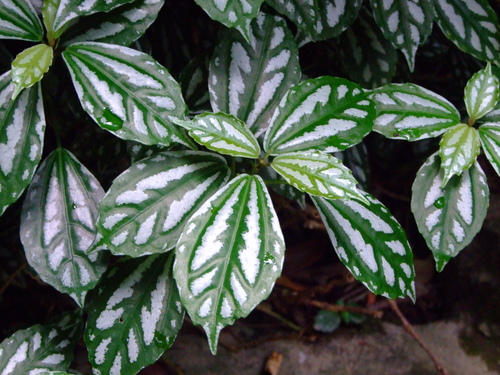
Commonly known as the aluminum plant, Pilea cadierei Gagnep. & Guillaumin is an evergreen perennial that grows up to 60 cm (24 in) tall. It has dark green oval leaves with slightly textured or serrated edges; each leaf bears four raised silvery patches, which gives the species its common name. This plant produces subterranean rhizomes to spread and colonize new areas. Its independent upright stems are somewhat succulent, and may become woody at the base over time. Stems are mostly smooth, but like the plant's stipules, petioles, and leaf blades, they are covered in a fine layer of spindle-shaped cystoliths. Leaves are arranged in constantly opposite pairs along stems, and each leaf is split into a petiole and a leaf blade. The smooth petioles are all nearly the same length, typically measuring 7 to 15 millimeters. The leaf blades are simple, dark green, parchment-like, fairly uniform in shape, and obovate, with a length of 2.5 to 6 centimeters and a width of 1.5 to 3 centimeters. They have a broad, wedge-shaped or nearly rounded base and a pointed tip. Three main nerves are visible along at least three-quarters of the leaf length, and there are three side nerves on each side of the main nerve. Leaf margins are indistinct to weakly serrated or unevenly notched. On the upper leaf surface, two divided white furrows form the raised silvery areas that also give the plant the alternate common name "watermelon plant". The parchment-like stipules fall off early; they are initially green, turn brown when dry, measure 10 to 13 millimeters long, and are elongated with two ribs. With a minimum required temperature of 15 °C (59 °F), Pilea cadierei is grown as a houseplant in temperate regions. It is valued for its decorative leaves and is easily propagated vegetatively through cuttings. This plant is non-toxic to cats, dogs, and horses, making it safe to keep around pets.