About Picea sitchensis (Bong.) Carrière
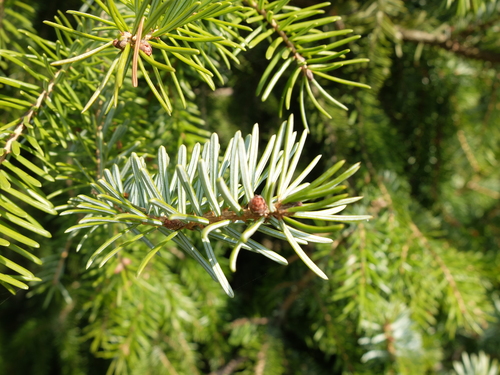
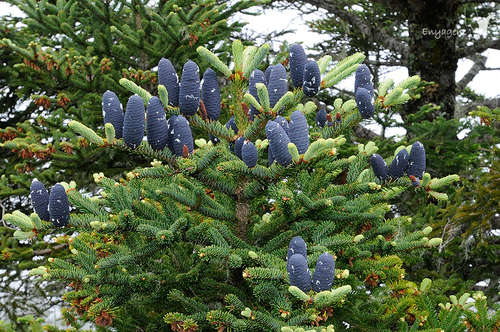
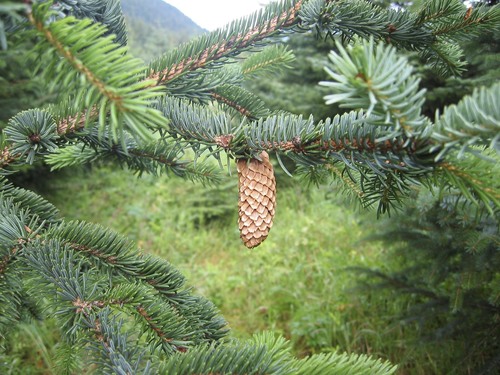
Picea sitchensis, commonly known as Sitka spruce, has a number of distinct physical characteristics. Its bark is thin and scaly, flaking off in small circular plates 5–20 centimeters (2–8 inches) across, with reddish-brown inner bark. Young trees have a broad conical crown, which becomes cylindrical in older trees; old trees often lack branches in the lower 30–40 meters (98–131 feet) of their trunk. Shoots are very pale buff-brown, almost white, hairless, and have prominent pulvini. Leaves are stiff, sharp, needle-like, 15–25 millimeters long, and flattened in cross-section. The upper leaf surface is dark glaucous blue-green with two or three thin lines of stomata, while the lower surface is blue-white with two dense bands of stomata. Cones are pendulous and slender cylindrical, measuring 6–10 cm (2+1⁄2–4 in) long and 2 cm (3⁄4 in) broad when closed, opening to 3 cm (1+1⁄4 in) broad. They have thin, flexible scales 15–20 mm (5⁄8–3⁄4 in) long. The bracts just above the scales are the longest of any spruce, and are occasionally just protruding enough to be visible on closed cones. Immature cones are green or reddish, and mature to pale brown 5–7 months after pollination. Seeds are black, 3 mm (1⁄8 in) long, with a slender pale brown wing 7–9 mm (1⁄4–3⁄8 in) long. Sitka spruce is native to the west coast of North America. Its northwestern range limit is on Alaska's Kenai Peninsula, and its southeastern limit is near Fort Bragg in northern California. It is closely associated with temperate rainforests; within the southern portion of its native range, it occurs only within a few kilometers of the coast. North of Oregon, its range extends inland along river floodplains, but rarely extends more than around 80 km (50 mi) from the Pacific Ocean and its inlets. It grows at up to about 2,500 m (8,200 ft) above sea level in Alaska, and is generally found below 450 m (1,480 ft) further south. Forests containing this species receive an average of 200 to 500 cm (79 to 197 in) of rain annually. It tolerates the salty spray common to coastal dune habitats, such as at Cape Disappointment State Park in Washington, and prefers soils high in magnesium, calcium, and phosphorus. Sitka spruce was introduced to Europe as a lumber tree in the 19th century. Today, Sitka spruce plantations are a dominant forest type in Great Britain and Ireland, making up 25% of forest cover in Great Britain and 52% in Ireland. Smaller Sitka spruce woodlands also grow in France and Denmark, and the species was introduced to Iceland and Norway in the early 20th century. Observations along the Norwegian coast show that Sitka spruce grows 25–100% faster than the native Norway spruce there, even as far north as Vesterålen. The fastest growing Sitka spruce plantations in Europe are those planted along the southwest coast of Norway. A 9-meter-tall, 100-year-old Sitka spruce growing on the permanently uninhabited sub-Antarctic Campbell Island is recognized by Guinness World Records as the "most remote tree in the world". Due to its occurrence in cool, wet climates, Sitka spruce has thin bark and a shallow root system that are not adapted to resist fire damage, making it very susceptible to fire. Sitka spruce forests experience a fire regime of severe crown or surface fires at long intervals of 150 to 350 or more years, which results in total stand replacement. The species recolonizes burned sites via wind-dispersed seed from adjacent unburned forests. Sitka spruce has a long history of human uses. Native Alaskan people use its root bark in basket-weaving designs and to make rain hats. Its pitch was used for caulking, as a chewable product, and for its medicinal properties. Native Americans heated and worked roots to make cord, and used the resin as glue and for waterproofing. Both native peoples and early pioneers split the wood into shakes for construction. The wood of Sitka spruce is light and relatively strong, and the species is of major importance in forestry for timber and paper production. Outside its native range, it is especially valued for its fast growth on poor soils and exposed sites where few other trees can thrive; in ideal conditions, young trees may grow 1.5 m (5 ft) per year. It has become naturalized in some parts of Great Britain and Ireland (where it was introduced in 1831 by David Douglas) and New Zealand, but has not spread extensively enough to be considered invasive in these areas. It is also planted extensively in Denmark, Norway, and Iceland. In Norway, Sitka spruce was introduced in the early 1900s, and an estimated 50,000 hectares (120,000 acres) have been planted there, mainly along the coast from Vest-Agder in the south to Troms in the north. It is more tolerant of wind and saline ocean air than native Norway spruce, and grows faster. However, it is now considered an invasive species in Norway, and efforts are underway to eliminate it. The resonant wood is widely used to manufacture pianos, harps, violins, and guitars, because its high strength-to-weight ratio and regular, knot-free growth rings make it an excellent conductor of sound. For the same reasons, the wood is also an important material for sailboat spars and aircraft wing spars, including those for flying model aircraft. The Wright brothers' Flyer was built from Sitka spruce, as were many aircraft before World War II; during the war, aircraft such as the British Mosquito used it as a substitute for strategically important aluminium. Newly grown tips of Sitka spruce branches are used to flavor spruce beer and boiled to make syrup. The needles can be used to make an aromatic tea.