About Picea pungens Engelm.
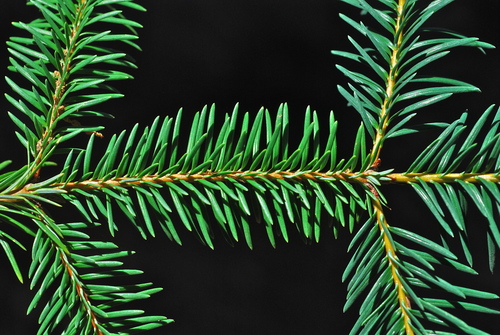
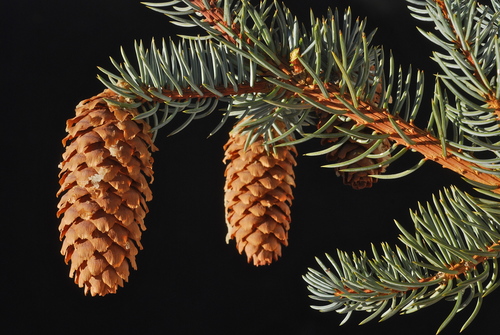
In the wild, Picea pungens (blue spruce) can grow as tall as 50 meters (164 ft), but most wild specimens reach a more typical height of 30 meters (98 ft). When planted in parks and gardens, it most often grows 9 to 18 m (30 to 60 ft) tall, with a spread of 3 to 6 m (10 to 20 ft). Its trunk has scaly gray-brown bark with a faint cinnamon-red undertone, and the bark is less rough than that of Engelmann spruce. On mature older trees, the trunk bark becomes deeply furrowed and scaly. The maximum trunk diameter can reach 1.5 m (4.9 ft). The blue spruce has a dense, compact root system with no taproot. Blue spruce is a conifer that develops a conical crown when young, but the crown becomes more open and irregular in shape as the tree ages. Stout branches grow horizontally in distinct whorls, but lower branches droop downward as the tree ages. Young twigs are always non-drooping and yellow-brown in color. The narrow, needle-like evergreen leaves are quite sharply pointed, and may be dull green, blue, or pale white. The white or blue glaucous hue comes from surface waxes on the needles; this color is most prominent on newly emerging foliage and fades as summer approaches. Wild stands of blue spruce generally have uniform coloration. Each needle is four-sided, with stomata on all four sides, stiff, and 1.6–3 centimeters (3⁄4–1+1⁄4 in) long. Needles attach radially to their shoots, but curve upward. The leaf buds are golden brown, cone-shaped, and measure 6 to 12 millimeters (1⁄4 to 1⁄2 in) in size; the tip of each bud can be either blunt or pointed. Pollen-producing cones (properly called strobili) develop throughout the blue spruce’s crown, but are more abundant in the upper half of the crown. Pollen cones are mainly yellow with a hint of red, and average 1.5 cm (1⁄2 in) long. Seed cones begin growing in May or June, and release mature seeds in the autumn of the same growing year. Young seed cones are purple-brown, while fully mature seed cones are light brown, longer than wide, and circular in cross section, with thin papery scales; mature cones can be either curved or straight. Cones measure between 5 and 12 cm (2 and 4+3⁄4 in) long, and most are 6 to 11 cm (2+1⁄4 to 4+1⁄4 in) long. Seed cones are only produced in the top tenth to quarter of the tree, and normally grow near the ends of side branches. The seeds are dark brown, averaging 4 mm in length, with a papery wing that extends almost twice the seed’s length beyond the seed tip. Blue spruce can be confused with four other spruce species: Engelmann spruce, European spruce (Picea abies), white spruce (Picea glauca), and black spruce (Picea mariana). Only the range of Engelmann spruce overlaps with blue spruce in the wild. While blue spruce cones are generally larger, cone and cone scale size ranges overlap between the two species. Engelmann spruce cones measure 3–8 cm long, with scales extending 3–8 mm beyond the seed impression; blue spruce cones measure 5–12 cm long, with scales extending 8–10 mm beyond the seed impression. The most consistent difference is that Engelmann spruce twigs are always finely hairy, while blue spruce twigs are usually hairless. The native range of blue spruce is mostly in the Central and Southern Rocky Mountains, and extends into moist mountain valleys and canyons to the west. In New Mexico, it only grows naturally in the state’s higher mountain ranges: the Sandia–Manzano Mountains, Sangre de Cristo Mountains, Jemez Mountains, and San Juan Mountains, as well as on Sierra Blanca Peak to the south. In Arizona, its range is even more limited; it grows only in Coconino and Apache counties. In Apache County, it is found in the White Mountains of central eastern Arizona and the Lukachukai Mountains in the state’s northeastern corner. In Coconino County, blue spruce grows only on the Kaibab Plateau. Blue spruce grows in every county in the western two-thirds of Colorado, and approximately half of the species’ entire natural range lies within Colorado’s mountains. In Utah, it is a locally common component of forests in the Uinta Mountains; west of the Uintas, blue spruces are less frequent, found in canyons south of Salt Lake City. Blue spruce has only very rarely become naturalized outside of its native range, and is not considered an invasive species. In North America, it has escaped cultivation in the U.S. states of Minnesota, Maryland, Pennsylvania, New York, and Maine, as well as the Canadian provinces of Ontario and Nova Scotia; it is considered naturalized in New York and New England. In Europe, it has been found growing outside cultivation in many areas: Iceland, Great Britain, Norway, Sweden, France, Belgium, Germany, Switzerland, Italy, and Austria. In the former Czechoslovakia, large areas of forest died in the 1970s and 1980s due to sulfur dioxide pollution from coal-fired power plants. In the Ore Mountains, the Ministry of Agriculture of the Czech Republic replanted many areas with non-native species, including 8,800 hectares (22,000 acres) of blue spruce — an area second only to that planted with birch. Small numbers of blue spruce were also planted on the upper plateau of the Jizera Mountains when new forests were established in the 1990s, alongside Serbian spruces (Picea omorika), although the majority of spruces planted were native European spruce. Despite being planted over large areas, blue spruce has not become established outside cultivation here. In Eastern Europe, blue spruce is an introduced species in the Baltic States, central European Russia, Bulgaria, and the Transcaucasus. Blue Spruce occurs at high elevations: 1,830 to 2,740 meters (6,000 to 8,990 ft) in the forests of the South Central Rockies, and 2,130 to 3,050 meters (6,990 to 10,010 ft) in the Southern Rocky Mountains. It grows in mesic montane conifer forests, often associated with Rocky Mountain Douglas-fir, ponderosa pine, or white fir. It has a riparian affinity, preferring moist soils such as those along streams or at the edges of wet meadows. Douglas-fir or ponderosa pine only associate with streams at lower, warmer elevations. Blue spruce may also be found growing alongside quaking aspen (Populus tremuloides) in the high mountain habitats of desert ranges in the Intermountain West. At the lowest elevations of its native range, it also associates with aspens in well-watered stream bottoms with deep alluvial soils. Though it grows alongside Rocky Mountain Douglas-fir, blue spruce is more tolerant of drought and intense sunlight. Blue spruce usually grows in cool and humid climatic zones where most annual precipitation falls in the summer. Blue spruce is generally considered to grow best with abundant moisture, but this species can withstand drought better than any other spruce. It can also withstand extremely low temperatures of -40 degrees C, and is more resistant to frost damage than other associated species. Picea pungens and its many cultivars are often grown as ornamental trees in gardens and parks. It is also grown for the Christmas tree industry. Although blue spruce prefers moist soils, it will develop very shallow roots in particularly wet or rocky soils, making it vulnerable to windthrow (being blown over in high winds) at exposed locations. It grows best in USDA growing zones 2 through 7; when planted in zone 7, it struggles to cope with high nighttime temperatures. Common cultivars are listed below (those marked agm have earned the Royal Horticultural Society's Award of Garden Merit): 'Baby Blue Eyes' (also called 'Baby Blueeyes' or 'Baby Blueyes') is a semi-dwarf cultivar that grows slowly, but may eventually reach 4.6–6.1 m (15–20 ft) in height. It has a pyramidal shape and retains its blue color well. 'Edith' agm is a small, slow-growing tree that takes 20 to 50 years to reach a height of 2.5–4 m (8 ft 2 in – 13 ft 1 in), with a spread of 1.5–2.5 m, and has a conical shape. 'Fat Albert' agm forms a symmetrical, perfect cone, reaching 2.5–4 m (8 ft 2 in – 13 ft 1 in) in height and spreading 1.5–2.5 m after about 10 to 20 years. If allowed to grow longer, it can reach 15–20 m (49–66 ft). Its needles are blue with fewer gray or silver tones, and are softer than the needles of many other cultivars. 'Globosa' agm is a shrub that reaches 90–150 cm (3–5 ft) in height, but takes 20–50 years to reach full size. 'Hoopsii' agm is a full-size variety with a dense pyramidal growth habit, known for its excellent silver-blue foliage color. It reaches 9.1–15.2 m (30–50 ft) tall when fully grown. 'Koster' (or 'Kosteri') is a medium-sized conical cultivar that reaches 8–12 m (26–39 ft) tall with a spread of 2.5–4 m after 20 to 50 years. It was introduced to the plant trade in 1915, but became less popular by the 2000s because grafted trees had unpredictable qualities. 'Montgomery' (or 'R.H. Montgomery') is a slow-growing dwarf variety. It typically grows only 90–120 cm (3–4 ft) tall in eight years, but may eventually reach a height of over 2.4 m (8 ft). It has tightly packed branches and silvery-blue needles. 'Pendula' (or 'Glauca Pendula') is a cultivar with drooping branches, spreading to about 1.2–3.0 m (4–10 ft) wide and growing 0.6–1.8 meters (2–6 ft) tall. It often must be tied to a stake for many years to prevent it from growing along the ground. 'Walnut Glen' (or 'Goldie') is a cultivar that grows slowly to 1.5–1.8 m (4 ft 11 in – 5 ft 11 in), but can eventually reach 7–10 m (23–33 ft). It produces cream-colored new shoots in spring that later turn the more typical gray-blue. It requires morning shade to prevent sun damage, and is also vulnerable to frost damage. Blue spruce trees are used in windbreaks around gardens, fields, or farm structures, and are recommended for this use by extension services in Montana, North Dakota, Oregon, and Pennsylvania. While broad-leaved trees generally produce deeper, higher quality soils on mine reclamation sites, blue spruce is among the best conifer species for this purpose, though it is less tolerant of drought than trees such as ponderosa pine. After 50 years growing on a reclaimed coal mine in Central Europe, blue spruce trees formed organic soils 4 cm deep. The wood of blue spruce is very infrequently used, because it is brittle, has an excessive number of knots, and is the wood of a less common tree. It has only 65% of the bending strength of European spruce (Picea abies).