About Picea mariana (Mill.) Britton et al.
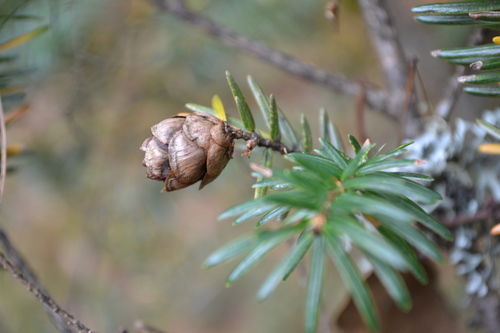
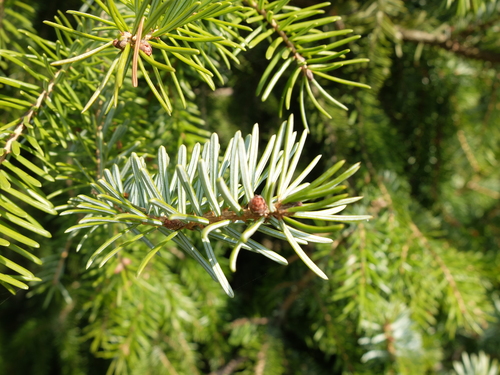
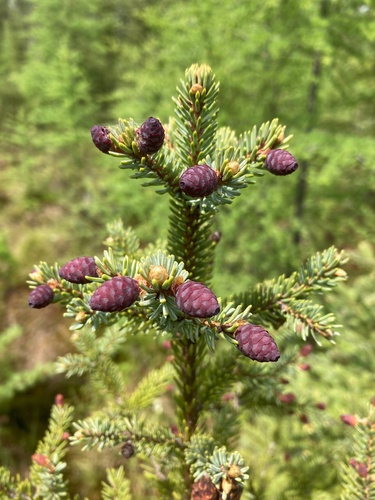
Picea mariana (Mill.) Britton et al. (black spruce) is a slow-growing, small upright evergreen conifer; it rarely grows as a shrub. It has a straight trunk with minimal taper, a scruffy growth habit, and a narrow, pointed crown made up of short, compact, drooping branches with upturned tips. Across most of its range, mature individuals average 5–15 m (15–50 ft) tall with a trunk diameter of 15–50 cm (6–20 in); rare mature specimens can reach 30 m (98 ft) tall and 60 cm (24 in) in diameter. Its bark is thin, scaly, and greyish brown. Its leaves are stiff, four-sided needle-like structures 6–15 mm (1⁄4–9⁄16 in) long, dark bluish green on the upper surface and paler glaucous green on the lower surface. Its cones are the smallest of any spruce, measuring 1.5–4 cm (1⁄2–1+1⁄2 in) long and 1–2 cm (1⁄2–3⁄4 in) broad. They range from spindle-shaped to nearly round, are dark purple when immature and ripen to red-brown, grow in dense clusters in the upper crown, open at maturity, and persist on the tree for several years. Natural hybridization occurs regularly with the closely related Picea rubens (red spruce), and very rarely with Picea glauca (white spruce). It differs from P. glauca in having a dense covering of small hairs on the bark of young branch tips, often darker reddish-brown bark, shorter needles, smaller and rounder cones, and a preference for wetter lowland habitats. Additional small differences in needle and pollen morphology exist, but these can only be observed with careful microscopic examination. Compared to true firs such as Abies balsamea (balsam fir), it can be distinguished by its pendulous cones, persistent woody leaf bases, and four-angled needles arranged all around the shoots. Because there is a large difference in moisture content between its heartwood and sapwood, these two tissue types are easy to tell apart in ultrasound images; this technique is widely used as a non-destructive method to assess the internal condition of the tree and avoid unnecessary log breakdown. Older taxonomic synonyms for this species include A. mariana, P. brevifolia, and P. nigra. Growth rate of Picea mariana varies based on site quality. In swamps and muskeg, growth becomes progressively slower moving from the edge toward the center of the habitat. Its roots are shallow and wide spreading, which makes the tree susceptible to windthrow. In the northern part of its range, asymmetric ice-pruned black spruce are common, with reduced foliage on the windward side. Tilted trees colloquially called "drunken trees" are linked to permafrost thawing. In the southern portion of its range it occurs primarily on wet organic soils, but its abundance on uplands increases further north. In the Great Lakes region, it is most common in peat bogs and swamps, and also grows on transitional sites between peatlands and uplands. In this region it is rare on uplands, except for isolated areas of northern Minnesota and the Upper Peninsula of Michigan. Most stands of black spruce are even-aged, due to frequent fire intervals in black spruce forests. It commonly grows in pure stands on organic soils, and in mixed stands on mineral soils. It is tolerant of nutrient-poor soils, and is commonly found on poorly drained acidic peatlands. It is considered a climax species across most of its range; however, some ecologists question whether black spruce forests truly reach a climax state, because fires typically occur every 50 to 150 years, while stable conditions may take several hundred years to develop. The frequent natural fire return interval maintains numerous successional communities. Across boreal North America, Betula papyrifera (paper birch) and Populus tremuloides (quaking aspen) are successional hardwoods that often invade areas burned by fire in black spruce habitat. Black spruce typically seeds in quickly after fire, and eventually comes to dominate over the hardwoods in the continued absence of fire. Black spruce is a pioneer species that invades sphagnum mats in filled-lake bogs, though it is often slightly preceded by Larix laricina (tamarack). Black spruce frequently outcompetes shade-intolerant tamarack during bog succession. However, as peat soil gradually rises from accumulating organic matter and site fertility improves, balsam fir and northern white cedar (Thuja occidentalis) eventually replace black spruce and tamarack. On drier sites after fire, black spruce can take over stands of faster-growing jack pine (Pinus banksiana), because it can grow in partially shaded conditions that inhibit pine seedling growth. Black spruce seedlings themselves are intolerant to the low light and low moisture conditions found under mature spruce stands. Balsam fir and northern white cedar, both more understory-tolerant species with deeper taproots, survive and eventually replace black spruce in the absence of fire. Spruce budworm, the larval form of a moth, causes defoliation that kills trees if it occurs multiple years in a row, though black spruce is less susceptible than white spruce or balsam fir. Trees growing alongside balsam fir and white spruce face the highest risk of damage. Numerous cultivars of Picea mariana have been selected for use in parks and gardens. The cultivar P. mariana 'Nana', a dwarf form, has gained the Royal Horticultural Society's Award of Garden Merit. Picea mariana is known to hybridize with Serbian spruce, Picea omorika; this hybrid is named Picea machala. Hybrids between Picea mariana and Sitka spruce are also known. Black spruce is the provincial tree of the Canadian province of Newfoundland and Labrador. Its timber has low commercial value due to the small size of the trees, but it is an important source of pulpwood, and is the primary source of pulpwood in Canada. Black spruce is often used to make fast-food chopsticks. It is increasingly used to produce cross laminated timber by companies including Nordic Structures; this production method leverages the high strength of the wood from its tight growth rings to assemble larger timber pieces. Along with red spruce, it has also been used to make spruce gum and spruce beer.