About Picea chihuahuana Martínez
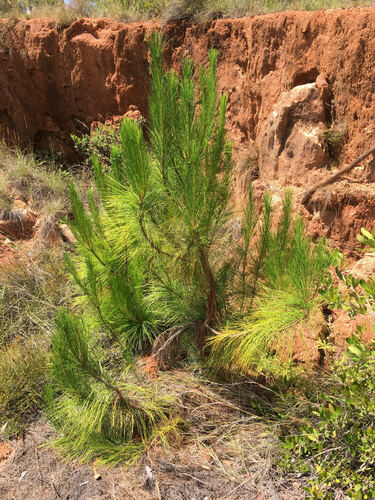
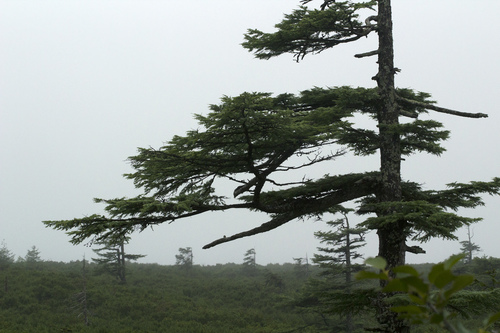
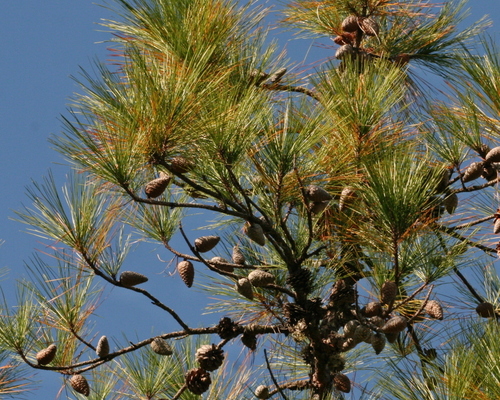
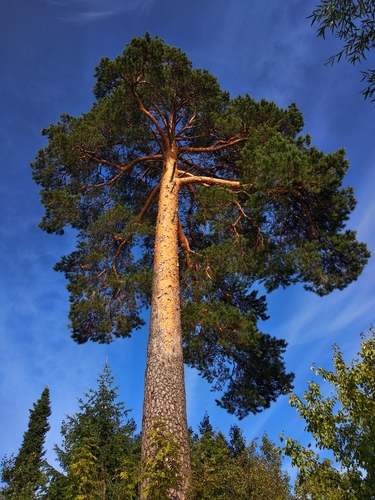
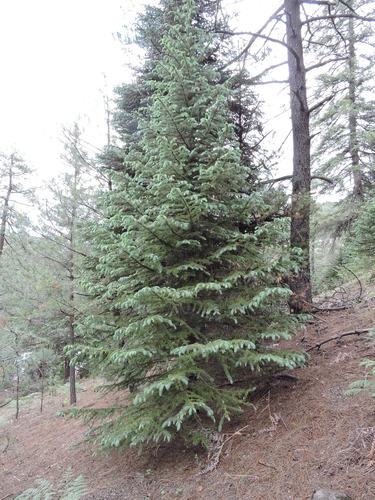
Picea chihuahuana, commonly known as the Chihuahua spruce, is a medium-sized evergreen tree that reaches 25 to 35 meters in height, with a trunk diameter of up to 1 meter. It is native to northwestern Mexico, where it grows in 25 small populations in the Sierra Madre Occidental mountains of Chihuahua and Durango. It occurs at moderate altitudes ranging from 2300 to 3200 meters, growing along streamsides in mountain valleys. In these locations, soil moisture levels are higher than would be expected given the area's otherwise low rainfall. Its bark is thin and scaly, flaking off in small circular plates 5 to 10 centimeters across. It has a conical crown with widely spaced branches and drooping branchlets. Its shoots are stout, pale buff-brown, glabrous, and marked with prominent pulvini. The leaves are needle-like, 17 to 23 millimeters long, stout, and rhombic in cross-section. They are bright glaucous blue-green with conspicuous lines of stomata, and have a sharply pointed tip. The cones are pendulous and broadly cylindrical. They are 7 to 12 centimeters long and 3 centimeters wide when closed, and open to 4 to 5 centimeters wide. They have stiff, bluntly rounded scales that are 1.5 to 2 centimeters wide. The cones are green when young, and mature to pale brown 6 to 8 months after pollination. The seeds are black, 4 millimeters long, with a pale brown wing 10 to 13 millimeters long. Chihuahua spruce was first discovered in 1942 by Mexican botanist Maximino Martínez. It is classified as endangered, with only 25 small populations, none of which contain more than a few hundred trees. It is related to Martinez's spruce (P. martinezii), which grows in northeast Mexico. It differs from P. martinezii by having shorter blue-green leaves, and smaller, narrower cones with smaller scales. No other closely related spruces grow in North America; its next closest relatives are native to eastern Asia. It is a very attractive tree, and is beginning to be planted as an ornamental in botanical gardens. It is particularly valued for planting in warm areas, as it is one of the most heat-tolerant of all spruces. It tolerates summer heat better than blue spruce (P. pungens), a species it resembles in foliage.