About Picea breweriana S.Watson
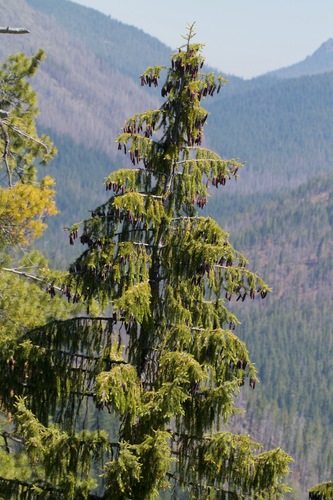
Picea breweriana S.Watson, commonly known as Brewer's spruce, is a large evergreen conifer. It typically grows 20–40 meters (66–131 ft) tall, reaching an exceptional maximum height of 54 m, with a trunk diameter of up to 1.5 m. Its bark is thin, scaly, and purple-gray in color. It has a very distinct crown, marked by level branches that bear vertically pendulous branchlets 1.2–2.4 m (4–8 ft) long; each branch forms a 'curtain' of foliage. This characteristic pendulous foliage only develops once the tree reaches about 1.5–2 m tall. Young trees smaller than this size, which are typically around 10–20 years old, have open crowns with sparse, level branchlets. Its shoots are orange-brown, covered with dense short pubescence about 0.2 millimeters long, and have a very rough texture from 1–2 mm long pulvini. Needle-like leaves with blunt tips grow singly on the pulvini; they measure 15–35 mm long, are flattened in cross-section, glossy dark green on the upper surface, and marked with two bands of white stomata on the lower surface. Its cones are longer than those of most other North American spruces. They are pendulous and cylindrical, measuring 8–15 centimetres (3–6 in) long and 2 cm broad when closed, and opening to 3–4 cm broad. The cones have smoothly rounded, thin, flexible scales that are 2 cm long. Immature cones are dark purple, and mature to red-brown 5–7 months after pollination. The seeds are black, 3–4 mm long, with a slender pale brown wing 12–18 mm long. Brewer's spruce is endemic to the Klamath Mountains of southwest Oregon and northwest California, where it grows at moderately high altitudes ranging from 1,000–2,700 m (3,300–8,900 ft) above sea level. This species grows very slowly, typically adding less than 20 cm (8 in) of height per year. It occurs mainly on ridgetop sites that get very heavy winter snow, which provides a steady source of meltwater through spring, but are dry in summer. It is very well adapted to handle heavy snow and ice loads: it has tough branches, and its drooping branchlets shed snow readily. Due to its slow growth, Brewer's spruce cannot compete with much faster-growing trees like Douglas-fir. It is also susceptible to wildfire because of its thin bark and pendulous foliage, so it is mostly found in exposed sites with poor, rocky soils, often at high elevation, where competition with other fire-sustaining conifers is reduced. It may also occur sporadically in open montane forests alongside conifer species adapted to similar conditions, such as white fir, red fir, or mountain hemlock. Common associated shrub species include huckleberry oak and deer oak. Brewer's spruce is known to host several species of pathogens and parasites, including the root rot Heterobasidion annosum, the dwarf mistletoe Arceuthobium campylopodum, and the adelgid Adelges cooleyi. Outside of its native range, Picea breweriana is a highly valued ornamental tree for gardens, particularly in Great Britain and Scandinavia, where it is prized for its dramatically pendulous foliage. This plant has earned the Royal Horticultural Society's Award of Garden Merit.