About Pica hudsonia (Sabine, 1823)
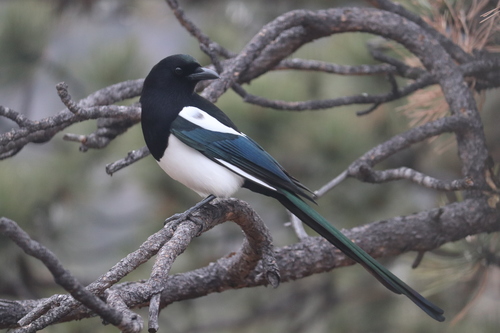
The black-billed magpie, with the scientific name Pica hudsonia (Sabine, 1823), is an easily identifiable bird across its native range. It is a medium-sized species, measuring 45–60 cm (18–24 in) from the tip of its beak to the end of its tail. Its plumage is mostly black, with white on the scapulars, belly, and primaries; the wings and tail show iridescent blue-green coloration. The tail is formed from long, layered feathers, with the central pair extending further out than the other tail feathers. The beak is entirely black, oblong in shape, and weakly curved toward its tip. Adult black-billed magpies also have black irises. Unlike most other members of the Corvidae (crow) family, black-billed magpies show sexual dimorphism in size and weight, though measurements of males and females can still overlap. On average, males are 6–9% larger and 16–24% heavier than females, with male weights ranging from 167–216 g (5.9–7.6 oz), wing chords from 205–219 mm (8.1–8.6 in), and tail lengths from 230–320 mm (9.1–12.6 in). Female weights range from 141–179 g (5.0–6.3 oz), with wing chords from 175–210 mm (6.9–8.3 in), and tail lengths from 232–300 mm (9.1–11.8 in). Juvenile black-billed magpies have less iridescence on their wings and tails, buffier scapulars and bellies, and do not grow the species' distinctive long tail feathers. Their rectrices are typically rounder and narrower than adults', and they have more black on their wingtips than mature individuals. Juveniles also have pink mouth linings and grey irises. All juvenile traits are usually lost after the first year's moult. The black-billed magpie can be told apart from the closely related yellow-billed magpie by its solid black beak and longer tail; black-billed magpies are on average slightly larger than yellow-billed magpies, which measure 43–54 cm (17–21 in) in total length, and size measurements between the two species overlap heavily. Eurasian magpies are visually very similar to black-billed magpies, but Eurasian magpies have slightly larger bodies and shorter tails and wings. The two species can also be distinguished by their different vocalizations and non-overlapping geographic ranges. Black-billed magpies are generally non-migratory, though some movement does occur during winter. The exact cause of this movement is unknown, but it is thought to stem from post-breeding dispersal followed by a return to nesting sites. This species' range extends from coastal southern Alaska, southwest Yukon Territory, central British Columbia, Alberta, Saskatchewan, Manitoba, and northwestern Ontario in the north, south through the Rocky Mountains to all Rocky Mountain U.S. states including New Mexico, Colorado, Utah, Wyoming, and Idaho, as well as some adjacent bordering states. The range can reach as far east as northern Minnesota and Iowa, with casual sightings recorded in northern Wisconsin and upper Michigan, and the range is thought to be limited further east and south by high temperature and humidity. The species is not found in California west of the Cascades and Sierra Nevada ranges, where the yellow-billed magpie occurs in its place. During the breeding season, the black-billed magpie prefers riparian areas with thickets. Its preference for open habitats with scattered clumps of trees means the species also lives in meadows and suburban areas. Outside of the breeding season, black-billed magpies can still be found in their breeding habitats, and also near feedlots, grain elevators, landfills, and around barns and houses.