About Physocarpus malvaceus (Greene) Kuntze
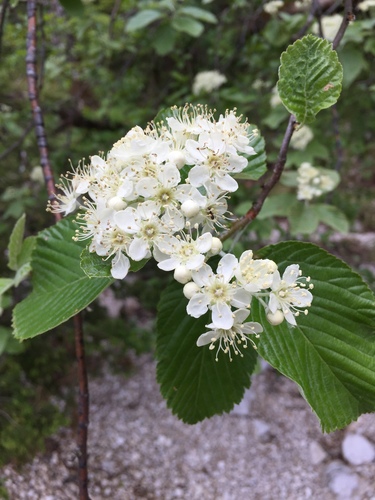
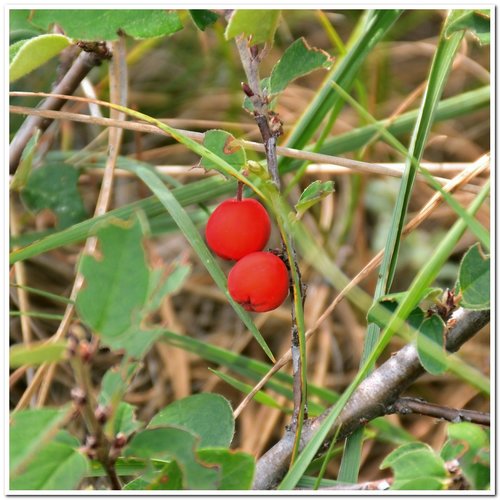
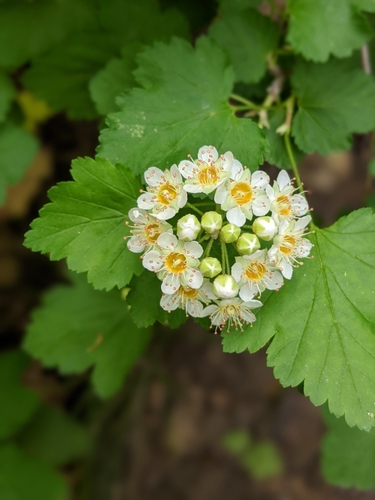
Physocarpus malvaceus (Greene) Kuntze is a deciduous shrub that usually grows up to 2.1 metres (7 feet) tall, and may occasionally reach 3 metres (10 feet). It can form dense thickets. Its branches are hairless, and older branches have shreddy bark. The leaves have three to five lobes, serrated edges, are dark green when mature, and turn brownish red by early fall. The inflorescence is a corymb of flowers with white petals that measure about 4 millimetres (1⁄8 inch) in length. The fruit is a follicle roughly one centimetre long. This species is native to western North America, with a distribution ranging from British Columbia south to Nevada and east to Wyoming. It grows in forests, woodlands, and oak scrub; the forests it grows in are dominated by subalpine fir (Abies lasiocarpa), grand fir (Abies grandis), Engelmann spruce (Picea engelmannii), Douglas-fir (Pseudotsuga menziesii), and ponderosa pine (Pinus ponderosa). Physocarpus malvaceus is associated with a variety of other plant species, including oceanspray (Holodiscus discolor), common snowberry (Symphoricarpos albus), mountain snowberry (Symphoricarpos oreophilus), white spirea (Spiraea betulifolia), serviceberry (Amelanchier alnifolia), creeping Oregon-grape (Mahonia repens), and pinegrass (Calamagrostis rubescens). In one common plant community, it is codominant with Douglas-fir. This shrub is a pioneer species that becomes more abundant after disturbance, and decreases in abundance as the overstory regrows and shades it out. It grows rapidly from rhizome sprouts after events like wildfire. It is classified as fire-resistant: it survives fire, resprouts after it, and becomes more common on burned sites than on unburned sites. Physocarpus malvaceus is not a preferred food source for wild or domesticated herbivores. It does provide good cover for small animals, and the Dusky Flycatcher (Empidonax oberholseri) nests in this shrub. This plant is known to hinder the regeneration of forest habitat after disturbances such as fire or logging, because it outcompetes new conifer seedlings. In some regions, it is controlled with herbicide spray.