About Physetica sequens Howes, 1912
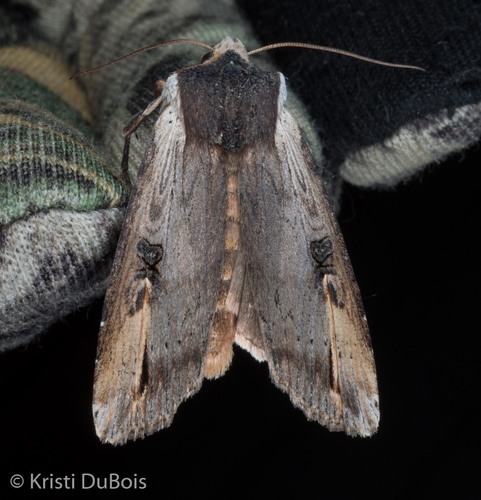
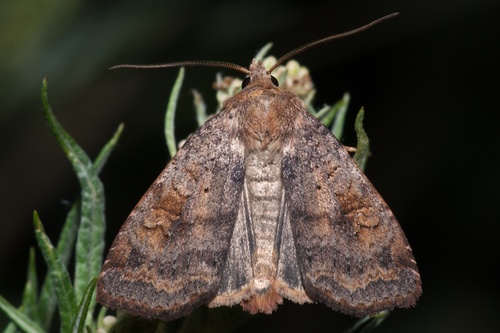
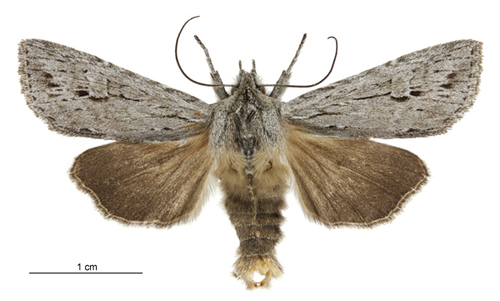
Physetica sequens was first described by Howes in 1912. Hoare describes the larva of this species as dull green with brown and grey dorsal markings. Howes described the adult of the species: males measure 31 mm, females measure 34 mm; head and thorax are grey, and strongly crested; antennae are filiform; abdomen is ochreous grey, with slight crests. Forewings are bright grey, dusted with fuscous. There is a jagged subbasal line, strongly marked on the submedian fold, where it turns abruptly toward the base. A dark double line crosses the wing at one-third, the space between the two lines is grey and not dusted with fuscous. A dark mark sits on the costa at half wing length, followed by two more dark marks above the reniform spot. The subterminal line is faint and suffused. There is a terminal series of black points, and a few dark points outline the veins. The orbicular spot is faint, but has a well-defined line along its lower edge. The reniform spot is defined by a dark line below and on its terminal edge. Forewing cilia are grey, mixed with fuscous. Hindwings are brown, darker toward the termen. Hindwing cilia are brown, with a fine paler line at the base, and grey-white tips. The full recorded adult wingspan range for male P. sequens is 31 to 42 mm, and for females is 32.5 to 44 mm. This species is variable in appearance, with larger specimens collected at Tongariro National Park. Although these larger specimens have a less prominently underlined reniform stigma, Hoare considered them to belong to this same species, as no other distinguishing features were found to support separating them into a separate taxon. P. sequens is similar in appearance to P. phricias, but can be told apart because P. phricias has a narrow black line along the forewing dorsum that P. sequens lacks. P. sequens is also similar in appearance to P. cucullina, but again the forewing dorsum of P. sequens does not have the narrow black line that is frequently present on the forewings of P. cucullina. This species is endemic to New Zealand, and is found throughout both the North and South Islands. It inhabits open native shrublands, peatlands, Northland gumland, inland volcanic dunes, and Dracophyllum-dominated areas, at altitudes ranging from sea level up to the alpine zone, reaching at least 1600 m. P. sequens appears to be more common in the North Island than the South Island.