About Physetica phricias Meyrick, 1888
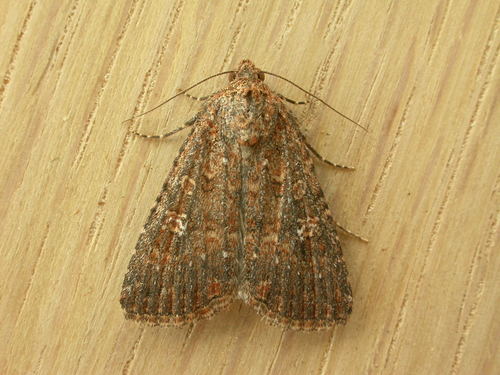
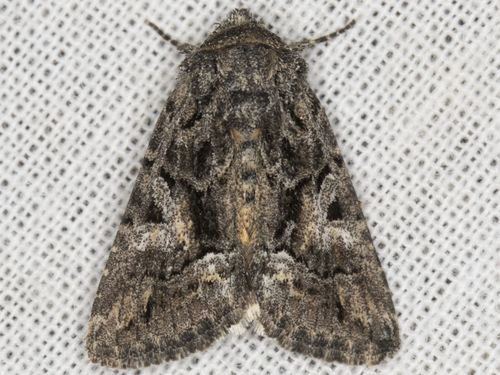
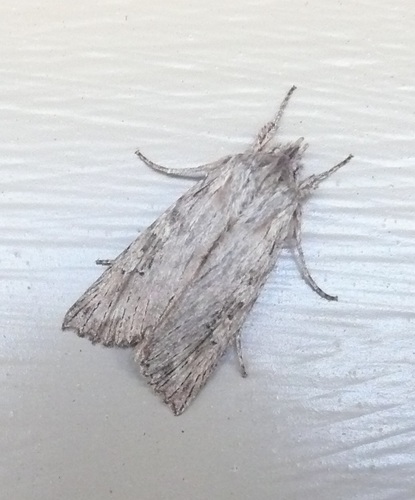
The larvae of Physetica phricias reach a maximum length of 33mm, and are grey with a pink tint on the dorsal surface. They have a black and white sub-dorsal line, as well as a broad whitish lateral band. Hudson's description of the adult moth of this species is as follows: wing expansion is about 1+1⁄2 inches. Fore-wings are pale silvery-grey; there are several obscure blackish marks near the base, and two dark shaded transverse bands, one located just before the orbicular, and one between the orbicular and the reniform. The orbicular is round, nearly white, with a faint greyish ring in the middle. The reniform is large and oblong, margined first with white then with black. There is a series of black crescentic marks near the termen, and another smaller series on the termen. Cilia are dark grey. Hind-wings are dull brownish-grey, and their cilia are grey with white tips. The terminal joint of the palpi is elongated. Physetica phricias can be confused with some forms of P. sequens, but can be distinguished by its less marbled forewing appearance. This species is endemic to New Zealand, and is widespread in the South Island. Hoare noted that while both Hudson and E. G. White stated that specimens had been collected in the central and southern North Island, he could not find any specimens in collections to confirm this record. The preferred habitat of P. phricias is scrubland. The known host plant for the larvae of this species is Discaria toumatou.