About Physalis philadelphica Lam.
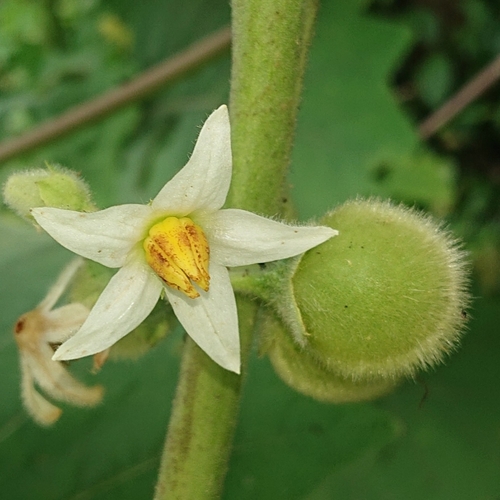
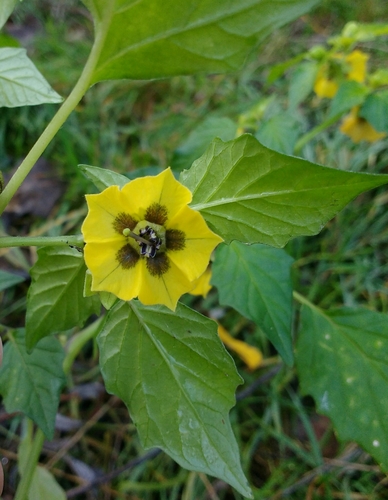
Physalis philadelphica Lam. is often confused with Physalis ixocarpa, due to their morphological similarities and the fact that neither species has had a clear type designation. Both species share several key traits: blue anthers that twist after opening, a yellow corolla marked with five blue-tinged spots or smudges, and a 10-ribbed calyx that is either filled or burst by the berry. The two species can be distinguished by differences in flower size and stigma type. P. philadelphica plants generally grow between 15 to 60 cm (6 to 24 in) tall, have few hairs on their stems, and leaves with acute, irregularly spaced indentations along the edges. More broadly, plants of this tomatillo group typically reach around one meter (3 ft) in height, and can be either compact and upright, or prostrate with a wider, less dense canopy. Their leaves are usually serrated, and may be either smooth or pubescent. Tomatillos are native to Central America and Mexico, with a wild growing range extending from Mexico to Costa Rica. They are cultivated most heavily in the Mexican states of Hidalgo and Morelos, and in the highlands of Guatemala, where the plant is called miltomate. In the United States, tomatillos have been cultivated since 1863; a variety marketed as "jamberry" was introduced in 1945, and other varieties have been sold under the names "Mayan husk tomato" and "jumbo husk tomato". The plant has since spread further to the Bahamas, Puerto Rico, Jamaica, and Florida. By the middle of the 20th century, it had been exported to India, Australia, South Africa, and Kenya. Wild tomatillos and related plants are found across most of the Americas, except the far north, with the highest diversity occurring in Mexico. In 2017, scientists reported the discovery and analysis of Physalis infinemundi, a fossil Physalis specimen found in Patagonia, Argentina, dated to 52 million years before present. This finding pushes back the confirmed earliest appearance of both the Solanaceae plant family and the genus Physalis, which includes the tomatillo. Tomatillos can be harvested at different stages of ripeness for different culinary uses. For salsa verde, they are often harvested early when the fruit is sour and lightly flavored. Harvested later, when fruits contain more seeds, they develop a sweeter taste. Tomatillos have a wide range of culinary uses, including in stews, soups, salads, curries, stir-fries, baked goods, cooked meat dishes, marmalades, and desserts. They are a key ingredient in both fresh and cooked Mexican and Central-American green sauces; their main culinary contributions are their green color and tart flavor. Purple and red-ripening cultivars often have a slight sweetness not found in green- and yellow-ripening cultivars, so they are generally used to make jams and preserves. Like their close relative the Cape gooseberry, tomatillos have a high pectin content. Unripe tomatillos still inside their husks typically have a varying degree of sappy, sticky coating. Ripe tomatillos with their husks stay good for about two weeks when refrigerated; they last longer if husks are removed, and the fruit stored in sealed plastic bags in the refrigerator. Tomatillos may also be frozen whole or sliced. They can also be dried to enhance their sweetness, in a method similar to drying cranberries, with a faint hint of tomato flavor. Tomatillo flavor is used in fusion cuisines to blend flavors from Latin American dishes with those of Europe and North America.