About Phyllotreta striolata (Fabricius, 1803)
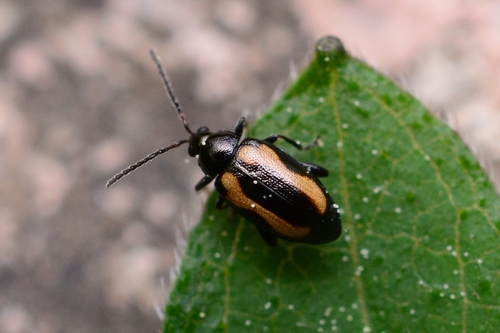
The striped flea beetle, Phyllotreta striolata, is a small flea beetle 1.5 to 2.5 mm long. It has a shiny black body with a greenish tinge, and a wavy amber line runs the full length of each of its elytra, or wing covers. Its thickened hind legs let it jump like a flea when disturbed. It is a known pest of cabbage and other brassica crops. This species lays tiny, oval to elongated white eggs in soil close to its host plants. When fully grown, the white, brown-headed larva reaches 3.2 to 5.0 mm long, and has three pairs of very small legs near its head. The white pupa is roughly the same size and shape as the adult striped flea beetle. Originally from Eurasia, the striped flea beetle is now common across eastern and Pacific regions of the United States, though it is not present across most of the Rocky Mountain region. It is also found in South Africa. While larvae live in soil and feed on host plant roots, they do not cause meaningful damage. Primary crop damage comes from adult beetles feeding on plant foliage. Adults use their chewing mouthparts to create small round pits in the cotyledons and leaves of young plants. As the plant grows, the remaining thin layers of damaged tissue dry out and fall away, leaving small "shot holes" in the foliage. This damage can kill young plants, and severe damage can destroy entire seedling stands. Additionally, adult striped flea beetles can act as vectors that spread plant disease. Striped flea beetles spend the winter among plant debris in and around agricultural fields. They emerge early in spring to attack young plants and seedlings. Females lay eggs in tiny crevices they gnaw into the base of host plant stems. Grubs hatch from the eggs around ten days later, then move into the soil to feed on host roots. After feeding for three to four weeks, larvae pupate for seven to ten days, then a new generation of adult beetles emerges. In warmer climates, generations can be continuous, with at least two new generations produced each year. Several management practices can prevent severe infestations of striped flea beetle. Cultural control methods include covering seedbeds with thin transparent gauze strips to protect seedlings from adult feeding before transplanting. Effective weed control and removal of crop residue in and around fields reduces the size of overwintering beetle populations. After harvest, plowing fields exposes overwintering larvae. For rapid control of large populations attacking young seedlings, insecticide sprays are the only available option. Biological pest control can also be used against this pest. Multiple insect species act as parasitoids that attack the striped flea beetle, including the braconid wasps Microtonus epitricis, M. punctulatae, M. vittatae, and Townesilitus psylliodis. Among biological insecticides, the nematode species Steinernema feltiae and S. carpocapsae have shown good potential for control. Planting resistant crop varieties can reduce damage from established beetle populations. Resistant cabbage varieties include 'Stein's Early Flat Dutch', 'Mammoth Red Rock', 'Savoy Perfection Drumhead', and 'Ferry's Round Dutch'. A resistant collard variety is 'Vates and Georgia'. 'Florida Broadleaf' is a resistant mustard variety, while 'American Purple Top' is a resistant rutabaga. Resistant cauliflower varieties include 'Snowball A' and 'Early Snowball X'. Resistant broccoli varieties include 'DeCicco', 'Coastal', 'Italian Green Sprouting', and 'Atlantic'. Resistant kale varieties include 'Dwarf Siberian', 'Dwarf Green Curled Scotch', and 'Early Siberian'.