About Phyllostachys aurea (André) Rivière & C.Rivière
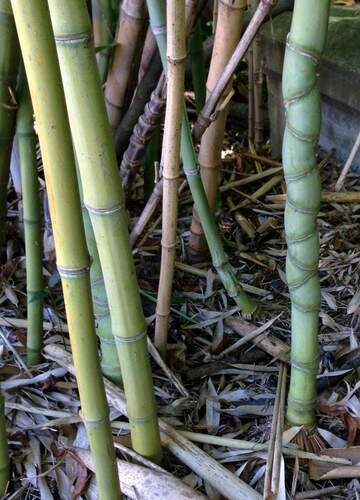
Identification and growth habit: Common forms of Phyllostachys aurea are easily recognized by their distinct compressed internodes on the lower section of canes, which give the canes a tortoise shell-like appearance. This internodal compression leads to shorter maximum heights (around 25 feet, or 8 meters) and thicker cane diameters relative to height than most other Phyllostachys species. Exposed to full or partial sun, the canes turn yellow, and deepen to a gold-orange color as the plant matures. Compared to many other Phyllostachys species, branching and foliage typically start lower to the ground. Many gardeners choose to remove lower branches to highlight the unique tortoise shell-patterned lower portion of the canes. It is a tall evergreen bamboo that grows to 8 m (26 ft) tall and spreads to 4 m (13 ft) broad. Cultivation: Phyllostachys aurea is cultivated as an ornamental garden plant. It is classified as an invasive species in the United States, Australia, South Africa, and Italy, where it crowds out native plant species and forms hard-to-remove monocultures. It is a cold-hardy bamboo that grows well in USDA hardiness zones 6 to 10, which covers areas from Connecticut to Florida in the United States. It has received the Royal Horticultural Society's Award of Garden Merit for cultivation in the United Kingdom. Like most bamboos, it can become invasive when grown in warm, moist conditions, in good quality soil, and with full sun access. It is listed as a prohibited species in New York. Uses: The lush foliage of P. aurea makes it popular for ornamental planting and privacy hedges, and its unique knotty compressed lower internodes make it sought after by plant collectors. It is also well-suited for making bamboo pipes.