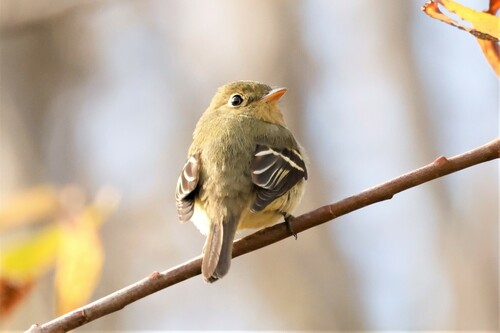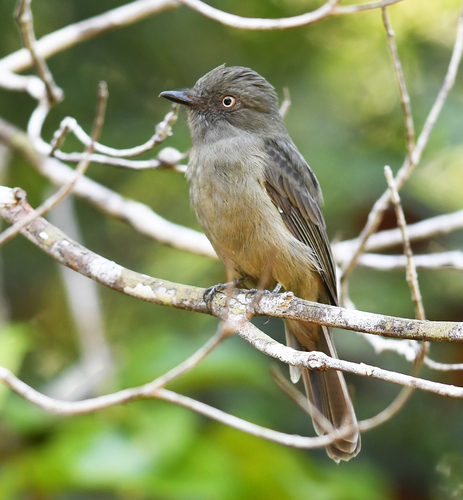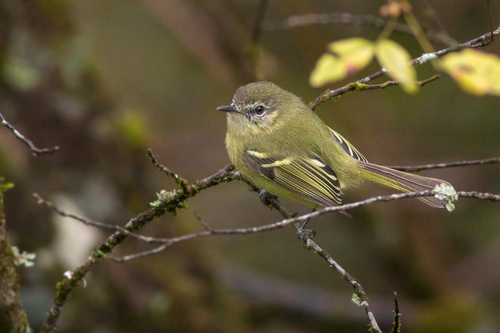
About Phylloscartes ventralis (Temminck, 1824)
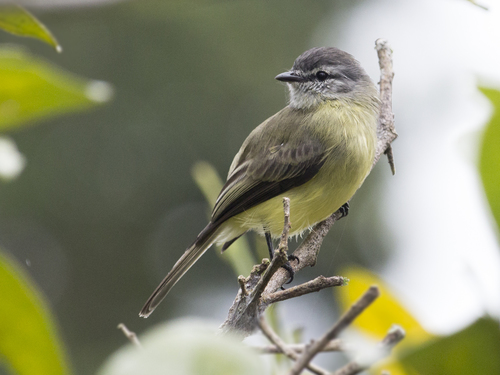
The mottle-cheeked tyrannulet, scientifically named Phylloscartes ventralis (Temminck, 1824), is approximately 12 cm (4.7 in) long and weighs around 9 g (0.32 oz). Both sexes share identical plumage, and all subspecies also have essentially matching plumage. Adult individuals have a short, thin whitish supercilium, an indistinct broken whitish eye-ring, a dusky line running through the eye, a wide whitish and dusky crescent below the eye, a dusky "moustache", and the namesake whitish and dusky mottled cheeks. Their crown, nape, back, and rump are dark olive. Their wings are dusky, with bright olive-yellow outer webs at the base of the flight feathers. Their wing coverts have pale yellow to yellow tips that form two distinct wing bars. Their tail is dusky, with bright olive-yellow outer webs at the base of the tail feathers. Their chin and upper throat are whitish. The rest of their underparts range in color from olive grayish to mostly yellowish, with faint olive markings. Their belly and undertail coverts may be a paler yellow. All subspecies, both male and female, have a dark brown iris, a long, flat, pointed black bill with a pinkish to yellowish base to the mandible, and slate to bluish gray legs and feet.
This species has a disjunct distribution, with each of its three subspecies separated from the others. Subspecies P. v. angustirostris forms one population found on the eastern slope of the Andes, from Amazonas Department in northern Peru south through Peru into La Paz and Cochabamba departments in Bolivia. Subspecies P. v. tucumanus is found in northwestern Argentina, from Jujuy Province south into Tucumán and Catamarca provinces. The nominate subspecies P. v. ventralis has the largest range, found from Minas Gerais state in southeastern Brazil southwest through Mato Grosso do Sul into eastern Paraguay, and south throughout Uruguay and into northeastern Argentina as far as Entre Ríos Province.
In the Andes, the mottle-cheeked tyrannulet primarily inhabits montane evergreen forest, and to a lesser extent occupies higher ridgetop cloudforest and lower tropical forest, occurring at elevations between 1,000 and 2,400 m (3,300 and 7,900 ft). In Brazil, Paraguay, Uruguay, and northeastern Argentina, it occurs in montane forest, and also in tropical forest, gallery forest, and temperate forest dominated by Araucaria or Podocarpus. In this part of its range, it is mostly found below 1,500 m (4,900 ft), but occurs somewhat higher locally.